I guess I can post about this since there was no follow-up. About six weeks ago, I got a chat message on Reddit from a reporter with Pro Publica. She saw some of my posts/comments on Reddit about how long it has taken to try and get a live donor transplant. I believe she was planning on writing a story on the subjective hurdles of getting a kidney transplant. I replied agreeing that I would speak to her if she kept it anonymous since at the time, I was still waiting for UCLA Transplant Center to approve my sister as a donor. She replied that she would keep my name off the story and asked for times to contact me. I replied again with my availability, then nothing. I checked Pro Publica for her stories and she has not published anything about kidney transplants yet. Maybe the story was cancelled or delayed?
Regardless, I think we need to shed more light on this topic. The National Kidney Foundation has some depressing statistics on kidney failure. They claim that there are 2 million people on dialysis worldwide and that only represents 10% of the population that needs it. Outside of rich countries, most kidney failure patients just die. The transplant centers should be doing more transplants, not less. I’ve always felt they are trying to preserve their post-surgery scores rather than helping as many people as possible. I guess it’s hard to avoid since SRTR publishes reports like this all the time.
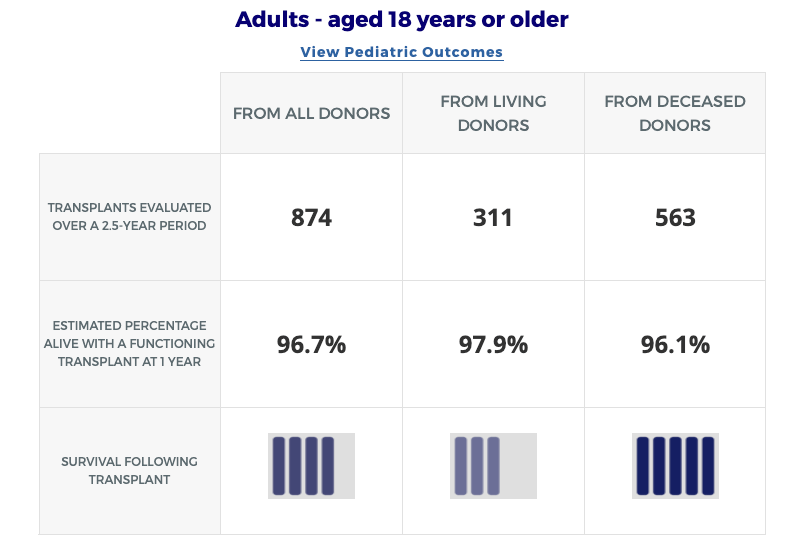
On the latest report, it says UCLA has a post-surgery survival rate of 97.9% for living donor kidney transplants. That’s pretty good but useless to me if they won’t do the transplant. I would still risk it if the number was as low as 80% since dialysis really sucks. My nephrologist said they were pretty risk adverse on transplant candidate selection. It’s a research hospital… shouldn’t they be taking more risks?
Anyway, I hope the Pro Publica story gets written and published, whether or not they include my experience. It seems like the health agencies could do more to inform people about living donor transplants and encourage new developments in kidney care and dialysis treatments. Here is a Nature paper on the state of dialysis and it’s pretty sad.
Abstract
The development of dialysis by early pioneers such as Willem Kolff and Belding Scribner set in motion several dramatic changes in the epidemiology, economics and ethical frameworks for the treatment of kidney failure. However, despite a rapid expansion in the provision of dialysis — particularly haemodialysis and most notably in high-income countries (HICs) — the rate of true patient-centred innovation has slowed. Current trends are particularly concerning from a global perspective: current costs are not sustainable, even for HICs, and globally, most people who develop kidney failure forego treatment, resulting in millions of deaths every year. Thus, there is an urgent need to develop new approaches and dialysis modalities that are cost-effective, accessible and offer improved patient outcomes. Nephrology researchers are increasingly engaging with patients to determine their priorities for meaningful outcomes that should be used to measure progress. The overarching message from this engagement is that while patients value longevity, reducing symptom burden and achieving maximal functional and social rehabilitation are prioritized more highly. In response, patients, payors, regulators and health-care systems are increasingly demanding improved value, which can only come about through true patient-centred innovation that supports high-quality, high-value care. Substantial efforts are now underway to support requisite transformative changes. These efforts need to be catalysed, promoted and fostered through international collaboration and harmonization.

 Life with chronic diseases
One thought on “Interview Request”