I get a lot of request for surveys via email and regular snail mail. Usually after a procedure, the hospital or medical group wants feedback. I’m fine with filling out the surveys if it leads to better patient service.
However, I received an email request for a survey a few days ago and I can’t figure out what it is for. The email is from Mission Heritage Medical Group, which is part of the St. Joseph Health network, but I do not remember visiting any of the sites listed on their website. If I click the link for the survey, it only asks for your birthday and then the survey questions begin. There is no indication of what services or dates they are asking about. The only possibility is the COVID-19 test I had to do prior to my colonoscopy but that was a drive-thru nose swab that took a few seconds, and I don’t really have any feedback since it was so minor.
I’m embarrassed to say that I ordered one of these:
It was selling for $40 on Amazon and had a 5★ rating. I have a JBL Flip 3 and liked the way it looks and sounds. I was taking a long shower in the morning and thought that I could multitask by listening to the news or something while showering. It’s a bit of a waste since who really needs a Bluetooth speaker in the shower; I’m not even sure I can hear it over the spray sound.
The product description says it’s waterproof but I’m going to hang it on the towel rack first. It gets pretty humid in the bathroom so being waterproof will be good. Not sure if I’m willing to put it under the shower head yet.
We’re up to 350 362 cumulative cases at my work site. There is an Intranet page that is updated daily and I get an email summary of all the changes. I’ve been deleting the emails as I read them so I don’t have data going back that far. My first COVID @Work post was on July 8th and we had only ~60 cases. Even on December 14, only three short weeks ago, the tally was 271.
Seriously, what are the people getting sick doing? The situation seemed under control early November with pretty low case counts and vaccines approval imminent. Now cases numbers have exploded, hospitals are out of beds, and the government seems unable to distribute vaccine doses. Is it just as simple as getting together for Thanksgiving and Christmas? Are people out partying every weekend with no masks and social distancing? My life hasn’t changed in the last two months: stay home and wear a mask if I need to go out. Is this not true for everyone?
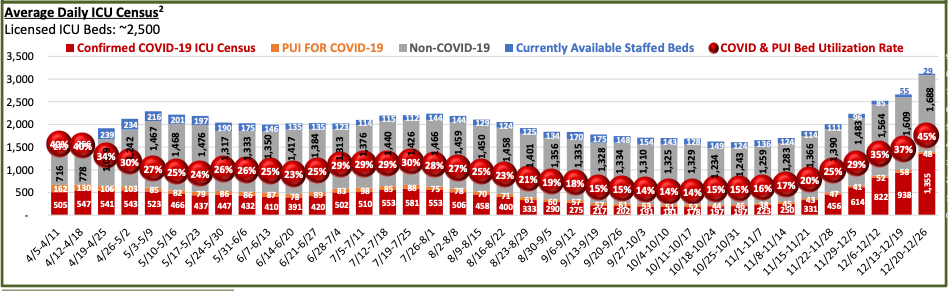
I’m looking at the hospitalization numbers for Los Angeles County and it’s depressing. I found the file through Google search; not sure how to access it directly. Anyway, as of December 31st, there are only 16 adult ICU beds free in the entire county.
I just got home after today’s dialysis session. Due to New Year’s Day being on Friday, the weekend schedule was shifted back one day. As I mentioned before, my weight was pretty high. Even after removing my thick jacket (but leaving my shoes on), the scale said 83.5 kg. I usually take 0.5 kg off for miscellaneous clothing but I cheated a bit more and told the tech I weighed 82.5 kg. That means I had to cheat at the end weigh-in too. Even at that weight, the tech decided that we would remove 3,800 mL of fluids, probably the most they’ve tried during one session.
Right at the beginning, there was a problem. The arterial needle didn’t go in that smoothly, and it hurt really bad. The venous needle was a bit better but there was a dull pain in my arm that wouldn’t go away. After about 30 minutes, the tech decides to move the needle since the pressure was wrong, and it hurt a lot worse. He ended up removing the arterial needle and jabbed me further up the arm. Initially, he missed the vein, but was able to hit in with a second needle. He jokingly said he was praying. Not sure how much of it was serious.
I started getting dizzy around the two hour mark. Both my feet were super numb for some reason but I tried to lie flat in the chair to raise my blood pressure. I guess it worked okay since I was averaging 140/80, even as the machine eventually pulled out 3,732 mL of fluids. When I stood up at the very end for the final blood pressure reading, I almost fell over, and the reading was 85/50. Not good. I took a few sips of water, waited five minutes, and tried again. This time it was 104/70 (or something) so good enough. Walking out, I was still pretty dizzy but felt better once I sat down in my car. The weight reading was 80.1 kg, which was 83.5 kg – 3.7 kg + a few sips of water. I ended up telling the tech that I weighed 79.2 kg so I have to watch what I eat/drink for the next few days. Of course, I was starving and stopped by Raising Cane’s to get four chicken fingers a la carte. No drinks. I ate them while driving home. They were super hot (temperature) and tasted awesome. I think I should get a job there after retiring from my real job. I leave you with a chicken finger video.
==========
Ugh, so tired. I think I woke up for a bit at 2:00 pm but I slept until almost 7:00 pm. Meanwhile, two of the dialysis needle insertion points are still bleeding, visible through the band-aids. I’ve gone through four of them already.
It’s been over a year since my open heart surgery and I still have problem sleeping regular hours. It seemed to have gotten better for a few months but it is getting worse again. I am more tired after dialysis, which means more naps in the afternoon, and leads to not being able to sleep at night.
I went to bed really early today since I was super fatigued again, after sleeping most of yesterday and today. It was something like 7:30 pm but I woke up a couple of times. I finally got up at around midnight, and have been trying to fall back asleep again. It’s now 2:30 am. The problem with the naps is that they are short, usually one to two hours. I would get up for awhile then need to sleep again. Fortunately, I’m working from home and can work around my crazy nap schedule. If I had to drive to work everyday, I don’t know how I would survive.
Related to my last weight post, I’m still at 83.0 kg right now. Some of the excess fluid must have overflowed into my chest cavity. Breathing is slightly more difficult than a few weeks ago, but nowhere near as bad as it was a few months ago. However, it’s just enough to keep me from sleeping at night.
I think I’ll just stay up for the next two hours. Since I cannot eat breakfast in case I put on more weight, I’ll probably just take a long shower right before I haver to leave for dialysis.
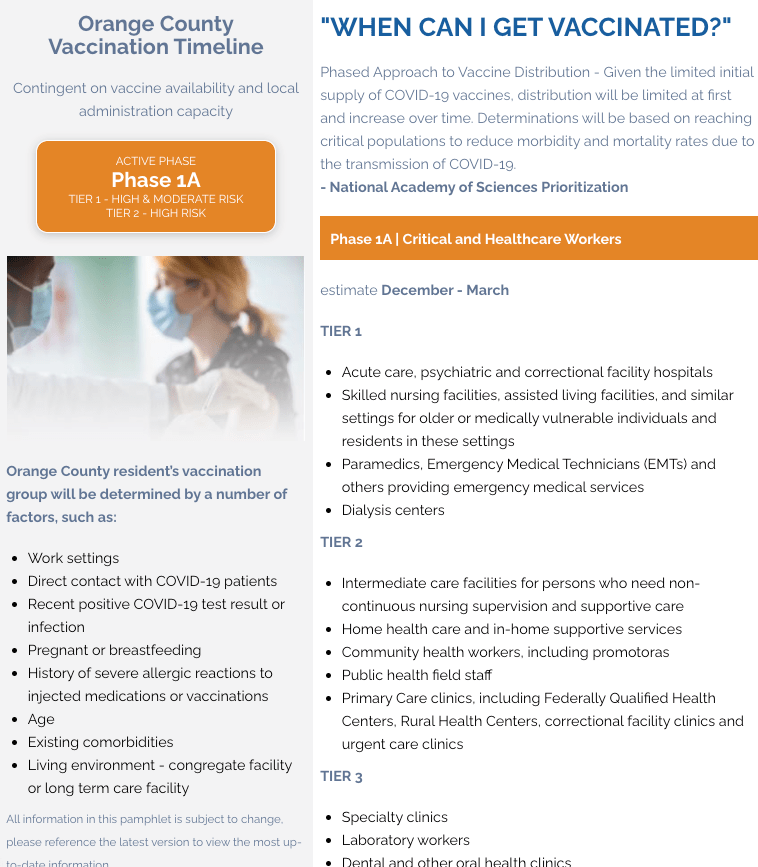
Since the COVID-19 vaccine became available, I have not heard anything about the distribution schedule for Orange County. Through Reddit, I found an official site with some information.
However, like many government websites, it has a lot of text but not that much useful information. The question everyone is asking is when they will be eligible to get the vaccine, and basically we are told that they are still developing guidelines. Huh? The vaccine has been available for weeks. I know supply is scarce right now, but at least have a plan in place. What if a large quantity of vaccine suddenly becomes available? Are they going to sit on their hands or scramble and throw a crude plan together overnight? Ugh. So much incompetence in government.
Even the current schedule is confusing:
I am guessing that we are in Phase 1A for Tier 1 and Tier 2 population? The explanation says Phase 1A: Critical and Healthcare Workers. Critical what? Critical healthcare workers, critical workers in general, or just critical people? Then they go on to explain Tier 1 but the last bullet just says Dialysis centers. Again, what about dialysis centers? Does Tier 1 include only dialysis center workers or patients as well? The three previous bullets in the same section are very detailed, yet the last bullet has zero information. If dialysis patients are not in Tier 1, and dialysis centers is not mentioned in Tier 2 and Tier 3, then are we (patients) included in Phase 1B and 1C?
Digging deeper, bullet #2 says,
Skilled nursing facilities, assisted living facilities, and similar settings for older or medically vulnerable individuals and residents in these settings
So non-healthcare workers are include in Tier 1. This population makes sense since that is a very high-risk group and there has been many documented deaths. My point is that dialysis centers are fairly similar. The workers do come in contact with a lot of patients but only 3x when compared to dialysis patients (three shifts per day). Dialysis patients are usually pretty high risk since many have multiple medical complications. I haven’t heard of a virus breakout at a dialysis center yet, but patients are basically immobile for 3-4 hours, unable to remove themselves from unsafe situations or environments. If dialysis centers are considered high risk areas, then us patients also share that risk along with the workers.
In addition, there has not been any communication from my dialysis center staff on any information they may have that may be relevant. Like always, zero information when you need it next. I guess I just keep doing what I have been doing for the past 10 months and hope I get the vaccine call before I get sick and die.
==========
I found an academic article online that suggests dialysis patients, especially in-center patients, are at very high risk, with short-term mortality at 20%.
Coronavirus disease 2019 (COVID-19) has affected the care and outcomes of patients treated with dialysis worldwide. In this issue of Kidney International, 3 reports highlight the disproportionately severe impact of COVID-19 on patients on dialysis, noting its high prevalence, particularly among patients receiving in-center dialysis. This likely reflects patients’ limited ability to physically distance as well as community exposures, including residence in areas with high rates of infection. Patients on dialysis are at extremely high risk should they develop COVID-19, with short-term mortality of 20% or higher. Accordingly, it is imperative that the kidney community intervenes to reduce the threat of COVID-19 in this vulnerable population by focusing on modifiable factors, including universal masking of patients and staff and enhanced screening, including testing for COVID-19 in the patients who are asymptomatic during times of high local prevalence.
Ugh, I’m so dead for tomorrow. I just weighed myself and I’m at 83.2 kg without much clothing. With clothes and shoes, less my 0.5 kg adjustment, I’ll probably come in at 84.0 kg. I was below 80 kg on Thursday so I’m way over my last weight, and dry weight is still 78.2 kg. I heard a tech bitch at another patient Thursday for being 4.5 kg over, with talk of ER visits and ventilators. If I’m ~6 kg over, they are going to freak out and schedule additional sessions.
I’m not even sure what happened. I measured myself at 82.1 kg this morning, a bit high but manageable. I had some coffee (~300 mL) and an egg sandwich for breakfast. I even skipped lunch. I don’t think I ate or drink anything else, except for a few Korean crackers at lunchtime. Don’t know why the scale read 1.1 kg gain. My mom made beef curry over rice for dinner. There’s no way I can eat that: rice and curry sauce is mostly water. She also baked some Costco mini-eggrolls so I had a few of those so I wouldn’t starve. I really think the dialysisi center went too low with my dry weight but they’re hesitant to raise it after lowering ti consistently over the last few months. Not sure what I’m going to do. If I think I can be disciplined over the next few sessions, I can “cheat” and do a bigger adjustment before/after so it looks like a gradual decrease over time. Of course, the problem gets worse if I keep gaining fluid weight. I guess I can always take off my sweatshirt and sh9es and another 0.5 kg for the remaining clothes. That will lower the baseline but that also means taking longer at weigh-ins going forward.
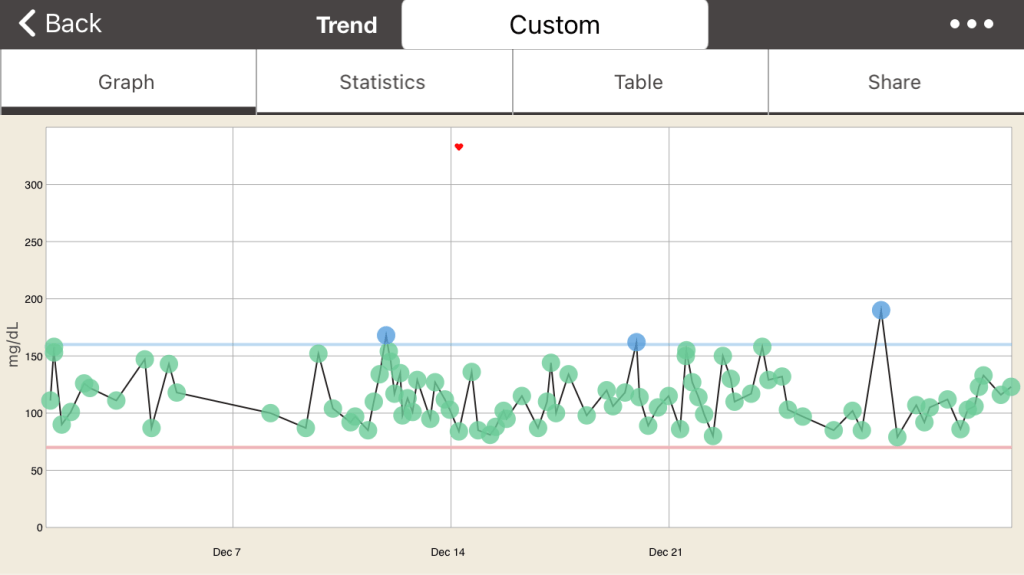
Because I don’t want to start insulin injections, I’ve been testing my blood glucose levels quite often, sometimes 6-7 times a day. My endocrinologist wrote a prescription for test strips. The supply order is probably for a month with three tests per day, so about 100 test strips. Even with insurance, the pharmacy is charging me $70. I still have hundreds of strips so I’m going to reject the prescription until I figure out the pricing. Unfortunately, the new year started so I have to pay the out-of-pocket amount again. Not sure what this does to my share of prescription orders. I’m still on Tradjenta, which is costing my work insurance about $10/day.
Back to my blood glucose, the above is a screenshot of the past 30 days as recorded by my meter. The upper/lower limits are 160 and 70 respectively. With the one measurement that was taken too soon after a snack, all the numbers look fine and within normal guidelines. I sent this data to my endocrinologist during Christmas weekend and she was fine keeping me off insulin if the numbers are consistently normal.
I wanted my first post of 2021 to be a serious dissertation on dialysis or kidney transplant, but it’s going to be a complaint about how Apple does it’s billing. Oh well…
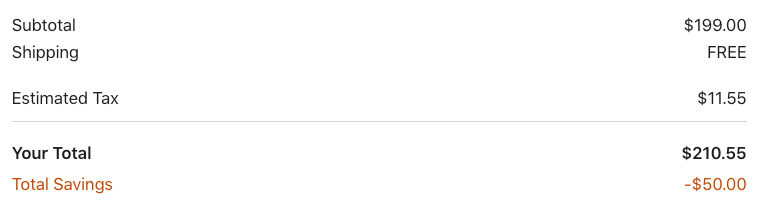
So, I purchased an Apple TV 4k during Black Friday weekend. The price was $199 for the 64GB version, but you get a $50 Apple gift card. When I placed the order, the sales tax was $11.55 so the total was $210.55. The order summary I saw online looked like this:
Very unclear what amount was going to be charged to my Apple credit card. $210.55 or $160.55? Then I get a notification on my phone that Apple charged $160.55. “Oh,” I thought, “Apple applied the reward gift card to the purchase. Cool.” I then forgot about this whole transaction.
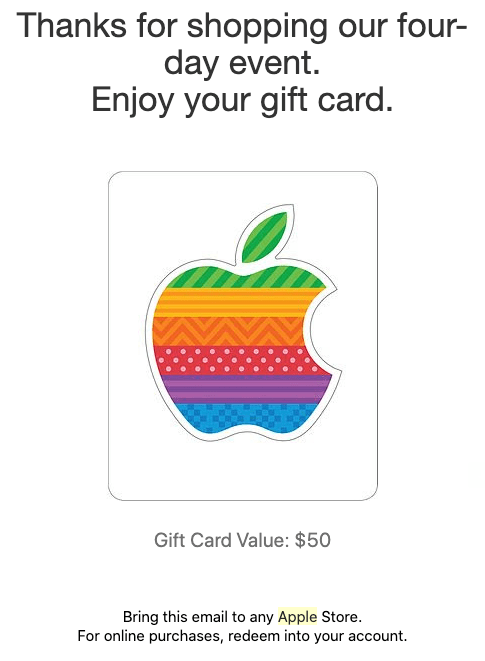
Today, I get a notification that my billing statement is ready, and I took a look; usually I don’t look and let autopay take care of it. I saw the $160.55 charge, but a few days later, I see a $50 charge. I did not buy anything for $50 from Apple since then, and the Wallet app on my iPhone has no details. It took some digging but it turns out Apple billed me twice for the Apple TV order: $160.55 + $50.00 = $210.55. So they billed me for the discounted price, then charged me for a $50 gift card that was then sent to me, at a different email address (my fault). Why?! As a finance person in real life, I kind of know why. If they just deduct $50 from the price, Apple’s revenue decreases by $50. If they use this circuitous give card route, a portion of their customers won’t redeem or use up all the gift card balance, and Apple get to recoup some of the lost revenue. Kind of lame, but it’s standard gift card business practice.
Furthermore, I could not find an online statement of my Apple account. The best I could see is a list of purchases but no payment information. After digging through all sorts of links and pages, I found my account balance through the iTunes/Music app on my MacBook. Even then, it was hard to find. All it said was balance = $37.06. I had to guess that it was the $50 less an app I bought for $1.99, some in-game purchases for $7.96, and my monthly iCloud storage plan for $2.99. Ugh, very confusing and frustrating to track down transaction data from several places online. Did some engineer design their credit card user interface?
It’s 11:45 pm Pacific Time so 15 minutes until 2021 locally. In many ways, 2020 has been a terrible year. For me personally, it started with recovery from open heart surgery, followed by COVID-19 and 10 months of isolation, atrial fibrillation, then pleural effusion. Somewhere in there I stepped on a plastic stool and almost severe one of my toes. Plus several surgeries and procedures to make dialysis work better. The only bright point was having my sister approved as a kidney donor and me almost fully approved. Hope that momentum carries to 2021, and have some normalcy return to life.
I started this blog 18 months ago as a place to vent my peritoneal dialysis frustrations and ended up being my main blog. I did have another blog with >2000 posts that’s been mainly ignored. I only gave this URL to a few people so I don’t even know who is reading this. Whoever you are, I hope you survived 2020 relatively unscathed, and that you will haver a wonderful and safe 2021!
I’ve been very tired lately. Not sure if it’s just dialysis catching up to me, or my inability to sleep well at night. After dialysis this morning, I went and got some lunch and charge my car. I got home at around 11:30 am and took a nap. I think I woke up at 2:00 pm and 4:30 pm but went back to sleep. I didn’t get up until around 7:00 pm to eat dinner. After dinner, I cleaned up a pile of paperwork, then napped a bit more. Now it’s 11:30 pm and I probably slept 10 out of the last 12 hours and I’m still tired.
I probably won’t be able to sleep tonight though. My biorhythm is all messed up.
==========
I’ve been trying to sleep during dialysis without much success. It’s mainly because of the sucky chairs. When it’s fully reclined, the chair is not exactly flat, and my feet are dangling of the end of the footrest. If I stay in that position, my back starts to hurt after about 30 minutes. Today however, I tried leaning a bit to my right, since sleeping to the left still puts pressure on my heart and chest cavity. I had to be careful because of all the tubing and I couldn’t move my right arm, but was able to rotate about 30-40 degrees to take some pressure off my back. It wasn’t exactly comfy but I was able to fall asleep for about an hour. I’m going to try that on Sunday to see if I can get more rotation and a bit more sleep.
Since several of my friends haver been asking me, maybe other people have questions as well. This is from several past conversations with my transplant coordinator so I’m not 100% sure it’s accurate until I hear from my current coordinator about my case.
UCLA has two different groups to handle transplant recipients and donors. They each have a coordinator and a separate surgical team. For example, I’ve never heard any information from the donor side. I only get information since my donors candidates are my sister and good friend, and they pass along news to me. In my sister’s case, it took over three years but she finally got approval from the donor committee a few months ago. My friend was rejected in June due to his oxalate levels. I was approved in the past but was put on hold due to my heart surgery, and needed a bunch of tests ans appointments to get back on approved status. When my sister was approved, I had three more conditions to meet: 1) heart stress test, 2) colonoscopy, and 3) approval from cardiologist to temporarily stop taking Eliquis (blood thinner). Since then, I took a Lexiscan test which required two echocardiogram follow-ups, did my first colonoscopy, and got agreement from my cardiologist to stop the medication a week before surgery. My coordinator has not communicated any more conditions to meet so I assume the transplant committee will meet to approve/reject my candidacy. I can’t remember if they meet on Mondays or Fridays but I should hear back in a few weeks at the most.
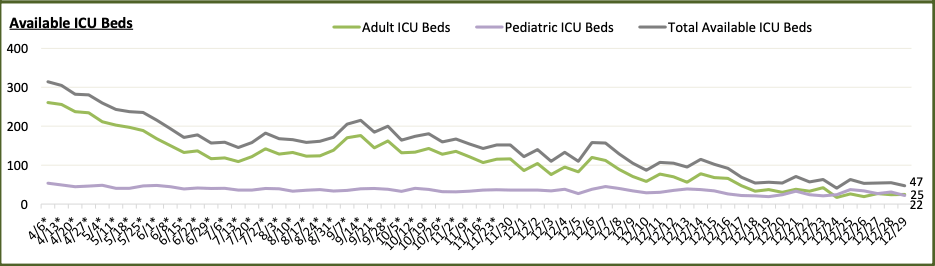
Once both patients are approved, then the donor and the transplant coordinator meet to schedule the surgery since both need to happen around the same time to preserve the health of the donated kidney. They will also need to reserve two ICU beds: 2-3 days for the donor, and 5-6 days for the recipient. This likely was not an issue in the past but now with the COVID-19 resurgence, there are no ICU beds in Los Angeles County. Because we can control the timing of the surgeries, I believe a live donor transplant is classified as an elective surgery so they’re pretty low priority right now. Hopefully, with the vaccine and more awareness, all things pandemic will improve and some ICU beds will free up. Here are some LA County hospital capacity data:
There appears to be only 25 unoccupied and staffed ICU beds in LA County as of 12/30. Not sure how many are at UCLA, but pretty sure they aren’t going to reserve two for a kidney transplant anytime soon.
<rant> Finally, to the covidiots who think violating social distancing orders and getting sick has no impact on society, you are wrong. You may survive and recover, but other people you may have infected are dying, in large numbers. Also by being careless, you are using up scarce medical resources that are needed by other patients. I have been on dialysis for over four years so another few months won’t kill me but for stroke or heart attack patients that cannot find an open ER or ICU bed? They are dying thanks to you. </rant>
The steel watch band I ordered for my Apple Watch 6 arrived today. Apple store wanted $450 for their Space Black Link Bracelet. That’s more expensive than the actual watch ($429). So I went on Amazon and found something for ~$18. Of course it won’t be the same quality but 25x is a huge premium.
The band is pretty heavy and I had to remove four links from the band to have it fit my “skinny” wrist. The fit and finish is not great: some of the “paint” or whatever already rubbed off on the packaging, and it was very hard to get the anchors into the Watch band slots. Still, 25x price difference. I’m pretty sure the Apple one will be super shiny and fit perfectly in the Watch slots.
Ultimately, this is what bothers me about manufacturing in China. Chinese factories also assemble the actual Apple products like iPhones and iPads and they do an excellent job. Why can’t they produce more quality goods on their own? Amazon is flooded with cheap Chinese products, often from the same factory, with ridiculous Engrish brand names. It’s either exorbitantly priced name brands or super cheap knock-offs. I want something in between: decent quality for a decent price. Maybe this is normal in the evolution of manufacturing. In the past, Japan, South Korea, and Taiwan were seen as only capable of producing cheap inferior products. Today, they are seen as comparable or better than US/Europe manufactured goods. Perhaps China will get there one day but I’m not holding my breath.
=========
It’s only been a few hours and I’ve experienced the cheapness effect already. I guess I was trying on the watch band after adjustment so I didn’t lock in the second pin, and it slopped out just now. There were spares so I put one back in, but pin was faulty so the included tool wasn’t able to push it back in. The tool is also very cheap and didn’t fit the band very well. It’s basically a screw with a long thin tip mounted in a plastic holder. The thin tip does all the work pushing the band pins and it’s bent already. Finally, one side of the watch band doesn’t fit the Watch perfectly so you can feel the edges protrude out. On the same side, the locking mechanism is already weak so the band wiggle. Sigh… why can’t they charge a bit more and make a better product? I don’t have a preconceived on how much a stainless steel watch band should cost. If everyone sells the same cheap product for $15-20, then that’s the expected price. If there was a better made $40 option, I would go for that, but not the $450 Apple option.
With the pandemic in full swing, I’m doing all my shopping online, which means Amazon.com. I’ve placed a lot of orders with them and sometimes it feels like I’m getting a package everyday. I’m even ordering small stuff like bath puffs and antibacterial hand soap. Well, one of the orders wasn’t received on time, and the Amazon website said the orders were lost. I had the choice of getting a refund or a replacement order. I tried doing the replacement online but wasn’t able to, so I ended up chatting with some guy in India and getting a refund. Of course, the packages showed up yesterday, about five days late. Amazon Prime it’s not.
I’m on a live chat right now with another guy from India, asking him what I should do next. The easiest option is to charge my card again and reverse the refunds and I’m okay with that. They probably wouldn’t do anything if I didn’t contact them since it was only ~$15 but I thought it was the right thing to do to let Amazon know.
Now I’m thinking I should have ordered a new Macbook or something. 😀
=========
Just as I though. For $15, they’re just going to let me keep the products and the refund. Probably since it was their shipper that lost track of the package for a few days. Interestingly, the my first chat message was either lost or ignored and a different Indian guy helped me after I sent a “Hello?” message.
Pretty sure if the shipment was a Macbook, they would have tracked me down.
I met with the nurse practitioner yesterday and she said everything looked fine. They removed four polyps; most were normal but there was one that needs closer attention. There were also some voids(?) in the colon walls that may collect debris and become infected. She told me to eat more fiber, including supplements like Metamucil, and go back for another colonoscopy in three years. Arg! I thought I was done for another 10 years. Actually, the whole experience wasn’t too bad except for the cleansing part.
I also got an email from UCLA letting me know that they were good with my second echocardiogram. I assume the colonoscopy results are fine for a transplant so we’re all done with tests. Now the scheduling wait begins.
A long long time ago, when I first started shaving, I just used regular soap. Later, I started using Gillette shaving gel. It would come out of the can as a greenish gel, and would foam up as you mixed it with water. I’m not sure what was in there but it burned my skin a bit, kind of like aftershave.
When I got married, my ex-wife asked me to switch to Gillette Foamy shaving cream, specifically the sensitive skin version, because she liked the scent. While taking a shower this morning, I noticed that I was still using the same shaving cream brand, even though I’ve been divorced for over 14 years. I guess if you don’t have a strong preference for a product, you get into a habit of using the same thing. The product is not really listed on the Gillette website; it’s not in the current drop-down list of products. I’m not sure what I’d use if Gillette discontinued Foamy.
==========
Another thing that became “normal” after marriage was buying new cars with cash. It probably coincided with getting better paying jobs that made cash purchases feasible. Previously, all the new cars in our family were financed by auto loans. We never had enough money to pay cash. My ex-wife’s family however, were better off and bought all their cars with cash. After marriage, we also started buying cars with cash. First was a 1999 Toyota 4Runner that was mostly a wedding gift. Then I bought a 2000 Hyundai Elantra, a 2004 Nissan 350Z, a 2011 Nissan Maxima, and a 2016 Tesla Model S (consecutively), all with cash.
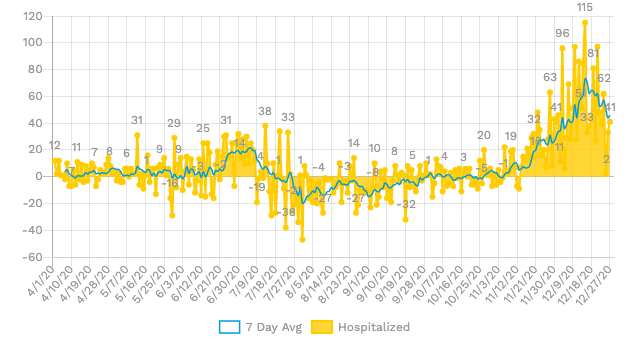
The chart shows daily number of hospitalization in Orange County. There was definitely a huge spike starting in mid-November, but the rate of increase is trending down again. If I was optimistic, then it looks like the “second wave” is behind us with better days ahead. More likely however, the current spike is from careless people gathering during Thanksgiving, and an even bigger spike is coming for Christmas/New Years. With the hospital out of ICU beds and just full in general, a bigger spike in patients needing hospitalization will just mean more dead people. There’s a lot of hope and expectation placed on the new vaccines.
😰… I’ve been a bit slack in controlling my fluid intake this week. My “dry” weight is currently 78.2 kg, but I ended Sunday’ session at 80.x kg (I can’t remember the exact number). I don’t think I went overboard with food and drink. In fact, it’s about 2:00 am right now (can’t sleep again) and I am starving. The scale at home is not calibrated with the scale at the clinic but I am 82.6 kg this morning without shoes. I typically weight myself at the clinic with shoes on, and then subtracting 0.5 kg to get to a consistent baseline. This would put me at ~83.0 kg, which is only ~3 kg increase but ~5 kg over dry weight. Since my blood pressure has been dropping precipitously near the end of each session this past week, the clinic have not been super aggressive with the ultrafiltration (UF) or fluid removal as they would like. They may even add another session for UF if I can’t lower my weight on my own.
All that is secondary. I’ve also noticed that my breathing has become more labored, especially if I lay down on my left side. That has always been marginally the case, but it feels a bit worse this week. I feel much better than a few months ago when I definitely had ~500 mL of fluid in my chest cavity, but maybe some has diffused back.
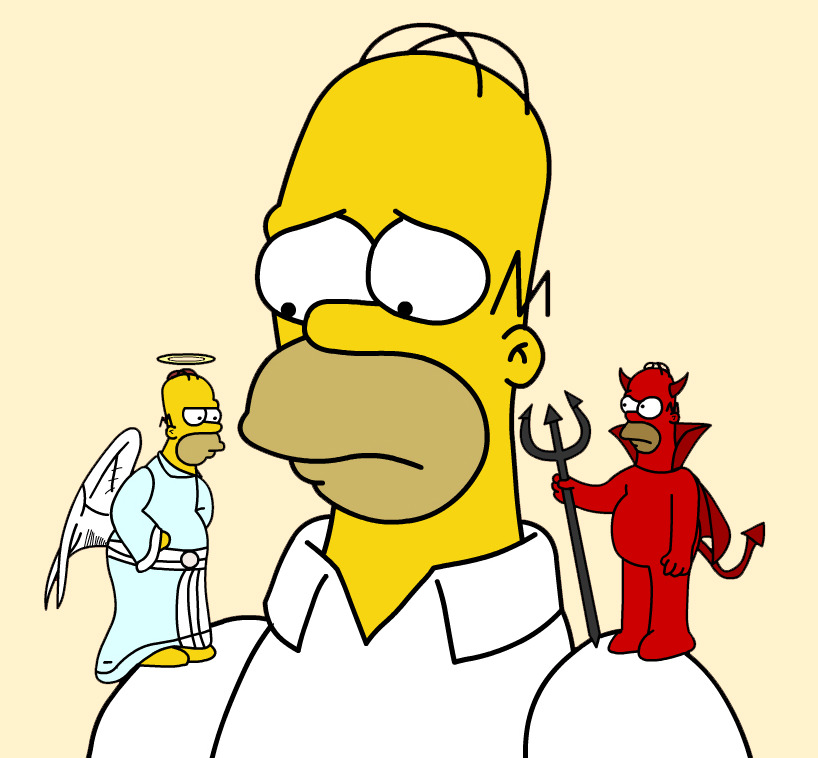
Recently, I’ve felt like the guy with an angel on one shoulder and the devil on the other, arguing about self-control. The right thing to do is to watch what I eat and drink more diligently since my weight is creeping up, and my phosphorus/potassium lab results are high. However, I’m getting more urges to forget all that, and eat/drink whatever I want. Maybe it’s spending nine months in semi-isolation that’s weakening my resolve? Or that I’m so close to the end of the tunnel for a kidney transplant but it on-hold indefinitely due to the recent COVID resurgence?
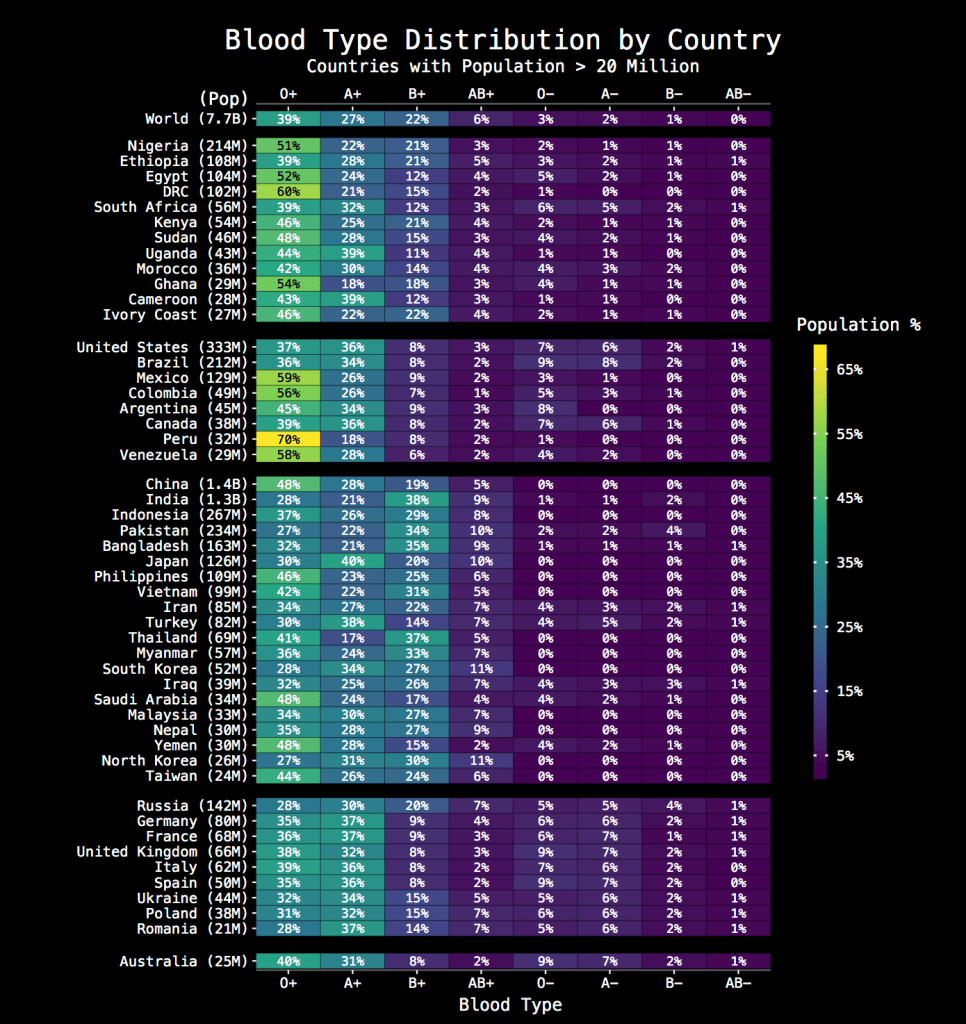
I didn’t see a source citation in the post but the chart shows the blood type distribution % by country.. I’ve always been told that the transplant wait list for B+ is pretty long in Southern California. This gives one reason: there are less people with my blood type in the US. Worldwide, this chart says 22% of the population is B+, but it’s only 8% in the US. This shrinks the potential donor pool, thereby making the wait time a lot longer. I joked about moving back to Canada but the B+ percentage is about the same as the US. Taiwan is a lot higher at 24% of the population but with already four years accrued on the UNOS list, the remaining wait time is probably similar to starting over in Taiwan.
Today was a super eventful day at dialysis. Maybe it was because it was a Sunday when the clinic is hot typically open. I mentioned previously that I had problems sleeping this morning so I was already exhausted when I got to the clinic. Also, I thought I was going to be very overweight so I skipped breakfast. Finally, my morning blood pressure was satisfactory at 143/80/60 so I also skipped all my morning medications, including the Tradjenta as I was not eating.
I was having problems staying awake during the 15 minute drive to the dialysis center. Not a good start. My regular tech was still out on vacation so another MWF tech poked me. Even with lidocaine, it hurt a lot going in and kept hurting for about 15 minutes. She probably hit a nerve by sticking the needle almost straight down initially. My blood pressure was pretty normal at this point at 158/78/65. but over the next two hours, it rose steadily until it hit 174/91/63 at about 7:40 am. Thinking that it was going to keep rising, I took all my morning meds, including the blood thinners and Tradjenta. Within about five minutes, the next reading was 123/73/68. The elapsed time was too short fo the meds to take effect so the 174 number was wrong?
From that point, my blood pressure started dropping more until I was feeling kind of nauseas and lightheaded. My BP got as low as 103/58/64 before I asked the tech to turn off the UF. For the next 15 minutes, we kept manually measuring my BP until a 98/60/65 popped up, but both readings before and after were in the 140’s/150’s. Again, I don’t know if the BP meter is accurate but having the number swing 50 points down then up didn’t feel good. At the same time, I think my blood sugar was crashing too since I didn’t eat anything for breakfast and I also only ate a small dinner the previous day, worried about being too much over my “dry” weight. I ended up drinking a small can of Sierra Mist and taking a few glucose pills to try and put some fluids and sugars back. Even though they took me off 15 minutes early, I sat in the chair after the session to recover and didn’t leave until 10:15 am. I was even more tired at that point but starving so I went to get lunch, ate it in the parking lot, and drove home to sleep. I just woke up at around 2:30 pm, still very tired, but feeling a lot better.



 Life with chronic diseases