My dialysis clinic texted me this morning to come in earlier. Since my parents still won’t let me drive to dialysis, I had to wake everyone but managed to get here about an hour early. This means I’ll get out around noon so I’m going to look for a place for lunch. I’ve been mostly going home right after dialysis and resting, often skipping lunch so a change will be nice.
Usually dialysis sucks because all you can do is sit for 3.5 hours. With my neuropathy and numbness in my feet, the sitting is a lot worse. Today, I need to review a three page resume and a very long tax opinion letter so hopefully I will be distracted for most of the session. It’s when I have to sit and stare into space for 3 hours that I get a little stir crazy.
Due to Friday traffic, and the fact their last delivery was out in Indio, the mattress delivery guys arrived 15 minutes past their window. They were very apologetic and set up my new bed in 10 minutes. The mattress is pretty thick and firm, and the adjustable base worked well. The only minor issue was that the mattress kept slipping off the base, even when I just sit down on the bed. I guess everything is new and shiny, and since it was only a Twin XL mattress, there’s not enough inherent weight to hold the mattress down. We managed to find some non-slip pads, stuck them between the mattress and bed base, and the mattress no longer slips.
I slept for awhile in the bed at a slight incline and it was pretty good at relieving the pressure in my chest. However, the combination of dry air and foot numbness woke me up after about two hours of sleep anyway. It’s ~3:00 am and I’m still up. I tried sleeping on my right side but felt that I needed to make the mattress flat so if I change positions during the night, I need to adjust the bed as well. I wished the bed was “smart”, i.e., Alexa compatible so I can just yell at it instead of looking for the bed remote. “Alexa, raise bed back by 15 degrees!“
It’s been two whole days since I’ve had an episode of phantom smells. I think there were several times I thought I smelled something but nothing like what I was experiencing just two days ago. I remember sitting at my sister’s house during Christmas dinner smelling smoke though no on in the house smoked.
Since I’m unsure of what triggered the initial symptoms, I haven’t been using the saline nasal rinse even though the nasal drip is worse. I’m also coughing up a lot more phlegm. This would indicate that a possible sinus infection is getting worse but a potential symptom has disappeared. Strange…
For a few weeks now, I’ve been having problems sleeping. When I was discharged from the hospital, I was sleeping on the recliner downstairs but I was sleeping great. My Fitbit thinks I’m only getting 3:40 of sleep each night this week on average. Part of the problem was my mattress. I had just purchased a nice foam mattress online and it was fine prior to surgery. Post surgery, it was way too soft to support my back and I could not find a comfortable position at all. I ended up switching back to my cheapo Ikea mattress which was a lot firmer but still not great.
We ended up at Custom Comfort mattress store last week looking for a new mattress. I purchased a mattress from them about 20 years ago and really liked it. Long story short, I bought a new adjustable Twin XL bed. My bedroom is pretty small so I had to stay with the small sized mattress. In trying out the bed, if I raise my back slightly, it seems to take pressure off my chest. With a mattress protector and some nice sheets, the bed came out to be ~$1,500. I thought that was expensive but my mom said it was pretty reasonable. The delivery is supposed to be here anytime; hopefully this will help me get a few more hours of sleep each night.
Since the sun was still out and I wasn’t feeling too tired, I decided to go out and walk some more. I think I’m supposed to do an hour of exercise a day eventually. This time, I started the walk using the Fitbit app instead of using the Fitbit itself, so the tracking worked without any issues. I ended up walking for 0.96 miles at a 24’21” pace. That’s about 2.5 miles/hour; not to quick but I was only doing 3 miles/hour before the surgery. That means I can walk a 5k in about 1.5 hours.
I was definitely more tired this time. My legs felt heavy after only a couple hundred feet. All this is prep for the Cardiac Rehab program. UCLA Transplant Center will only clear me for transplant if I pass the program. I’m not sure what passing means. My nephrologist said most of the patients are a lot older and more sick; if they hold everyone to the same goals, I should be able to kick everyone else’s butt… maybe. She even asked if I can accelerate through the program faster since I’m likely much healthier than most patients, excluding the bad kidneys.
I just walked for about 1.15 miles. It’s the longest I’ve walked non-stop since the heart surgery. I would have more specs about the walk except my Fitbit had a brain fart. It stopped tracking after 0.15 miles for some reason. I initiated the “walk/run” using the Fitbit (Charge 2); I think I will go back to starting exercises using the app on the phone. It seems more reliable, and since the Fitbit doesn’t have GPS, it’s relying on the phone anyway.
I did hit that “wall” soon after I started walking. Everything was going fine then I became really tired suddenly. I just kept walking and even though I still felt tired, I was able to walk another mile. I was really tired and sweaty at the end however so I guess that’s good? I’m also wearing compression socks from Wanderlust that I bought for airplane rides. They’re kinda thick so I don’t like wearing them all the time. I can still feel the lumps through the socks so not sure if that will work.
I told my sister right after the surgery that my goal is to run in a 5K soon. I can walk the ~3 miles but not sure I could run that long without walking even before surgery. I downloaded the C25K app and will be starting probably after I complete Cardiac Rehab.
It’s been about three weeks since I stopped taking amiodarone. That drug is supposed to regulate your heartbeat but has a ton of bad side effects. More common are nausea, vomiting, insomnia, numbness in the hands and feet, plus a lot more. Since I thought I was experiencing many of those symptoms, I got my cardiologist to stop the medication. However, the “half-life” of the drug is very long, from weeks to months after you stop taking it. Wikipedia has the half-life at 58 days which is ~2 months.
Since all my weird symptoms started about two weeks after discharge, which is about the time it takes for amiodarone to kick in, I was hoping that stopping the medication will ease the symptoms. After three weeks, I’m eating and sleeping better but can’t tell if that’s part of the regular recovery or the residual drug effects wearing off. My main issue with numbness in my feet have not subsided. I have peripheral nephropathy but don’t remember the numbness being that bad. I read somewhere that if your feet are cold, it makes the numbness worse so I been wrapping my feet with electric blankets. I did get some fluffy slippers from Amazon so hopefully that will help.
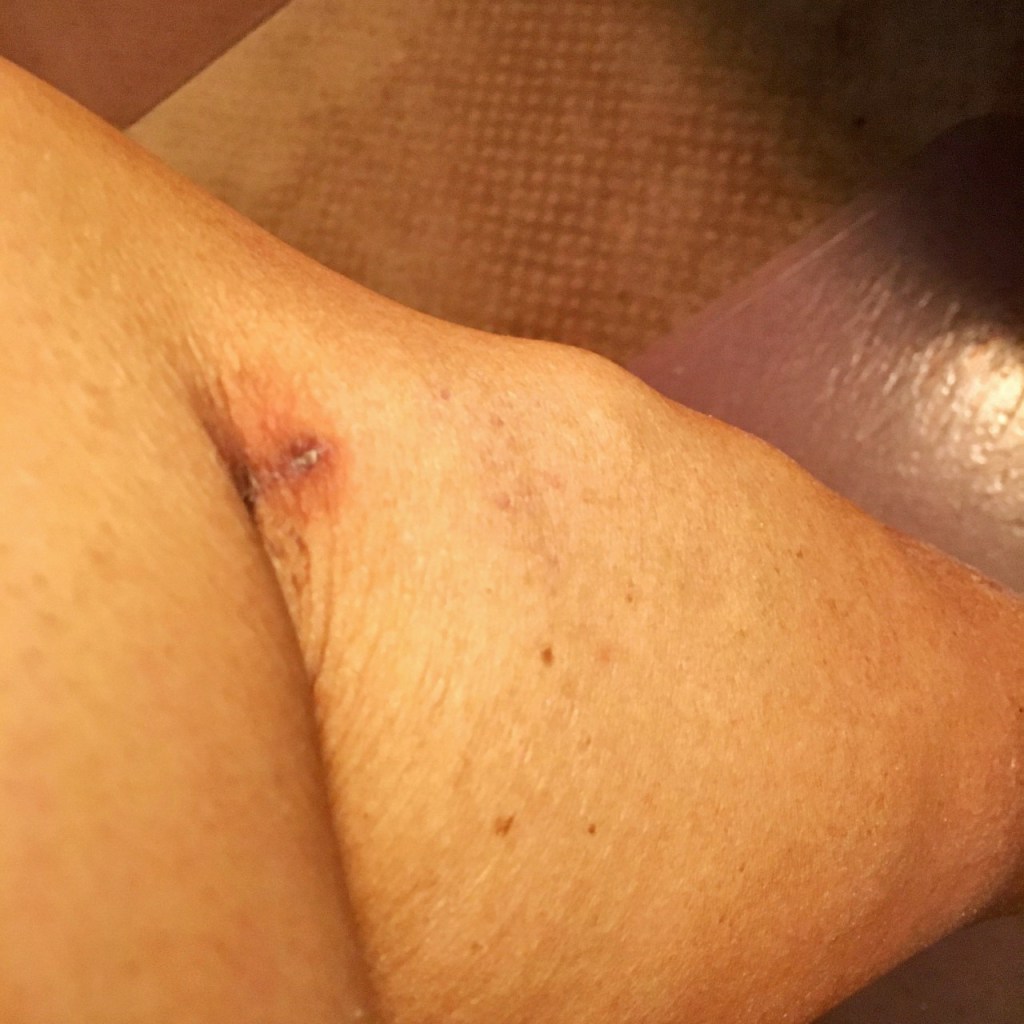
Starting this past Monday, I’ve been getting these lumps in my left leg, right where they removed the vein for my heart bypass surgery. The lumps are soft; if you press down, it feels like they’re fluid filled. There is also a small ridge running down where I think the vein was.
The scar at the back of the knee is the upper incision for vein removal. The lumps change in size slightly and do not hurt when I press on them.
I called the cardiac surgery nurse and sent a message to my nephrologist about this during dialysis. My nephrologist was doing rounds at the main hospital next door so she decided to stop by to take a look. The main concern is that it is a blood clot but she thought it didn’t look like one. Typically in the leg you get deep vein thrombosis (DVT) if there is a blockage while my lumps looks like they’re on the surface. Also if there is swelling, DVT will cause the entire lower leg to swell. However, to be safe, she will send in ultrasound orders to two imaging labs and I can go in next week if the lumps get larger.
Later in the afternoon, the cardiac surgery nurse called back. She said that she has seen this before and it’s probably blood pooling in the space where the old vein was. Her suggestion is for me to wear compression socks during the day to push the excess blood back up to the heart. She want me to try for a week then call her back. I have some thick travel compression socks but decided to buy a pair of open-toe sheer socks from Amazon instead. Amazon must think I’m running a clinic with all the medical related items I’ve been ordering lately.
Why do I get this feeling that I’m experiencing all the negative side effects of the surgery and post-surgery medication? Sigh…
I had my surgery on November 14th and was discharged on November 21st. In the discharge materials, there is a brochure called “My Six-Week Care Plan.” Well, Week 6 starts today (December 27th). Here are some of the items listed:
You will be able to resume most normal activities progressively
Check with your surgeon if you participate in strenuous activities
Attend Cardiac Rehab
You may return to work if approved by your doctor
You may travel. Make plans.
Enjoy life to the fullest!
Meanwhile, I still cannot eat and sleep regularly. Again, I really hope that is caused by taking amiodarone for three weeks, though it appears less likely as the weeks go by. I hate to have difficulty eating and sleeping going forward. Also, I don’t think I’ve recovered physically. Cardiac Rehab won’t even schedule me until after 8 weeks. When I go out walking, everything would be fine at first but after 1/3 of a mile, I suddenly become very tired and start breathing hard. That’s pretty weak. Is the heart stressed out from not doing much this past six weeks? Does that mean I need to walk even more or just wait for Cardiac Rehab? Also, I don’t think I can go back to work. My coworker texted me about an issue today and I spent an hour looking into it. That little bit stressed me out; not sure if I can handle going back to work full-time yet.
Finally, I haven’t traveled in over three years. Dialysis makes travel very difficult, no matter if you’re on hemodialysis or peritoneal dialysis.
As I mentioned before, my blood seems to be too thick for the dialysis machines. For two days, I was clogging the tubing and filters, and setting of alarms non-stop. I believe they ended up replacing the dialyzer during dialysis because the previous one was clogged up so back. One option is to inject agatroban into the dialysis machine like they do with heparin but I think tat would be really expensive. Instead, the clinic decided to switch out to a different dialyzer. I thought it was one “standard” filter for everyone but I guess Fresenius makes a lot of different ones. I believe they said I used the different dialyzer at the main hospital.
It’s been two days and the clogging and alarms have stopped. Hopefully it keeps working since I doubt they will spend the money on agatroban for the machine.
I am allergic to heparin. I believe it triggers something called Heparin Induced Thrombocytopenia. This is a bit of a pain in the ass since heparin is used everywhere, from most surgical procedures to preventing the dialysis machines form clogging. At my dialysis clinic, instead of locking my catheter with heparin or injecting it into the dialysis machine, they use argatroban afterwards to prevent my catheter from clogging. At the other dialysis clinic I was at, they don’t have argatroban so they just use saline. My catheter clogged once during the month I was there. Their solution is to drip a stronger anti-coagulant into my catheter whenever it starts clogging.
Argatroban is expensive. I heard the nurses say that one vial is ~$7,000. I guess my insurance is paying for it. What happens after I switch to Medicare? Does Medicare cover such an expensive drug? If not, do I just go without and deal with clogs in the catheter? Maybe that’s another reason to get a fistula.
Cross my fingers but I think the phantom smell symptoms stopped this morning. Last night I was still smelling cigarette smoke everywhere but I have not had any episodes today. It seems like it just suddenly stopped. Was it a sinus infection that healed? Was it related to dental issues? My teeth are still the same mess as it was a few weeks ago. Maybe the heavy rain washed some pollutants out of the air?
I think I’ll stay away from the nasal saline rinse and my bottle of Flonase for now. Hopefully the symptoms don’t return anytime soon.
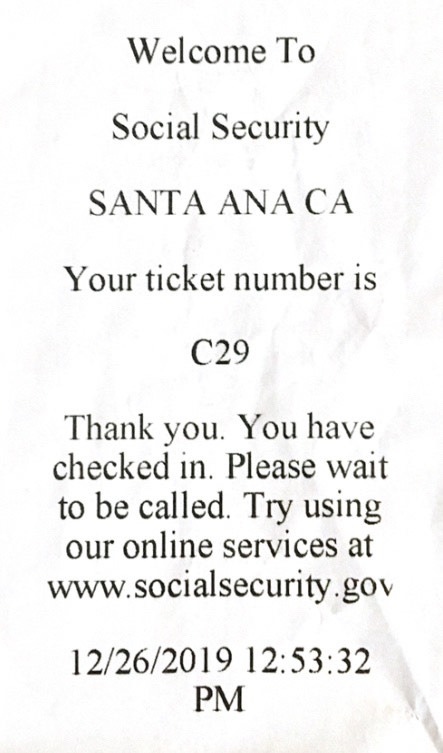
Ha! So I got called the second time as I was typing the last word in my previous blog post. I thought they were going to call me into the back office but instead, I was called to another window along the wall. There, a nice lady asked me a bunch of questions, updated the computer to indicate that I was an American citizen, and made a photocopy of my passport. Overall, it took less than 5 minutes but with parking and walking in/out of the building, it took us a bit over an hour for the entire visit and $6 for parking. Efficient!
She also said that my Medicare coverage should start on January 1, 2020. That was faster than I was expecting. My company’s insurance will still pay for dialysis for another three months so I’m not sure what Medicare will pay for to justify me paying three months of Part B premiums. Maybe Medicare will take care of some of my co-pay. I always hit my out-of-pocket maximum in January. Just to complicate things, I also maxed out my FHA contributions for this year so another healthcare thing to add to the mix.
When I applied for Medicare this past Monday at the local Social Security office, the agent asked me for my passport. Of course I didn’t have it with me so he told me to come back another day, sign in saying I have an appointment, and they’ll make a copy. I thought 5, 10 minutes tops.
Nope. After checking in at the kiosk, I waited 30 minutes to check in at a window just to tell the guy why I was there. Of course he can’t make/take copies so I need to wait for another guy to call me. There are no numbers so I have no idea how long the wait will be. It’s been 15 minutes already. I just need to show someone my passport and I’ve waited 35 minutes already. Plus parking is $2.00 every 20 minutes so this is a waste of time and it’s costing me money. Arg!
One of my many worries is having a lot less urine output than before. If you are on dialysis, this means everything you drink (and eat to some extent) needs to come out as sweat or UF during dialysis. I saw some of my lab results from before and it looked like 1700 mL to 2100 mL per day of urine output. However, while I was on peritoneal dialysis, that number dropped, especially near the end, to almost nothing. My nephrologist thinks that may be the effect of inadequate clearance while on PD, which increases the toxins in my blood, which may reduce urine output.
I think I mentioned previously that post-surgery, I did not have any urine during the week in the hospital, and also the first two weeks after discharge. Only after the third week was there a trickle. Since then, I thought that I was making more and more urine. A week ago, the dialysis center asked for a 24 hour sample and I think my result was only 50 mL. If I’m improving daily, surely I’m at 100 mL or 200 mL after another week.
I found a small sample cup used for PD and collected urine since 8am yesterday (it’s 1am now). Not quite 24 hour but maybe we can extrapolate. I also bought a few disposable measuring cups to use. So after pouring all the urine I collected into the measuring cup, there was only 50 mL of fluid. Sigh, there was no improvement at all (or slightly if you extrapolate another 7 hours). Add to the fact that I’m not improving as quickly anymore… still can’t eat or sleep regularly, shoulder and neck still hurts, I can’t help but think my recovery has stalled. There’s always this thought, “What if I’m like this forever?”
One thing unique to End Stage Renal Disease (ESRD) is that dialysis treatments and kidney transplants are paid for by Medicare. In 2017, Medicare spent $11.4 billion on dialysis and dialysis centers lose money on Medicare reimbursements. All the profit is from charging patients with commercial insurance a lot more. Medicare pays about $90,000/year for hemodialysis treatment; my work insurance was charged about $250,000/year. Needless to say, insurance companies do not want to pay for dialysis forever so after 33 months, the primary insurance for dialysis shifts to Medicare.
I started hemodialysis in July, 2017 so this is month 30. I was told that I needed to apply for Medicare by the end of this month so that there is no interruption in insurance coverage when my work insurances stops paying in April, 2020. There is a lot of information on how to apply but my dialysis clinic suggest that I apply in person at the local SSA (Social Security Administration) office in case documents or files gets lost. No local number is listed online for Social Security offices so I had to start with the national 800 number.
The first call had a wait time of 45 minutes while my second call had a wait time of 41 minutes to speak to someone. I decided to call earlier at 7am and finally got a wait time of only 21 minutes. After speaking to the agent, I was even more confused since they wanted me to file for disability first. I can still work so I’m not sure I want to pursue that route. After sitting around for six week so far recovering from heart surgery, I’m pretty sure I want to work as long as I can.
Anyway, instead of waiting, I decided to just stop by the local office after dialysis. How bad can it be? The office is on the 5th floor of a high rise office building. Parking is expensive ($2.00 for 20 minutes) and the SSA does not validate. When I arrived, there were probably 100+ people waiting already. I stepped up to a kiosk, entered some personal info, and got a ticket with the number C59. There were 9 windows and various letter/number ticket combination was being served. To my surprise, after only 5 minutes, I was called to a window to provide more info on my visit. Then I was told to wait until someone form the inner office called me. After about 20 minutes, I was called and followed a worker to his cubicle. He helped me fill out the application and I was out of there in about 50 minutes. I still need to go back to show them my proof of citizenship (passport) but I should receive my Medicare card within 30 days.
I still have about six remaining in my FMLA leave unless I get another certification from one of my doctors. At this point, I’m totally not sure what is happening at work. We had just reorganized our department at work and I transitioned my main responsibility for the past three years to another manager. In return, I picked up several new direct reports/positions and was supposed to be responsible for all the software systems in our department. I just transferred in an analyst a few weeks prior to surgery and waiting for a developer to transfer in from our internal software group. I also had a new hire start the Monday after my surgery. I met him during the interview process but have not seen him after he started.
I did review my emails about a week ago but another 100+ came in this week. I think I may have to review weekly and at least read the relevant emails. I probably need to schedule a few 1:1 meetings at work early January, especially with my boss, to discuss plans on returning to work. For sure I need to work part-time on Tuesdays and Thursdays due to dialysis. Maybe I can work one or two more days at our Irvine office and only do the full 3 hour commute the remaining day(s). I think I’ve decided that I need a new start in life after the heart surgery close call, and potential kidney transplant. I haven’t decided what that means career-wise.
So after a week of saline rinsing my nose and spraying Flonase, the phantom smell is stronger than ever. I still think it’s more sinusitis related than something neurological but it’s starting to bother me.
I’ve noticed something weird though. Since it’s so dry at night with both the forced air heating and radiator space heater, I bought a humidifier to increase the humidity in my bedroom. I noticed if I breathe the cool output mist, then the phantom smell disappears. This is true near the humidifier but once I step further away, the smell comes back. I’ve also noticed that if I put on a blue surgical mask, the smell also goes away. If it’s neurological, then the smell should be fairly consistent at all times. So why does the mask and the humidifier block the smell? Is it humidity since I’m breathing in my exhaled breath while wearing a mask? Or are there physical particles in the air triggering an allergy/immune response? Particles that are blocked by the mask or pushed away by the humidifier vent. Maybe by coincidence the concentration of air irritants increased enough to trigger a response the same day I used tap water for a nasal rinse.
As she was hooking me up to the dialysis machine this morning, my nurse mentioned that there was increased resistance in the blood flow in my catheter and may need to go to the hospital for an anti-coagulant drip. My dialysis is complicated by my allergy to heparin. The dialysis center cannot inject heparin into the machine during dialysis to prevent/minimize blood clots.
Similar to Thursday, one of the alarms kept going off about 2.5 hours into dialysis. I think the display said “TMP too high” where TMP is high transmembrane pressure. They tried to fix the problem but ended up replacing the dialyzer filter with a new one.
Happy 100th post (even thought this is #102). I didn’t think I had that much to say but as long as I am receiving dialysis, I’ll try to post something. I will shut down this blog right after my kidney transplant surgery.




 Life with chronic diseases