I was replying to a Reddit post on r/dialysis, and for some reason, I started counting the number of surgical procedures I had related to dialysis. Here’s the list:
First chest HD catheter in (July 2017)
PD catheter in (April 2019)
First chest HD catheter out (June 2019)
Second chest HD catheter in (November 2019)
PD catheter out + fistula in (January 2020)
Fistulagram (August 2020)
Second chest HD catheter out (September 2020)
All of these were outpatient procedures, except for putting in the second chest catheter. I was already in the hospital for my heart surgery, otherwise it would have been done in a few hours total. All together, I was under full anesthesia for only two items on the list that included the peritoneal dialysis catheter. The last one is best. A physician assistant didn’t know I was on a blood thinner so he just cut some sutures and yanked the chest catheter out. Blood spurted out of the chest opening and he freaked out a bit.
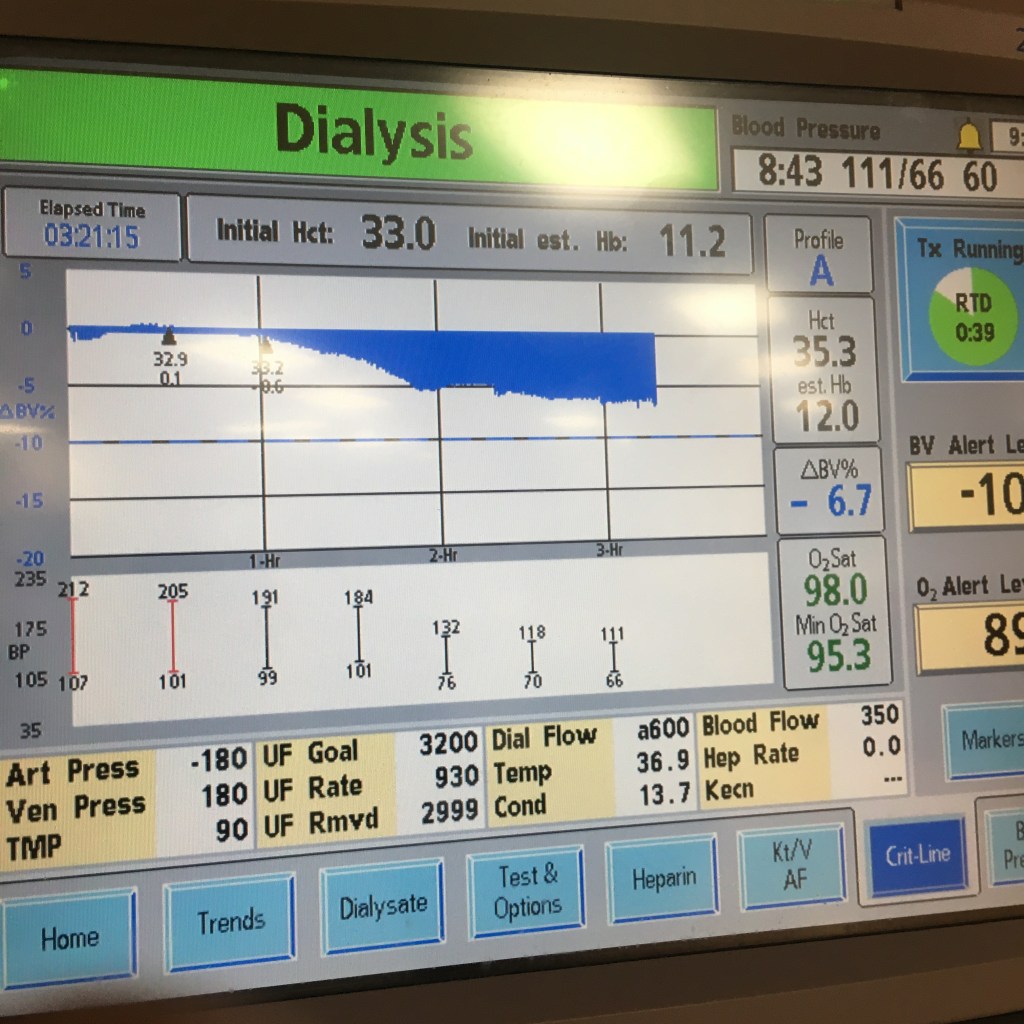
The dialysis center used the Crit-Line monitor again today to measure my change in blood volume % during dialysis. They think I still have some more fluid to take out, which matches with UCLA’s request for more “aggressive” dialysis. I went into the session at 82.0 kg, a gain of 2.8 kg over Thursday’s ending weight of 79.2 kg. We originally set the UF to 3000 mL over four hours, which is 750 mL/hour. However, the Crit-Line graph showed that there was not much change in the blood volume so we increased the rate to 1000 mL/hour, then to 1200 mL/hour.
From the photo above, you can see a definite drop in blood volume after the first hour.They ended up taking out 3217 mL of fluids in total over the four hours. You can also see the blood pressure measurements. It starts with a ridiculous 212/107 measurement, but once the blood volume starts dropping, the blood pressure also drops very quickly. At the end of hour 2, blood pressure is down to 132/76, and even lower to 111/66 at end of hour 3. I think my final systolic standing blood pressure was 103. I initially felt fine walking out but got a bit dizzy in the parking lot. I ended up getting some lunch and went to charge my car at the Santa Ana Supercharger.
I do think we’re getting close to getting rid of the excess fluid. My lower legs were on the verge of cramping today during dialysis. Maybe that’s due to the 1200 mL/hour rate. I had read that the UF rate should be kept under 10 mL/kg/hour. At ~80 kg, the maximum UF should be ~3200 mL over 4 hours or ~800 mL/hour. The supervising nurse came by and said that I’ve probably been waterlogged for a few months, and it may take a few weeks to get me back to the correct dry weight.
Just got a 10 minute lesson on fluid removal from the head dialysis nurse. There is an attachment on the machine that measures fluid volume in the blood plasma. I think the gist is that fluid is always being transported from cells to tissue space to bloodstream. However, if you can’t make urine, then the fluid stays in your bloodstream, which causes high blood pressure and excess fluid can backup in your organs (e.g, lungs).
YouTube video
This supports my theory that I’ve been losing tissue mass but retaining fluids. By keeping my “dry” weight somewhat constant, I’m actually retaining too much fluid. This was pretty evident a few months ago when I had difficultly breathing and a CAT scan showed ~500 mL of fluid in my lungs. It’s better now since they lowered my weight but it’s probably not enough. My lower leg and ankles are still swollen sometimes and my breathing is not back to 100% yet.
Crit-Line tab on dialysis machine
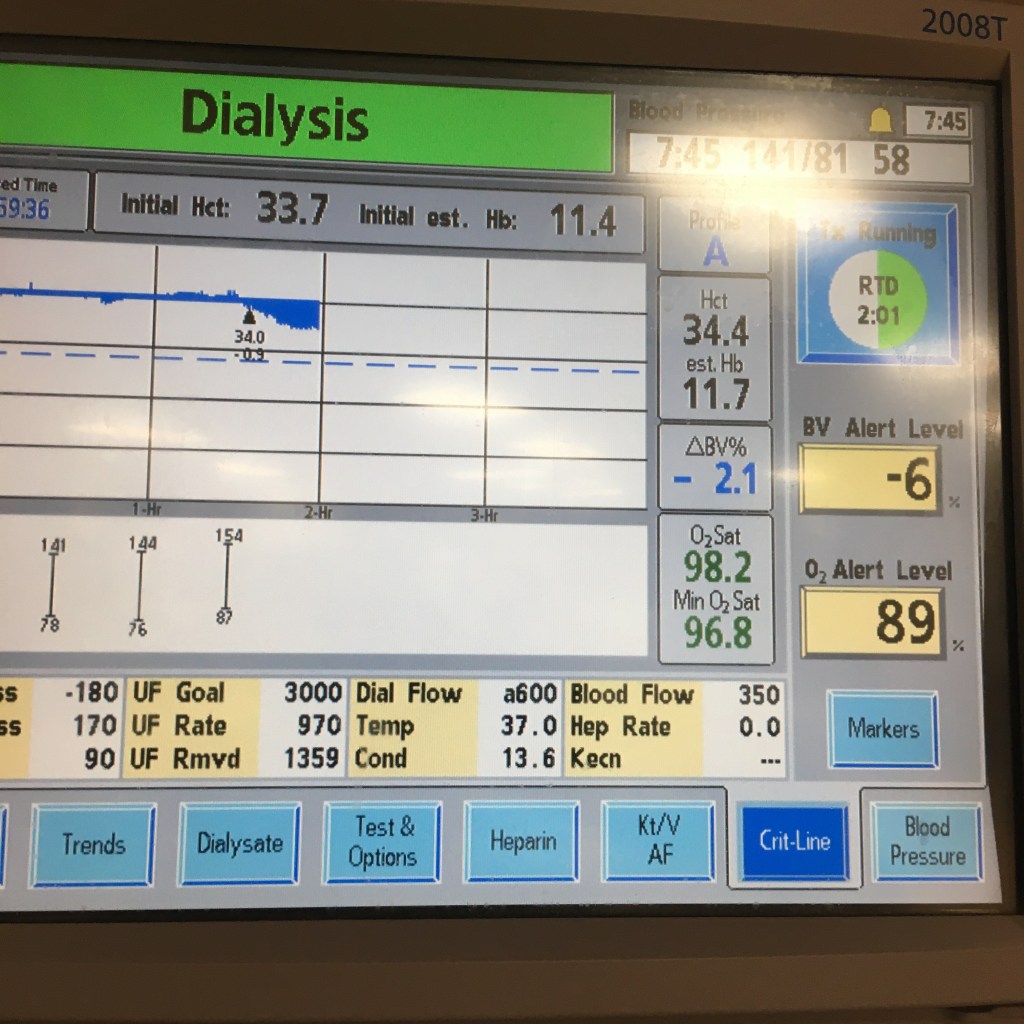
The above is a new screen on the machine that I haven’t seen before. It shows the change in fluid volume in post-dialysis blood. Before the marker on the graph, the change was around zero, which means my body was transporting the same amount of fluid to my bloodstream as the machine was removing. It’s basically saying we need to increase the rate of fluid removal to effectively reduce blood volume. I think the previous rate was 640 mL/ hour, and now it’s up to 970 mL/ hour. You can see the difference in the chart after the marker. My blood pressure is also dropping, which is normal for dialysis. I think the last systolic reading was 157 over something. Previously, since the blood volume was pretty constant and my medication for high blood pressure was being dialyzed out, my blood pressure was actually increasing. This also means that my weight post-dialysis will probably drop some more.
I did ask the nurse why they don’t run this analysis on every patient every session. She said most patients are stubborn and have lots of opinions about their treatment, especially how much fluid to remove. That seems crazy to me; why would I know more about dialysis than the nephrologist/nurse/technician? This device takes the guesswork out of determining the right amount of fluid removal. They’re going to do this a few more sessions to pinpoint the optimal fluid removal rate.
Science!
==========
We had to turn off the ultrafiltration part of dialysis about 30 minutes from the end since I was feeling dizzy, and my systolic blood pressure dropped to 103. I didn’t get a photo of the Crit-Line screen but the blue area was decreasing at the end, and my blood pressure starting increasing a bit. I think the systolic number got to 128 at the end of the session and I no longer felt dizzy. I left the dialysis center at 79.0 kg, which is the lowest weight recorded so far. We’re going to use the device again on Saturday since the nurse thinks there is more excess fluid to remove, but we’re going to start on a higher ultrafiltration rate and lower it over time, instead of starting low and going high at the end. This should reduce the risk of hypovolemic shock.
At the end of the dialysis session, after the tech removes the needles, I usually have to sit there and hold some rolled-up gauze on the needle sites to stop the bleeding. Today, the fistula bled a lot. It was probably the most I’ve ever seen of my own blood.
Since I have to sit there an hold the gauze for 10-15 minutes, I’m usually reading Reddit on my iPad. Normally I’m not looking directly at my arm. Today, I felt my arm getting warm which is unusual. When I looked over, there was a huge pool of blood under my arm. I quickly got the tech over and she managed to change the gauze. I then applied pressure again but it was still bleeding. The tech thinks my vein “rolled” away from the gauze while I was applying pressure so she stood next to my chair and held the gauze for 10 minutes. My fistula did stop bleeding after that but I wonder how much blood I lost.
I ended the session at 79.2 kg. The nephrologist lowered my dry/ideal weight again to 79.5 kg so I’m still losing weight, though not as much as the weeks right after surgery.
Got a statement of benefits from my work insurance regarding my fistulagram procedure on August 21st. The whole thing was billed at $14,261, and the Medicare rate was $5,744. My work paid 20% of that, which was $1,149. Again, not really knowledgeable about medical costs so I don’t know if that’s a fair price. I did spend a bit of time in the hospital, and was in an intervention radiology operating room with several OR nurses. However, this only covers the hospital portion. I’ll probably get another bill/claim from the vascular surgeon. Some of the line descriptions are not very detailed: Outpatient surgery, Medication, Medical equipment and supplies, etc. I wonder if I asked, someone (hospital, Medicare, Blue Shield) will send me a more detailed statement.
Also, I did a drive-thru COVID-19 test on August 18th, prior to the procedure. That was billed at $65 and the reduced Medicare cost was $33.72.
Happy to say that the fistula is working great today. The tech didn’t even use the rubber tourniquet; he just asked me to put some pressure on my arm with my finger below the elbow. Needles went in on the first try and flow has been good. No pain… yet. Thursday was like this too but something hurt really bad for a bit when the needles were taken out.
The bruise looks much better today.
Speaking of flow, my dialysis prescription is four hours at 350 mL/min, which comes out to 84 liters or ~22 gallons (US) total. All through two (relatively) small needles.
==========
Ugh. With about 30 minutes left in the session, the top of my third toe on my left foot starting hurting from neuropathy. I think it’s the first time that the pain attack started during dialysis. It was bearable but the tech saw me wince a couple of times and thought it was the dialysis needles. I had to explain that my arm is fine but my foot is killing me. Again, I took two Tylenol pills to see if I can head off the pain.
==========
The sharp pain in my arm happened again. I think tip of the bottom needle is too close to the top (venous) needle so when the tech presses down to control the bleeding post needle removal, he’s also putting pressure near the tip of the needle still in my arm and it hurts a lot. Last time he said he would pull the bottom needle out first but I guess he forgot. The pain went away as soon as he pulled out the second needle.
==========
Fortunately, the foot neuropathy pain didn’t last that long. I got some lunch on the way home from dialysis, and took a 3 hour nap after eating lunch. The pain went away sometime during the nap. This seems to be the new pattern: more nerve pain attacks but not lasting as long each time. I’m not sure if it’s the Tylenol or the leg shaking (for increased blood flow) or the calf massage that’s reducing the pain duration. It all seems kind of random; I wish there was more a cause-effect to this.
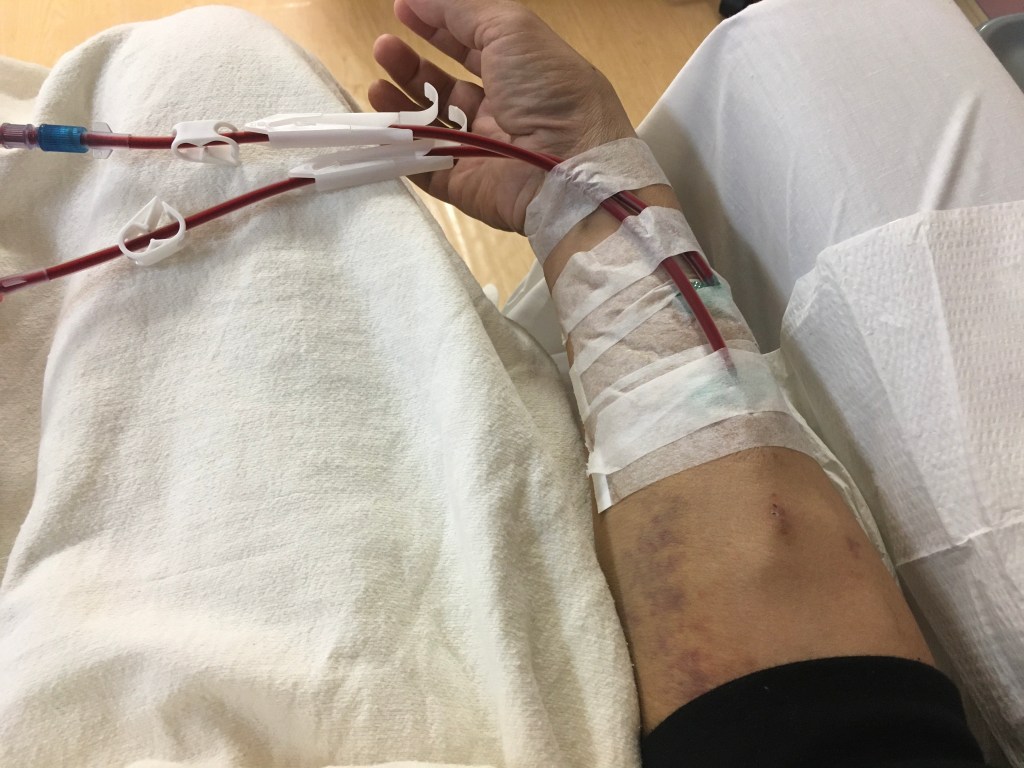
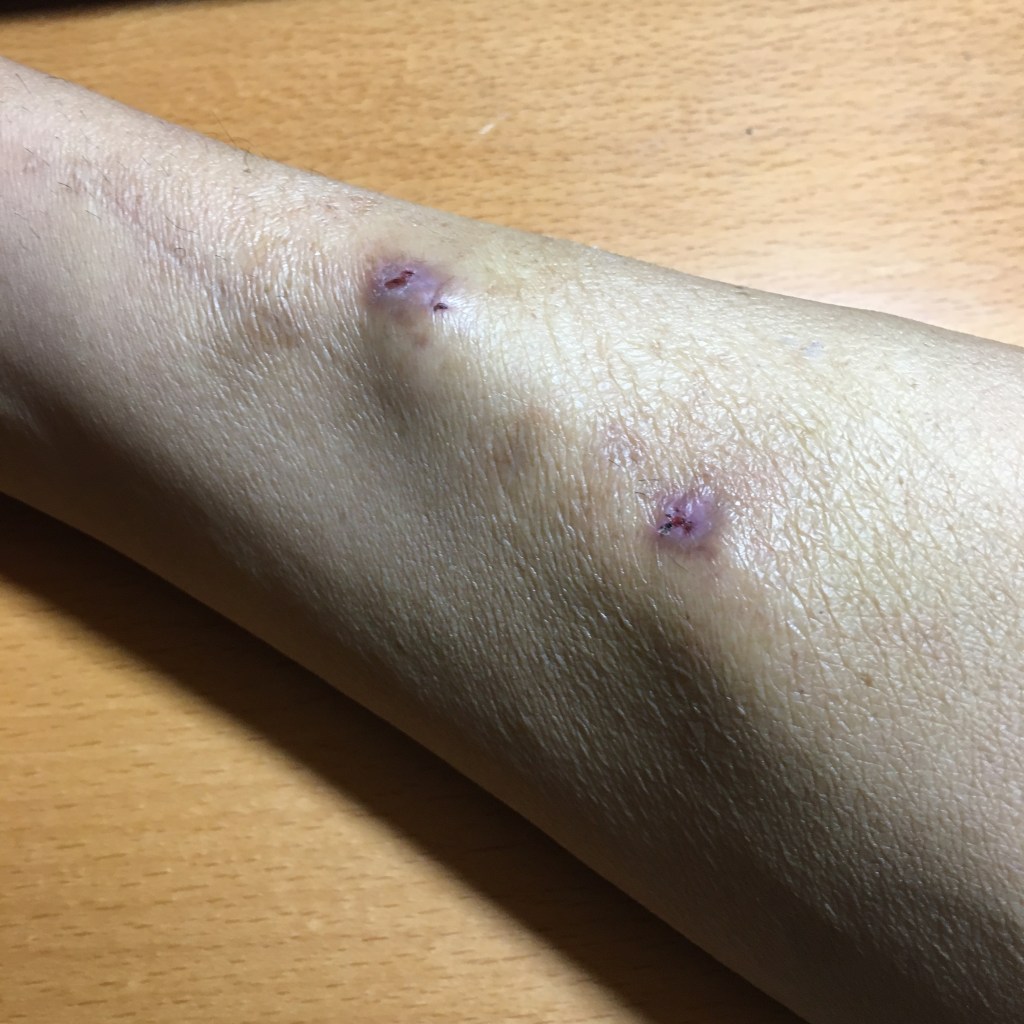
The purple spots near the elbow are bruises. It looks a bit worse this morning, but they still jabbed me in the same spot. I was instructed to put an ice pack on my arm today, then use a warm compress tomorrow to prevent the vein from hardening. I think this is from the screw up on Tuesday where the needle infiltrated the blood vessel and caused some internal bleeding. Fortunately, it just looks ugly and doesn’t hurt that much.
Also, the chaplain intern showed up today after disappearing for seven months. I’m not sure if he is still in school, or interning full-time. Unfortunately, his English didn’t get any better so I only got ~50% of our 10 minute conversation. It was difficult because I had to ask him to repeat a lot, and I don’t think he understood everything I said. Instead of asking me to repeat however, he just has a puzzled look, then keeps going with the conversation. He said he will be back to the clinic twice a week so maybe he’s making up for lost time.
Not off to a good start today. The tech that usually sticks me messed up this morning. Something happened to the return line needle after being connected to the machine. Pressure was too high or something. He tried moving the needle around a lot but to no avail, and the insertion site started to swell. I think that’s bad. He then went to the original lower site since swelling usually means the blood vessel was blown at that site. He asked me if I wanted lidocaine or just to stick it. I said, “Just stick it.” Holy shit, wrong answer. I guess I’ve always had lidocaine before needle insertion since it hurt like hell without it. The third site did work even though it hurt a lot at the beginning, and now we’re running at 350 mL/min again.
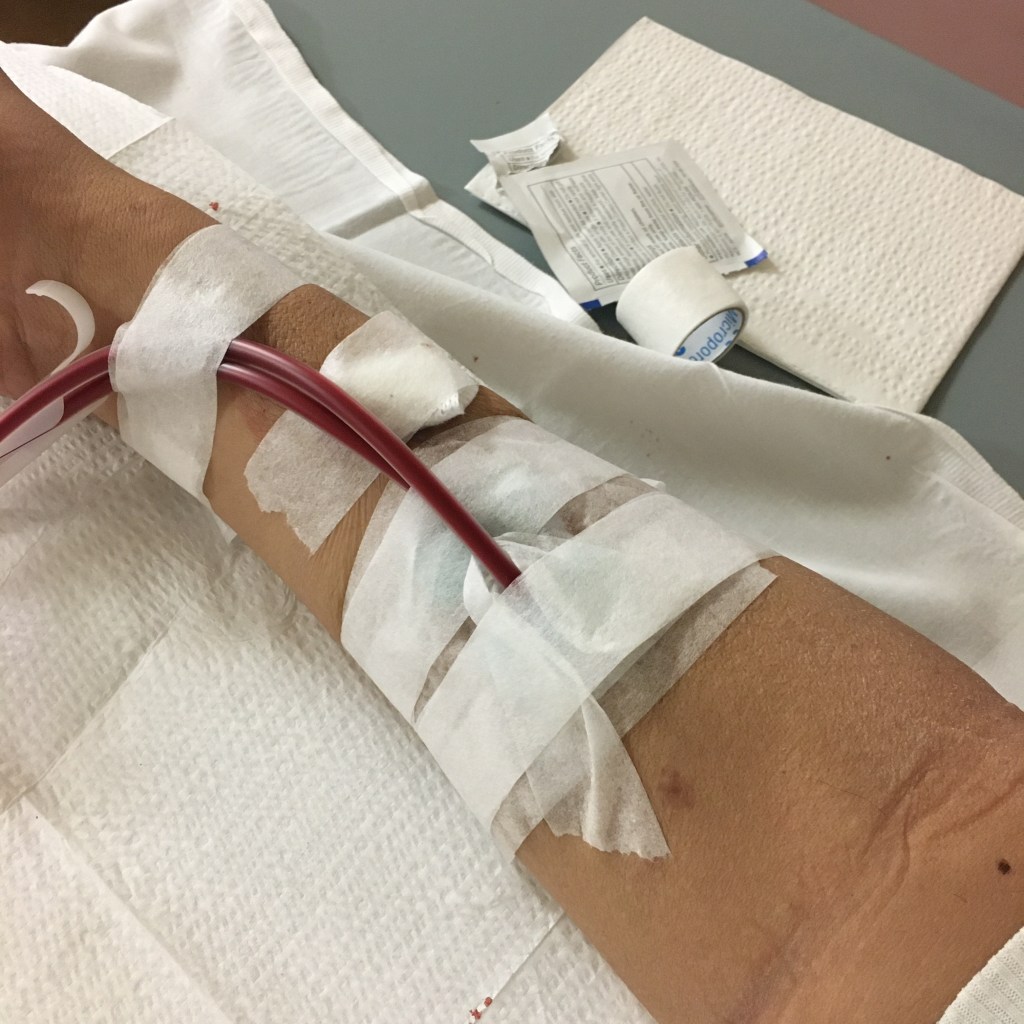
Here is my arm with three huge needles stuck in it. You can see the large bump on the top one that’s not being used.
Also, I skipped breakfast since I thought it was lab day. Turns out it’s not today so I kinda fasted for no reason. At least my blood pressure is somewhat normal today. Last reading was 133/74/56 sitting down. Three hours and twenty minutes to go.
==========
Ugh. Arm is hurting more than usual. Don’t know if it was the “no lidocaine” needle jab, or something else. I can’t tell where the pain is coming from since my arm gets cold and numb during dialysis as the blood flow is diverted away from my wrist/hand by the fistula. I’m going to try and sleep to hopefully pass the time faster.
My renal dietician came by briefly during dialysis to ask about my weight loss. The nephrologist lowered my dry weight again to 80.5 kg, and I left dialysis at 80.1 kg. My ankles are definitely a bit thinner, even after sitting, and my ending blood pressure was in range without taking the extra NIFEdipine pill. Maybe the “new” me does only weigh 175 pounds.
I told the nutritionist that I was experiencing diarrhea about half the time after drinking a protein shake, whether it’s Nepro (renal) or other brands. She said that this happens to other patients too, and to drink it more slowly. She also mentioned a second renal protein shake brand call Novasource from Nestlé. Like Nepro, there are three flavors: Vanilla, Strawberry, and Cafe Mocha. I also got two sample shakes and a discount order form from her.
Let’s compare Novasource Strawberry and Nepro Mixed Berry:
The two nutritional information charts had different formats and order so I chose the ones that I usually list in random order. The two products look fairly similar; both have low potassium and phosphorus compared to regular, non-renal protein shakes. I hope the Novasource shakes taste better. I’ve only really had the Mixed Berry Nepro, and have gotten to dislike the flavor somewhat. I used to drink them at room temperature but a lot of people online have suggested drinking it cold. It’s better cold, but the chalky aftertaste is still there.
The list price for Novasource on their website is $108 for a case of 27. The cheapest price I found on Amazon is ~$90 for 27 including shipping. The nutritionist gave me an order form directly from Nestlé that has each case for $64. Similarly, Nepro usually sells for $92 for a case of 24 but the discount price is $57. Question is why anyone would buy and drink these shakes if they’re not on dialysis?
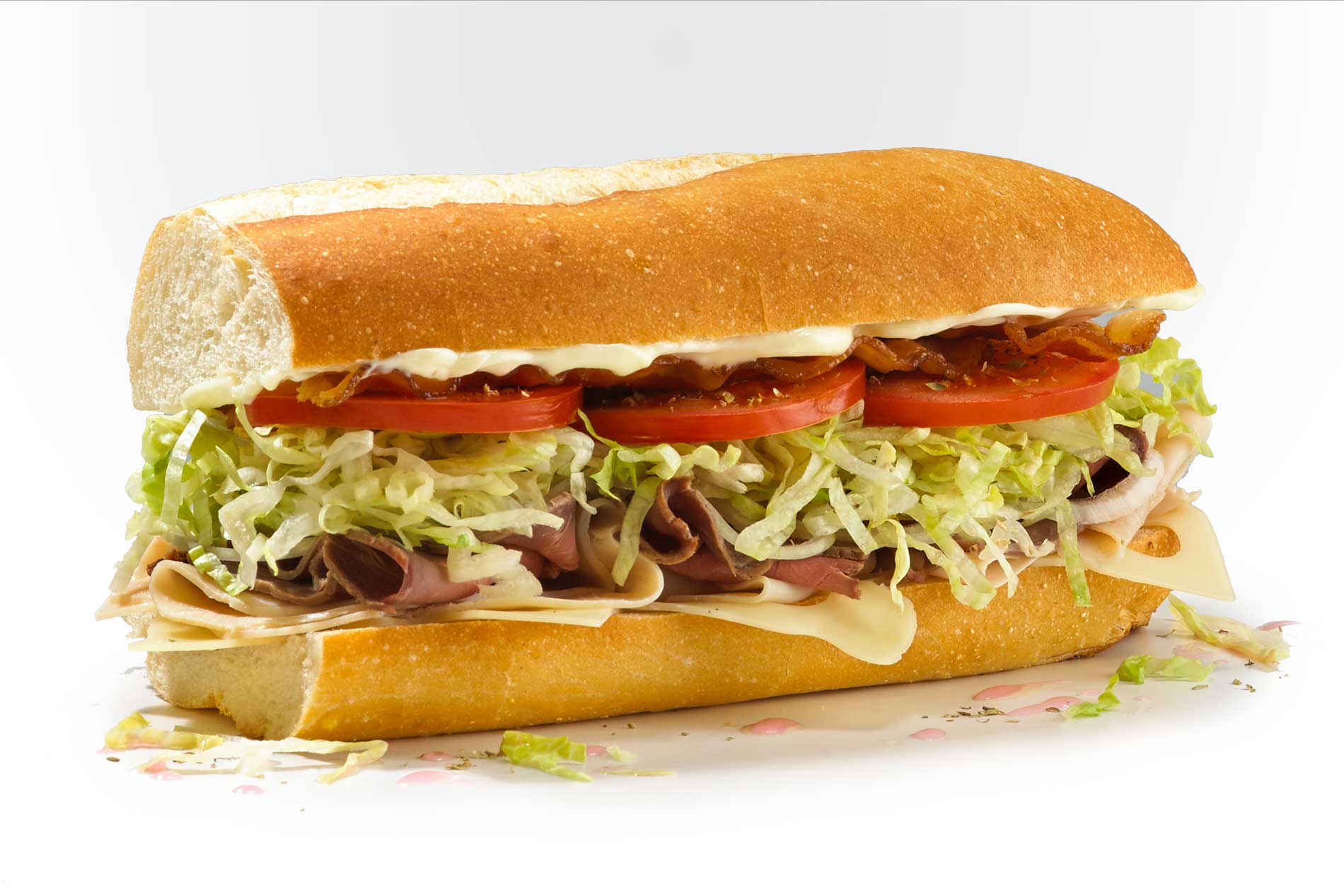
I went out and got a Jersey Mike’s sandwich for lunch. I usually just get the turkey sub but this time, I opted for the Club Supreme sub sandwich. It sounds more impressive than it really is. Just roast beef, turkey, and bacon.
I’m not going to talk about nutrition but rather weight. Jersey Mike’s sandwiches are pretty heavy. Not sure if it’s high water content in their deli meats or the vegetables, but for me, any fluid component is added to my weight. I also drank a can of soda (like I should not have), and my post lunch weight was 82.1 kg. That feels like a lot. I had one of those Jimmy Dean frozen breakfast sandwiches plus a small cup of decaf tea so everything together was about 1.0 kg or 2.2 pounds. Since a lot of the food is make of water, all that needs to come out tomorrow morning during dialysis through the machine. I think I left at 81.1 kg Saturday, so assuming the scales are somewhat similar, I’ll probably have ~2 kg to remove, and that’s okay for the three day of fluid removal.
==========
Just to reiterate how a lapse of self-control affects fluid balance. The can of soda was 355 mL and the Zojiroshi vacuum mug I used for the tea is 0.34 liters. Together that’s about 700 mL or about 1.5 pounds of fluids. Most people would just pee it out later but I can’t so assuming some of it is metabolized or lost through sweat, that adds ~0.5 kg to my fluid removal tomorrow.
Dialysis went well today. The fistula worked fine and didn’t give me any flow issues or pain. However, they had to go with the new insertion point again. The tech said the original arterial needle insertion point has scabbed over too many times and turned hard, so we may not be able to use that site again. I now see why people have fistulas that becomes unusable over time and have several fistula operations.
I didn’t get much sleep last night again so I played games for about an hour then slept until 9:15 am. This is the best kind of dialysis session, where I’m asleep for most of it. Since today is Saturday, there wasn’t a nephrologist doing rounds and waking up patients. Once again, I left the clinic at an all-time low weight of 81.1 kg. That’s about 179 pounds. I haven’t been under 180 pounds since high school probably.
I’m kind of stressed out about my heart stress test. The results look bad based on the LV EF number. I think part of me is already assuming that I will be disqualified from transplant surgery and the 3x/week dialysis sessions are going to be a permanent part of my life.
I guess I can post about this since there was no follow-up. About six weeks ago, I got a chat message on Reddit from a reporter with Pro Publica. She saw some of my posts/comments on Reddit about how long it has taken to try and get a live donor transplant. I believe she was planning on writing a story on the subjective hurdles of getting a kidney transplant. I replied agreeing that I would speak to her if she kept it anonymous since at the time, I was still waiting for UCLA Transplant Center to approve my sister as a donor. She replied that she would keep my name off the story and asked for times to contact me. I replied again with my availability, then nothing. I checked Pro Publica for her stories and she has not published anything about kidney transplants yet. Maybe the story was cancelled or delayed?
Regardless, I think we need to shed more light on this topic. The National Kidney Foundation has some depressing statistics on kidney failure. They claim that there are 2 million people on dialysis worldwide and that only represents 10% of the population that needs it. Outside of rich countries, most kidney failure patients just die. The transplant centers should be doing more transplants, not less. I’ve always felt they are trying to preserve their post-surgery scores rather than helping as many people as possible. I guess it’s hard to avoid since SRTR publishes reports like this all the time.
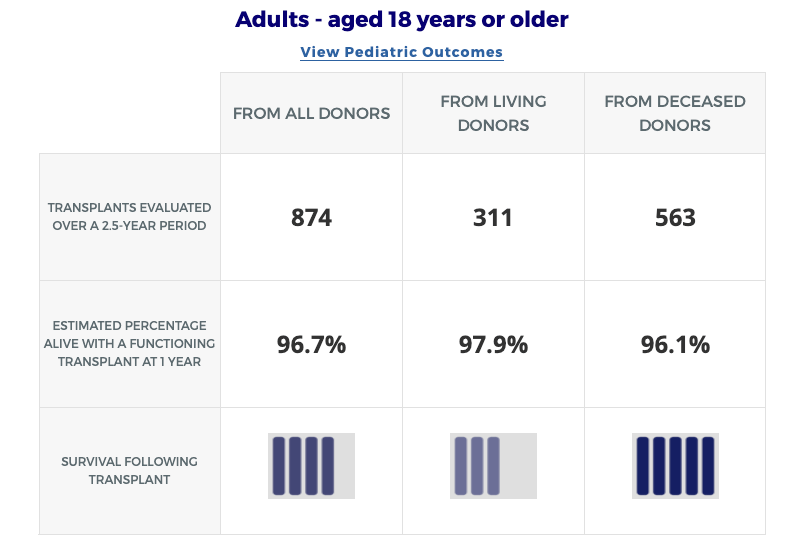
On the latest report, it says UCLA has a post-surgery survival rate of 97.9% for living donor kidney transplants. That’s pretty good but useless to me if they won’t do the transplant. I would still risk it if the number was as low as 80% since dialysis really sucks. My nephrologist said they were pretty risk adverse on transplant candidate selection. It’s a research hospital… shouldn’t they be taking more risks?
Anyway, I hope the Pro Publica story gets written and published, whether or not they include my experience. It seems like the health agencies could do more to inform people about living donor transplants and encourage new developments in kidney care and dialysis treatments. Here is a Nature paper on the state of dialysis and it’s pretty sad.
Abstract
The development of dialysis by early pioneers such as Willem Kolff and Belding Scribner set in motion several dramatic changes in the epidemiology, economics and ethical frameworks for the treatment of kidney failure. However, despite a rapid expansion in the provision of dialysis — particularly haemodialysis and most notably in high-income countries (HICs) — the rate of true patient-centred innovation has slowed. Current trends are particularly concerning from a global perspective: current costs are not sustainable, even for HICs, and globally, most people who develop kidney failure forego treatment, resulting in millions of deaths every year. Thus, there is an urgent need to develop new approaches and dialysis modalities that are cost-effective, accessible and offer improved patient outcomes. Nephrology researchers are increasingly engaging with patients to determine their priorities for meaningful outcomes that should be used to measure progress. The overarching message from this engagement is that while patients value longevity, reducing symptom burden and achieving maximal functional and social rehabilitation are prioritized more highly. In response, patients, payors, regulators and health-care systems are increasingly demanding improved value, which can only come about through true patient-centred innovation that supports high-quality, high-value care. Substantial efforts are now underway to support requisite transformative changes. These efforts need to be catalysed, promoted and fostered through international collaboration and harmonization.
When I woke up this morning, my ankles were less swollen than before. I jumped on my scale at home and it said 82.1 kg or 181 pounds. Fitbit also calculated my BMI as 25.3. I also had some slight cramping in my left ankle so maybe I’m getting close to my current “dry” weight.
I still think there is fluid in my lungs since breathing is not as easy as before but it’s definitely better. Maybe that extra 0.5 kg of fluids they removed during dialysis yesterday helped. I did sit for about an hour and a half this morning and I can feel fluid accumulating in my ankles again. I probably still need to raise my feet whenever possible. This was never a problem previously when I still urinated about 1.5 L per day. Fluid control sucks.
==========
Hmm, so the scales is a bit inaccurate. I just weighed myself again and it now says 82.6 kg. I don’t believe I ate 0.5 kg of stuff for breakfast so the scale is probably off by a bit each time I use it. Still, since I’ve been using the same scale for years, the decrease in weight over time is probably right.
Ugh. The tech didn’t get the arterial needle in right again this morning. After a bit of gauze and pressure to stop the bleeding, he managed to get it to work. However, they had to stick some more gauze under the needle to support it, so the angle of entry is weird. The result is that every minute, pretty sharp pain would shoot through my arm at the arterial needle site. It’s been 30 minutes of pain and I have three hours left. At least the blood is flowing.
==========
Just got home. I typed the above one-handed while on the dialysis chair. The four hours went by slowly. I finally fell asleep during the session just to have the rounding nephrologist wake me up. There was nothing new except he lowered my “dry” weight to 82.5 kg. I think I finished today at 82.7 kg, but my legs are still a bit swollen. Ugh, how much excess fluid do I have?
I picked up a 4-kabob family combo from Panini Kabob Grill after dialysis since my cousin and his wife are visiting us for lunch. They went to see their daughter (I guess that would be my niece) in San Diego, and they’re driving home to the Bay Area. I talked to them for awhile but I can’t eat lunch right now. I have the Lexiscan test later this afternoon and the technician wants me to fast beforehand in case I have a reaction to the injection and vomit.
It’s about 11:45 am now so I have to leave in about 40 minutes. The arterial insertion site was hurting all session long and it’s still hurting even now. Also, when the tech pulled out the venous needle, it hurt really bad. Today was just a painful day. I wish they could have kept me on the chest catheter for a bit longer.
This is going to be about politics and a little bit about dialysis. We’re slightly over a month away from the November elections and once again, California has a ton of propositions on the ballot. I hate propositions since it’s so easy for special interest to manipulate. However, with the Democrat supermajority in California, the state legislature is a one-party system where only one point of view matters and there’s effectively no political opposition.
For California propositions, there are many websites claiming to provide information, but most are totally biased. Ballotpedia seems to be the least biased and here is their website for California 2020. My normal reaction to ballot propositions is to vote no unless it is super compelling, since it’s usually sponsored by groups that will benefit monetarily or want to bypass a law they do not like.
Specifically, I wanted to comment about Proposition 23 since it impacts dialysis centers. This is the third ballot proposition sponsored by SEIU-UHW West or Service Employees International Union, United Healthcare Workers West (not linking to these a$$holes) as part of their fight to gain a foothold in DaVita and other for-profit dialysis centers. All the propositions are flawed since they all impose additional costs on dialysis centers in order to force them to compromise on allowing SIEU to form a union. This particular proposition aims to have a full-time physician at each dialysis clinic. Currently, a nephrologist from each office will do weekly rounds and talk to patients about their care. This is totally sufficient. During dialysis, 99% of the time you are just sitting there. When there is an emergency, the clinic can call for a paramedic since an on-site doctor won’t be able to do much anyway. All this proposition does is increase operating costs for dialysis providers until they cry uncle and let the union in. I hate unions, especially SEIU since they’ve been trying for three years to gain political power on the lives of dialysis patients. All the nurses and techs at my dialysis clinic were/are against all these SIEU proposed propositions.
The other proposition that I’m pretty adamant about is Proposition 16. This is the proposition trying to overturn Proposition 209 passed many years ago by a Republican administration. If you look at the supporters, it’s just about every Democratic politician. I am totally against affirmative action, which to me, is just discrimination in reverse. I am voting no on this one too. If you want to see the results of racial preferences, just read up on the story of King/Drew Medical Center where identity politics overruled medical competence. .
Even though my breathing is a bit easier, there’s probably still some fluid in my lungs from looking at my lower legs. If you push down on my ankle with your finger, it still leaves an indentation for a few minutes, which means edema. The dialysis center has been “challenging” my weight for a few weeks and today, I finished at 83.2 kg using their scale.
I thought my ankles were going to cramp a few times but maybe they were just stiff. I really don’t like the fistula since I’ve never had any pain using the chest catheter. I don’t think I can do home hemodialysis since it’s so hard to get the needles right. Sigh, if the transplant doesn’t happen, then I’m probably stuck with in-clinic hemodialysis for several more years.
My fistula failed this morning. The tech could not get any blood flow from the arterial needle. She tried several times but was unable to get the needle in the right place. One of the supervising nurses decided to go up higher on my forearm and create a new insertion point outside of the area suggested by the vascular surgeon. Even though they used lidocaine, it hurt a lot when the needle was inserter. Fortunately, she was able to get good blood flow and we used the new site as the venous site since it was higher up in the arm. However, it did hurt pretty badly for the rest of the session, and I was told not to move my arm since it was a new site. They were afraid the blood vessel would collapse then I would be without a fistula. Not sure what happens after that? Skip a day of dialysis? Go to the hospital for another chest catheter?
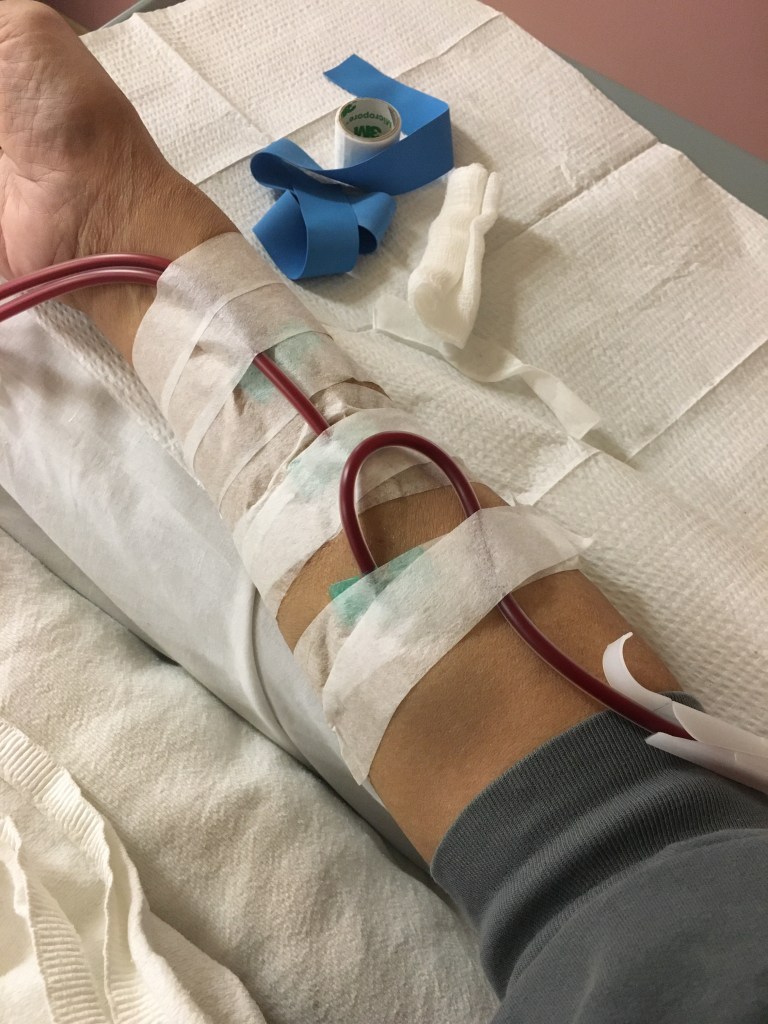
The gauze wad (second set of tape from the wrist) was the blown site. The tech had removed the first needle since I said it was hurting. They were going to leave all three needles in until the end of the session. As usual, there was quite a lot of bleeding but that stopped quickly. I tried to sleep but each of the three needle sites were painful so I was awake most of the time.
Here’s what my arm looks like the previous day. There’s persistent scabbing on both exit sites, and the vein underneath is very visible. It’s hard to see in the photo but the vein protrudes out quite a bit. I’m thinking of putting on a band-aid over the needles sites for cosmetic reasons since I look like an IV drug user with all the marks on my arm. Hopefully some of this will fade post-transplant.
I guess I’m using this title (Fistula Update) for general dialysis updates. Today was pretty uneventful. There was some pain in my arm and a bit of bleeding during the session but nothing noticeable. There was some problem with the arterial line at the beginning but the tech moved the needle a bit and it seemed to work fine afterwards. I was pretty tired again and semi-slept through about two hours of dialysis.
For some reason, the latest lab results are not on the patient portal. One of the nurses told me that my kT/V was 1.27 and URR was about 66%. Once again, I just barely passed the bar of 1.2 for kT/V and 65% for URR. That pretty much means they won’t be shortening my dialysis time in the near future. Maybe if they run the machine at a higher flow rate.
Blood pressure was weird again. I started at about 130 and again, it gradually increased to 182. At about 9:15 am, I took 10 mg of NIFEdipine and by 10:00 am, it was back down to 120’s. I think the final standing reading was 13o-something. My doctor friend also mentioned the importance of fluid balance so maybe my BP will stabilize once they remove some more fluids from me. I left dialysis today at 83.8 kg.
Each day after dialysis, as they’re removing the needles, the tech would ball up a piece of 2×2 gauze and tape it down on the exit site. I would then have to put pressure on the gauze for about 10-15 minutes to stop the bleeding. Then they would put a ton of tape to continue to apply pressure on the gauze. When I get home, I would remove the gauze after about six hours.
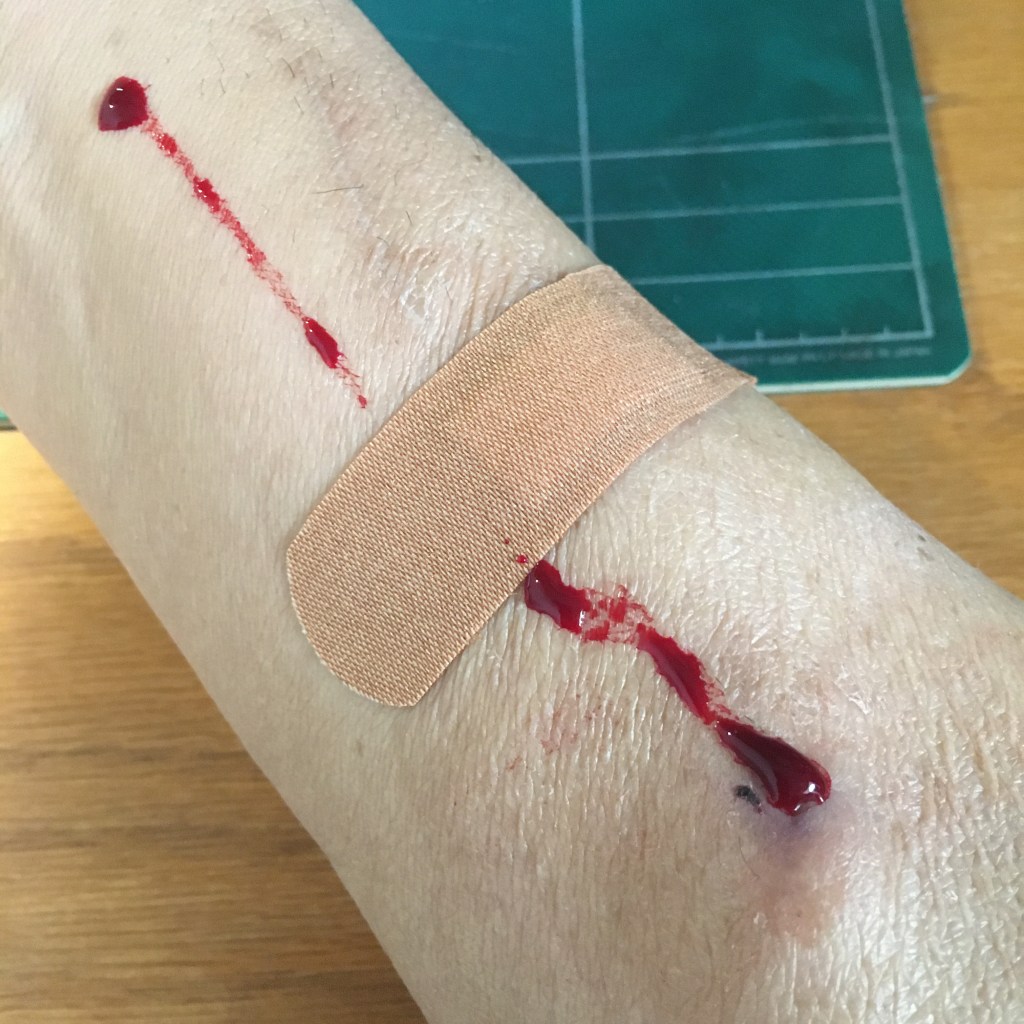
Well, ever since I started using the fistula, each time I remove the gauze, one or both of the needle exit sites would still ooze blood. Usually I would wipe up the excess blood, and put a band-aid on it. Sometimes the blood would overwhelm the small band-aid so I would have to change it. This means going through a lot of band-aid strips. I have a drawer full of medical supplies and there are about 10 boxes of assorted band-aids.
Today, the upper exit site was bleeding a bit. Like an idiot, I put the band-aid at the wrong place so it kept bleeding. Good thing none of the blood dropped on the carpet.
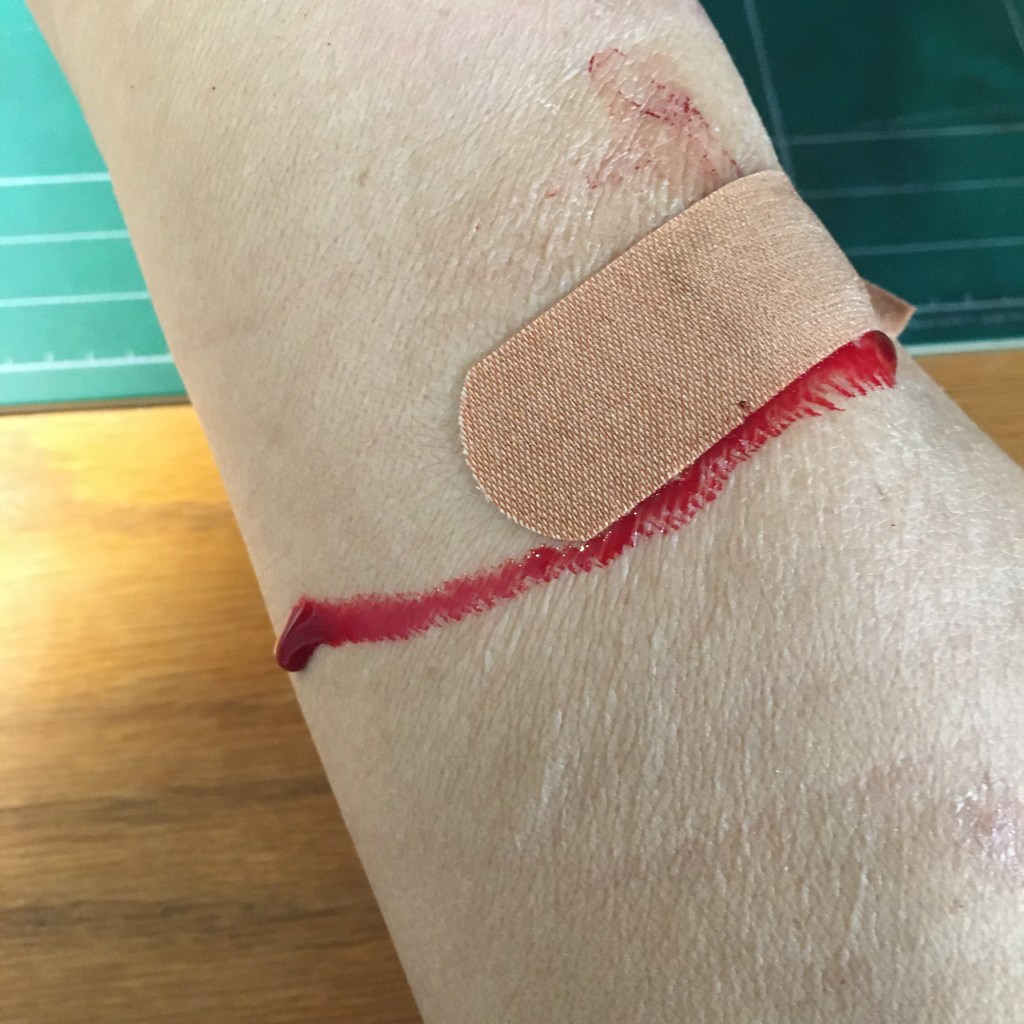
Dang it. The band-aid is on the right exit site but the blood has saturated the small gauze pad and is now leaking out. I’ll need to stop the bleeding first and change the band-aid again.
==========
I now have a piece of balled up gauze held down my medical tape on my arm, much like at the dialysis clinic. I’ll keep this on for about 15 minutes to see if the bleeding stops. There sure are a lot of side issues to deal with during dialysis.
==========
Aiya! It’s almost 8:00 pm and I’m still bleeding. I had a piece of gauze on the exit site for a few hours then put another band-aid on but just saw blood flowing out under it again. I now have yet another piece of rolled up gauze on my arm. I guess we’ll try again and see if I can get it to stop bleeding this time.
I spoke with my nephrologist today during dialysis since she was the doctor doing rounds. She lowered my dry weight some more to 84.5 kg since my blood pressure was still on the high side, and there seems to be some fluid in my lungs/chest cavity. For some reason, she could see the results of my CT scan from last week in the computer system, even though I have not received a call from the thoracic surgeon’s office. My nephrologist read the results to me. Other than the fluid, there wasn’t anything else abnormal. Probably the fluid is causing the shortness of breath, and maybe the extra pressure in the chest cavity. She also commented that my ankles look more bloated than before. She agrees with my gut feeling that I am losing tissue mass but retaining more fluid so my overall weight remains pretty constant. We will keep lowering the dry weight until I can’t take it anymore, i.e., cramping. Today, I weighted out at 83.9 kg, another low record.
I am feeling much better than a few weeks ago when I first called the thoracic surgeon’s office. Probably we removed some of the excess fluid from me so I can breath easier. Maybe I will get to 80.0 kg before transplant day.
==========
My blood pressure is still a mystery though. This morning, I measured my BP twice and both times it was 120/70. I then ate some oatmeal for breakfast, and took my two morning BP pills. When I got to the dialysis center, my first standing BP reading was 110/70. After sitting down for awhile, it was about 132/70. However, each half-hour measurement after that showed an increasing BP, even though the machine was removing fluids from my bloodstream. At the end of the session, I had a BP of 182/something. It doesn’t make any sense unless the low blood pressure was due to the NIFEdipine I took last night. It is the extended release version but that’s a long time to be still active. Is dialysis flushing out the remaining NIFEdipine plus the two medications I took in the morning? I asked my nephrologist and she didn’t really give me an answer. I think they’re hoping once we remove a few more kilograms of fluid, everything will stabilize themselves. In the past, I use to have borderline hypotension after dialysis, and had to sit for up to 30 minutes drinking water to raise my BP. Now they’re happy if my BP is under 160. Crazy.

 Life with chronic diseases