I noticed it again today. During dialysis, my right hand would get very cold. My hand would feel cold to me, and is actually cold to the touch. Blood to the hand was already diminished due to the fistula. It joined an artery to a vein in my lower arm so there is less blood flowing to the hand. The surgeon said to notify his office if I had a lot of numbness in that hand, but I’ve been okay so far. While on dialysis, the blood is drawn and put back near the same place in the blood vessel so I don’t know why it would make the coldness worse. Maybe it’s psychological.
It’s really staring to become more noticeable and is not very comfortable. I’m thinking of wearing gloves a glove on my right hand to keep it warm. We’ll see what the dialysis techs think of my idea.
==========
Other than the cold hand, dialysis went pretty well today. There was some intermittent pain in one of the needle sites but if I don’t move my arm, the pain is minimal. Likewise, when the tech removed the needles, it only hurt when she pushed down too hard on the gauze to prevent bleeding.
Did I mention before that I hate this fistula? I know everyone dislikes the chest catheter for being an infection risk but for the patient, it’s much easier. There are no needles to stick in you and zero pain.
The fistula started leaking as soon as it was connected. The tech did miss on the first try for the arterial needle but the venous connection started leaking. I could see a bubble of blood grow under the medical tape. It was slowing expanding and was going to leak blood all over unless the tech changed the tape. Next, the arterial needle started leaking but slowly so we left it until the end. When the tech finally pulled the tape off, there were large chunks of coagulated blood stuck to the needle site. Also, the arterial needle site was hurting the entire session. I tried to sleep but was worried about leaking blood everywhere.
It was a long four hours. At least my cardiologist’s office called me to okay the tooth extraction so the fun is not over yet for today.
Okay, today was a blood letting for sure. The arterial needle started bleeding about 30 minutes into the session. I was looking at my iPad so I didn’t notice until there was a nice pool of blood under my arm. The tech came by to clean up a bit and replace the tape holding the needle. Not after 20 minutes, it started bleeding again, soaking through all the tape and bandage. She changed me again and this time it held until the end of the session. At lease I’m not squeamish about blood; that would suck for a dialysis technician.
I think dialysis is barely working for me. I’m still at four hours each session which appears to be the longest of any patient at the center. The last set of labs had my URR at 68.1%. The value needs to be at least 65% and they increase my time when I don’t hit the goal. I think since I’m over, they should be able to reduce the time. We know that peritoneal dialysis doesn’t work for me at all. I guess the last thing to try is home hemodialysis but I (or my caretaker) would have to be able to stick the needles in my fistula consistently. I don’t know if they can put another chest catheter in the same spot since they inserted and removed two catheters there already. I guess the reality is that the fistula has to work since I am running out of options for dialysis.
I haven’t seen her for a few days but today, she walked into the dialysis center with help. I saw the same leg braces she was wearing when she walked out last time. Hopefully this means she’s on the road to recovery.
Why am I writing so many posts about someone whose name I don’t even know? I guess I’m afraid that whatever happens to the other dialysis patients will eventually happen to me if I don’t get a kidney transplant. It’s easy to ignore on a day-to-day basis but the ugly mortality numbers are always there in my mind. It feels like I’m walking in a minefield blindfolded, not sure when the next explosion will happen. I’m finding out about all these complications from dialysis that my nephrologist never told me about. I doubt it would have made any difference on medical decisions though. I had thought dialysis meant a “normal” life… ha! Dialysis just barely keeps you alive, if alive means exhausted all the time and susceptible to a bunch of new health issues.
Since the chest catheter was removed on Tuesday, this was the first dialysis session where all I had for access was the fistula. I told the tech that there’s no backup today. In the past, if something went wrong with the fistula, we could always move one or both dialysis lines to the catheter. Not so today. Anyway, the needles went in fine, and everything worked. There wasn’t even any bleeding today from the arterial needle, but there was the occasional mystery pain in the arm. It wasn’t too bad.
Since the nephrologist lowered my dry weight on Tuesday, we thought we would try to get ahead of it, or “challenge” me. I finished the session at 85.5 kg, another low weight mark. Yet my ankles are still swollen so maybe there is a few extra kg of fluid to remove.
==========
It’s now about 6:30 pm. I left this unpublished for several hours while I fell asleep. I’m still very tired but the nap went well. Breathing was a bit easier so I was able to sleep for a few hours without waking up every 30 minutes. I removed the post-dialysis bandages and only one needle prick point was bleeding. I also changed the bandage for the catheter exit site. There was still a tiny bit of blood so the hold should seal in a few more days.
Second chest catheter removed. It was much easier than removing the first one in the hospital. I went into the doctor’s office, sat in a reclining chair, and the nurse laid me flat. The only problem was she stuck a pillow under my back so to arch my back, but that made breathing 100x harder. I think I was going to pass out a few times. Then the surgeon came in with his assistant, who I’ve met several times. I think the surgeon was more interested in my fistula that he worked on then the catheter (he didn’t put that in). He told me the assistant will remove the catheter, and that I need more fluids taken out since my ankles were swollen. OK, thanks. He’s got to know I’m a dialysis patient and there are literally a team of people watching for edema in my legs.
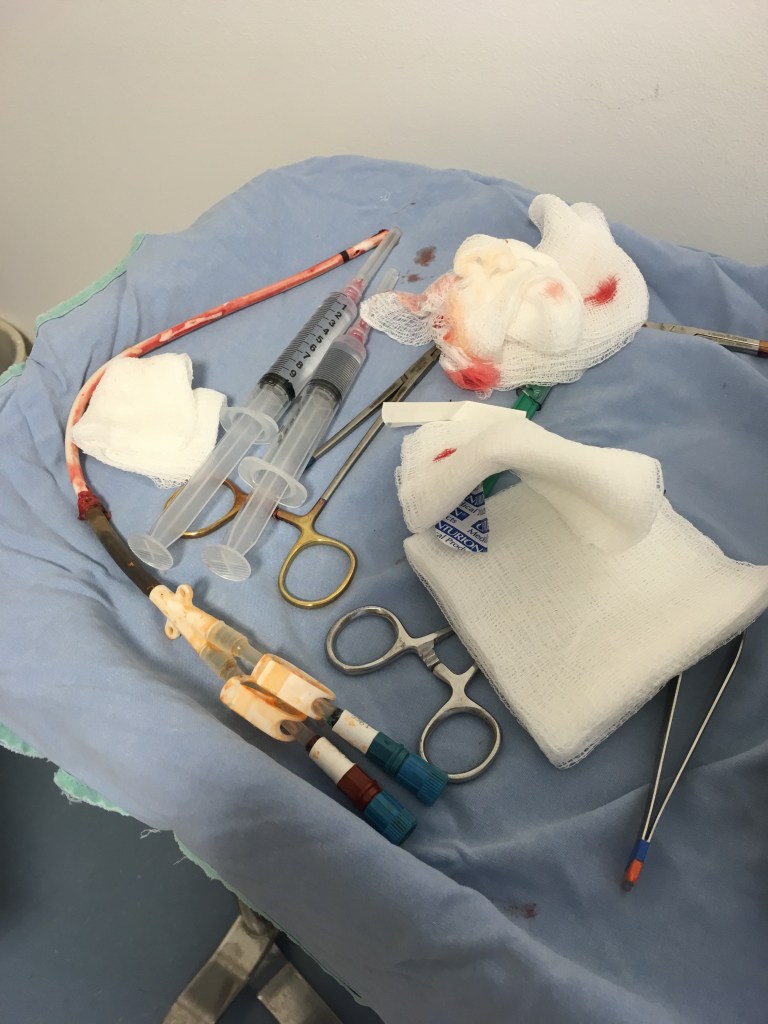
The assistant, let’s call him “J”, gave me several shots of lidocaine, the wonder local anesthesia, and proceeded to cut the sutures holding the catheter in. I think some of the flesh grew in around the catheter cuff so he had to cut around that too. Then J gave a hard tug, and it was out. Only problem? No one mentioned to him that I was on a blood thinner, and of course no one told me to hold the medication. Blood started squirting out of the opening. I didn’t see this but J told me later. He had to grab a lot of gauze and bandage to stop the bleeding, even asking me to put pressure on the wound. Good thing I didn’t pass out from the lack of oxygen. I was already breathing hard; putting pressure on my chest just made it even worse. Finally, after three gauze changes and lots of pressure bandage tape, the bleeding stopped and I was allowed to get up… and breath. Even thought J tried to wipe it down, there was quite a bit of blood on the chair. After dialysis with the fistula though, I was used to it. No pics this time, I was too busy trying to breath and not pass out. Here’s a photo after the previous catheter was removed if anyone is interested. I assume this one was similar; I didn’t even look afterwards.
Finally, they let me get up and leave, after giving me an instruction sheet. One of the item says: “Do not lay flat for 12 hours after catheter removal to reduce likelihood of bleeding.” Arg! Why did they schedule me for a 4:30 pm catheter removal, knowing that I have to sit upright until 5:00 am the next morning?! I can’t lay flat anyway but they didn’t know that. Other points are pretty normal post-op stuff.
So, another tiny chapter in my life comes to a close. I kinda like the catheter versus the fistula, even though I couldn’t take showers. I heard other people do shower with waterproof tape, bags, and other homemade contraptions to keep the catheter dry. I’m too nervous to try. Maybe that’s why I’ve never gotten an infection after 2.5 years of using the chest catheter. Supposedly I can take a shower after 24 hours, even if the hole in my chest hasn’t fully closed. yet. Hmm… I think I’ll wait. No point having shower water running through a hole and into your chest cavity.
Sigh. Occasionally I have days that are hard to get through. Nothing has changed overnight but I just get fed up about everything. Right now, it’s the heart issues and what seems to be too much fluid in me. I know some people have real scary diseases that cannot be managed. My issues are more like a very slow moving train but it’s hitting new stuff on the tracks. It seems like there is an answer to everything that ails me but the totality is overwhelming sometimes.
For several weeks now, I’ve been having more and more trouble breathing while lying down. For awhile, I could get by sleeping on my right but slowly, that’s not working either. It’s 3:40 am and I haven’t slept one bit. I’ve been trying to get the bed into a position that allow me to breath a bit but have not found it. As soon as my head hits the pillow, I’m gasping for air. Plus the pressure on my chest seems to be increasing as well. I’m pretty positive it’s not the heart itself since I walked 15 minutes on the treadmill last night and felt mostly fine, while bending over to pick up laundry winds me.
Then there’s the swelling in my ankles and feet that seems to be persistent. Post heart surgery, I was pretty bloated and it took a few extra dialysis sessions to bet rid of the excess fluid. Since March, it seems the fluid retention has gotten worse even thought my weight has dropped. I think my real weight (without fluids) is even lower since I’ve been eating a lot less, and I still have too much fluids in me. I haven’t come close to the amount of cramping as before on hemodialysis. Maybe I can ask the nurse to pull more fluids out today, or see if I can talk to a nephrologist since it’s Tuesday.
The current situation is that I run out of breath kind of randomly, probably based more on body position than exertion. My doctor friend thinks it may be the chest wall healing and constricting, while my cardiologist thinks it’s musculoskeletal too. I need to call today to set up that CT scan so the thoracic surgeon can see what happened. The excess fluid is just uncomfortable since I can feel the extra pressure as more nephropathy. I think the danger is that the skin will stretch out and crack, and I’ll get several spots where infections can take hold. Infection of the feet for diabetics is bad news.
3:51 am. Maybe I can sneak in a 30 minute nap before leaving for dialysis. Another week of life in paradise…
Today was the second to last day of dialysis with the chest catheter still intact. Even though we’re not using it, it’s good to know it’s there in case the fistula becomes troublesome. The needles went in pretty smoothly today, but there was some sharp pain in the arterial line as we started dialysis. This is the line that leaked blood all over the place last session. I guess the pain should have warned me that there will be bloodletting today too.
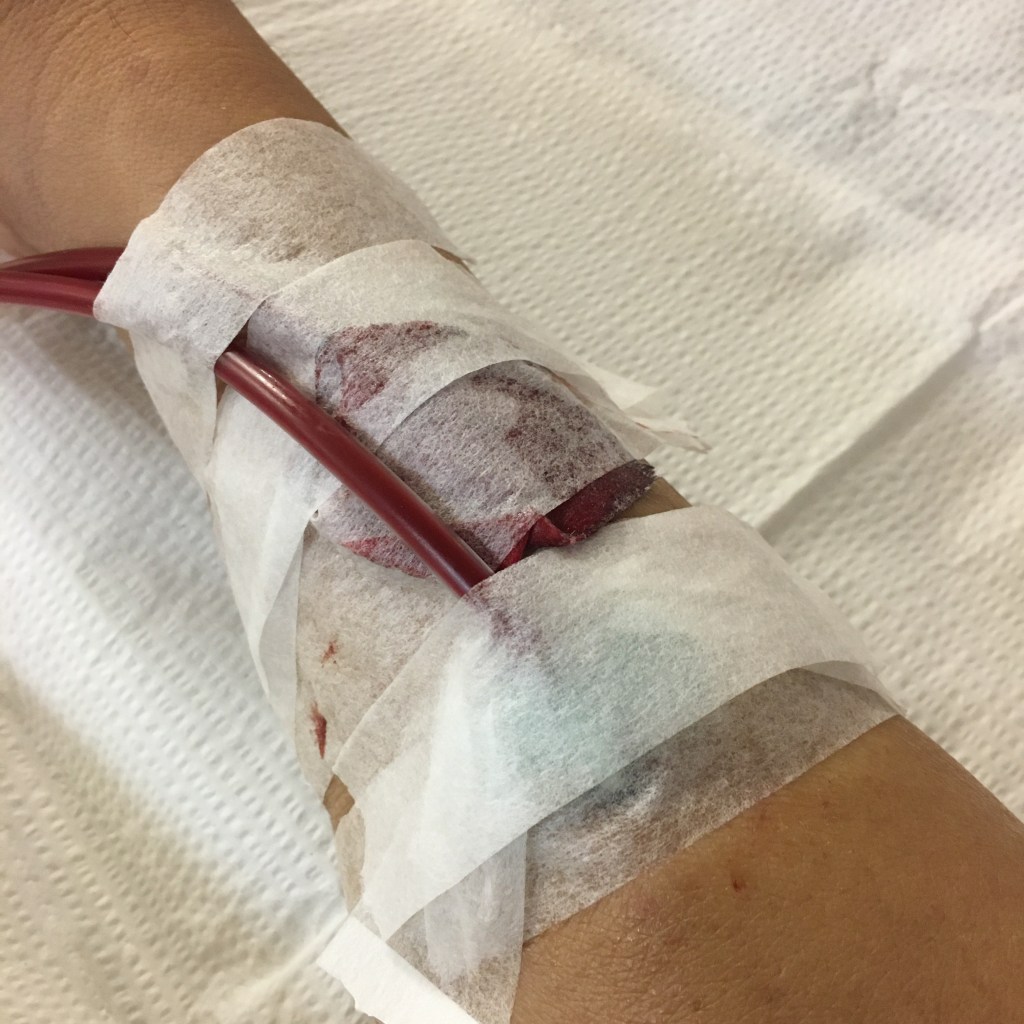
I was so tired from not sleeping that I fell asleep right away but woke up at ~7:00 am. I looked at my right arm and there was a trickle of blood coming from the arterial line again. I called the nurse and she cleaned it up, this time putting a alcohol pad on the insertion point as well. About two hours later, I look again and both the pad and the tapes seemed saturated with blood. I got a picture this time but it’s pretty gross. I don’t know how to embed photos other than as an inline graphic so no room for a trigger warning.
This was all coming from the lower needle; the upper venous line was doing great. By now, most of the blood had clotted so the tech said to leave it until the end when she removed the needles. There was still sharp pain coming from that area for the rest of the session and a lot of blood when she finally took all the tape off. Nobody was concerned though so not sure if it’s a big deal if it leaks each session. I’m just afraid I’ll fall asleep and bleed all over the floor.
Okay, I’m exaggerating but there was a lot of blood. About three hours into the dialysis session, I noticed that there was a growing bloodstain on the waterproof napkin they were using to line the dialysis side tables. I looked at my arm and the lower needle (arterial) was leaking blood. I pushed the call button, much like in an airplane but not quite, and the tech came over to help. She said that leaks happen occasionally and it was nothing to worry about. She proceeded to get some alcohol swabs and wiped away all the blood running down my arm. She then replaced the medical tape holding the needle down, and promised me that she would finish cleaning up when the session was over.
I wasn’t too bad. The bleeding had stopped when she changed the tape, and post-dialysis clean up was pretty easy. Still, it was weird watching your own blood leak out of a rubber tubing and not being able to stop it. I really don’t like this fistula but since the chest catheter is coming out Tuesday, I’m stuck with no other options going forward.
Not yet. The procedure is scheduled for next Tuesday. This time, the vascular surgeon will take it out in his office. Last time, I had to go to the hospital, which means at least a 4 hour wait. Th doctor took it out in the pre-op room anyway, so it wasn’t a full OR experience. This time,it should be much faster. Hello hot showers, again.
The dialysis center also removed my one suture from the fistulagram last Friday. The head nurse did it and commented that it didn’t even bleed when he removed the one stitch. As always, he talked to me aboutTesla since he bought a Model 3 while I was here before.
The fistula works much better now too. The tech was able to cannulate me on the first try for both needles and run the machine at 350 mL/min without any alarms.
==========
Update: 8/28/2020 3:45 pm
I don’t think I shared this photo before since it’s kinda gross, and it was taken before I started this blog. This was the previous catheter after it was removed form my chest. The procedure was done in the pre-op room at St. Joseph hospital. They were prepping me like I was going into an OR. I was wearing a hospital gown and I think they stuck an IV needle in me. Then the surgeon walks into the room, gives me a local anesthesia shot, then yanked the catheter out. I think he asked me if I wanted to keep it. Uh, no.
Catheter is the long white thing on the left of the picture. The bottom part were the ports that stuck out of my chest.
It didn’t hurt coming out but it did feel weird. I thought there would be more blood since it was sitting in a large vein for the past 20 months. This time, I’m only going to a doctor’s office to remove it. The actual hole in the chest should close up in a few days so may a week for the first shower in many months?
It’s 11:00 pm and I have try and sleep now, with dialysis in about six hours. I think this problem definitely has something to do with the heart surgery since the keloid on the scar is starting to hurt. I don’t think I’ve experienced this in the nine months since surgery. The chest pressure symptom has always been there in one manner or another, but it’s a lot more pronounced. Over the course of the day today, I tried take a nap several times. Either the shortness of breath gets worse until I have to sit up to breath, or I fall asleep somehow for a hour before waking, still as tired as ever. The cardiologist didn’t call me back yet but usually it takes them two days to reply. I hope I can get some sleep tonight so I don’t have to sleep on the dialysis chair for four hours.
I saw the girl patient that was brought in on a stretcher walk on Tuesday. It was after dialysis and she was walking out of the dialysis center to a car in the parking lot. She had pretty large leg braces on both legs and was using a walker. I had to use a walker for several weeks after the heart surgery. Anyway, she was walking super slow since she could not bend her knees, and it looked exhausting. Did something else happen? Was that complications from dialysis treatment?
Well, on Thursday, she was wheeled in and out on a stretcher again. I’ve only seen her try to walk that one time. Same thing Saturday: in and out on a stretcher. Maybe she’s not healed enough for walking yet, or whatever condition she has got worse. Ugh, if kidney failure doesn’t kill you, dialysis slowly will. That is why I’m pissed off at UCLA right now. Unless the medical director tells us something surprising, I think they just wasted two years of my life on dialysis.
And f*ck Trump for getting our hopes up with his executive order on kidney transplants and home dialysis last year… then not following up with anything. What was the point of the totally useless executive order? Nothing has changed.
At dialysis yesterday, the tech was able to get both needles in the blood vessel on the first try, however the arterial needle seemed to have high pressure again. She went and got the OG tech, and he was able to readjust the needle so it flowed much better. They haven’t use the chest catheter for over a week now. I’m getting worried that if they don’t flush it soon, it may clot and won’t work if we need it again.
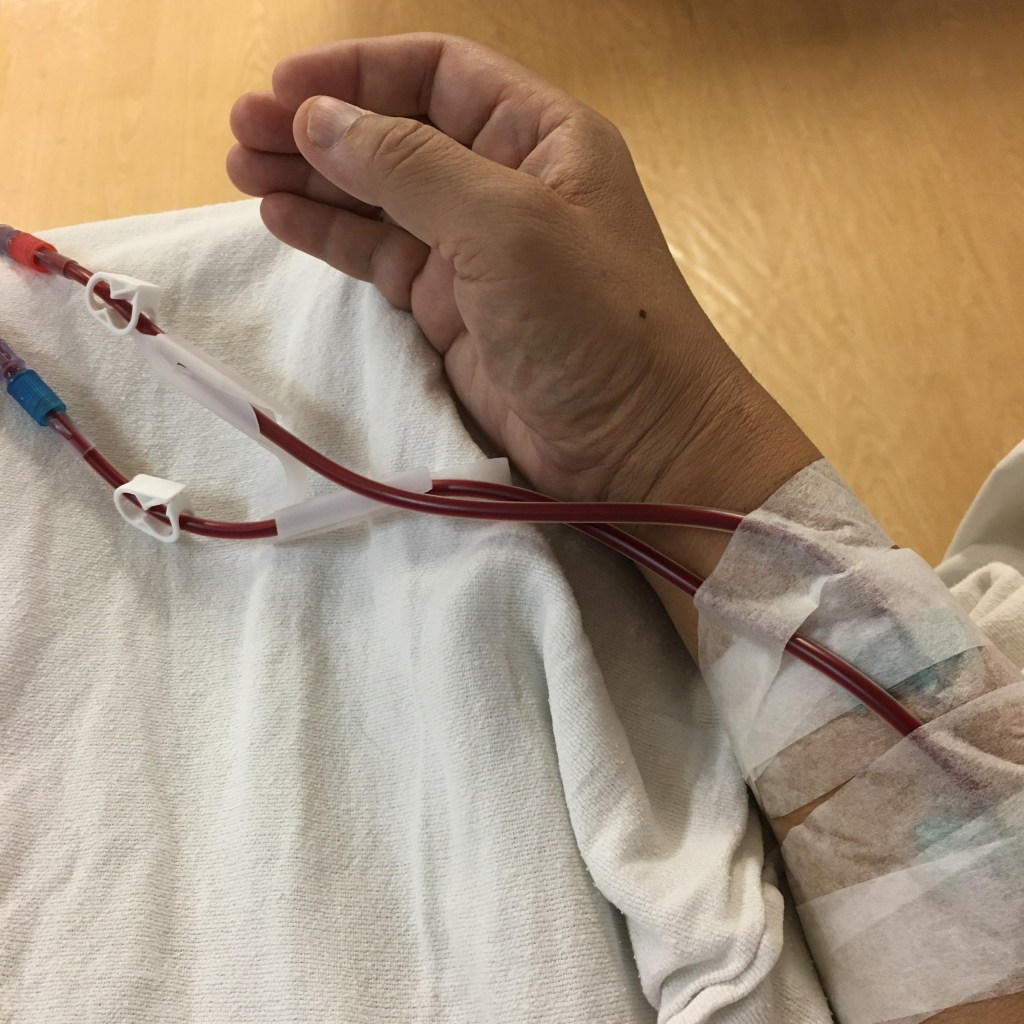
My lifelines, literally
Also, the tip of the upper needle looked like it was getting pretty close to the fistulagram incision site. Right after hooking me up to the machine, the incision site started to hurt. I think it was still healing from the cut and to have that much blood flow near it wasn’t good. The pain subsided in a bit but occasionally I would get a brief shooting pain near the lower needle. That went on until late in the night last but hasn’t come back yet.
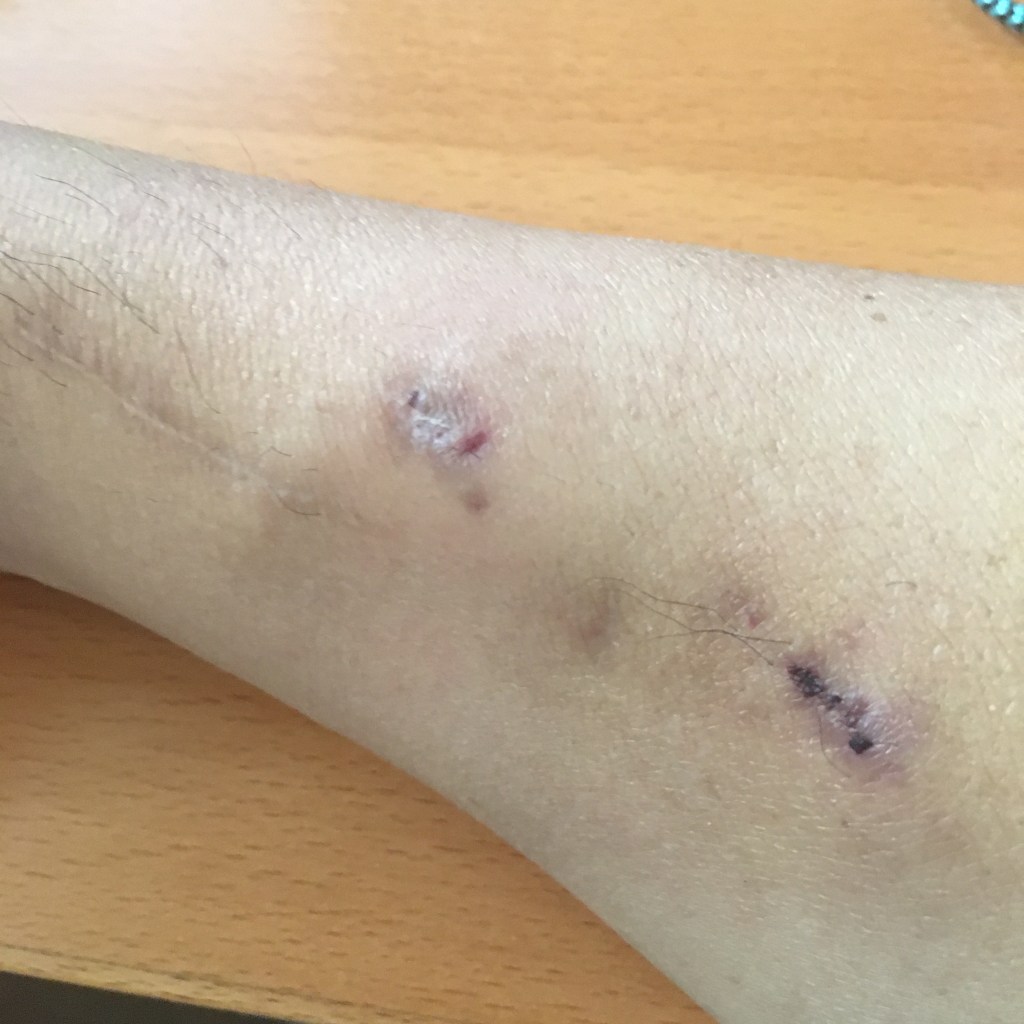
Again, I really don’t like the fistula. It’s ugly and it hurts a lot more than the catheter. No one has shown me the actual statistics for the infection rate for the different access methods. I’m pretty sure infections are more serious with the catheter but is it common? What about compared to all the complications that can happen with a fistula? I also think poking the needle in the same spot all the time can’t be good. The scabs covering the insertion site never heals and there are permanent dark spots on my arm from the repeated cannulations. Even after I get a transplant, those fistula scars will probably never go away. Lovely. Another scar to add to the many on my upper torso: long open heart surgery scar, exit sites for heart fluid draining tubes, peritoneal dialysis catheter port, and two holes for hemodialysis chest catheters on my upper right chest. I feel like Frankenstein.
Hmm, I feel like I can start a new blog just for daily fistula updates. At the dialysis center, the techs rotate pods (areas) once every three months. The tech that has the most success cannulating me is actually in another pod currently. He usually comes over when he has free time to insert needles in my arm. That’s why my nurse usually connected me through the catheter first so I can start the dialysis treatment, then switch the access point if he is successful.
Today, the tech that’s actually in my pod currently wanted to try again, and she was successful on the first try on both needles. There must still be some differences in technique because it hurt a lot more, even with a lidocaine shot. Once in though, the fistula worked pretty well at the 350 mL/min rate. The nurse still thinks there may be a problem with the fistula, even though they have been pretty successful in using it.
This is what my fistula looks like right now. It’s hard to see in a photo but there are definite bulges where the vein is developing. You can totally feel the blood rushing through the vein and also hear it. They insert the needle in the same spot each day so it keeps scabbing over and the scar never heals.
Which brings me to my scheduled fistulagram tomorrow. Not sure what is involved but I would feel rather stupid if the surgeon can’t find anything wrong since it seems to be working now. Likewise, I’m not sure what to say if he wants to go in again to do something since I don’t want another surgery unless it’s a kidney transplant.
Hmm, I often hear people brag that if California was a separate nation, it would be ranked #5 (2019) in the world between Germany and India. If this economy is dependent on electricity, why can’t we figure out how to provide a stable and inexpensive source of power after all this time? I got this email from SoCal Edison this morning:
We need your help. Very hot weather is expected to continue for most of Southern California through Wednesday, causing stress on the power grid. Since this heatwave began, the California Independent System Operator (CAISO) has issued two statewide Stage 3 emergencies and directed SCE to reduce its electrical power load, including through rotating outages of customers.
I know there rolling blackouts at work on Friday, and I heard that some neighborhoods in Tustin had their power shut off for about an hour. It’s probably people running their air conditioners more hours than usual. CALISO has a lot of interesting information. Here is today’s forecast:
I guess the problem is the gap between forecasted peak demand (49,726 MW) and available capacity (44,426 MW). If so, the gap is over 5,000 MW. It’s even more interesting if you look at the supply and demand curves by hour. Here is Friday’s data:
The demand peaks at around 5-6 pm, probably when people get home from work, fire up the AC, and start cooking dinner. I know our house had the AC going basically 24 hours since mid last week. At the same time, a large part of the supply starts to drop off (green line). That’s our renewable power supply, which is mostly solar. Solar generation peaks during noon at about 11,000 MW and drops off to basically zero after 7:00 pm, just when there’s peak demand. You can see we have to start up all the natural gas generation plants to fill the gap.
So is California’s focus on solar power wrong? I have about 3.7 MW of solar panels on my house so unless my AC is running or I’m charging the car, I’m a net producer during the day. Ironically, I wanted more panels on my install but Edison would only allow me 12 panels. I managed to get 14 installed but I still don’t know why they limited the solar supply, especially when we still have rolling blackouts. When the AC is on, I don’t generate nearly enough power to compensate, thanks to Edison’s restrictions.
Where’s nuclear power? If you look at the supply chart, there is a flat dark blue line of ~2,250 MW. This is the Diablo Canyon Power Plant near San Luis Obispo, the only nuclear power plant in California since San Onofre shut down. Diablo Canyon is also scheduled to be shut down, seemingly due to protests from environmentalists. I’m a big supporter of renewable energy. I installed solar panels on my house, and I drive a 100% electric vehicle. I have not gone to the gas station in almost four years and ~60,000 miles. But it’s got to make economic sense. I think the vitriolic opposition to nuclear power is stupid and short-sighted. We should be focused on more research for safer and cleaner power, with the goal of fusion power that runs off seawater. Instead, we build tons of solar farms that are only good during the day. At least the sky is sunny most of the time in Southern California. Could be worse…
I thought a lot about this when I was on PD. The cycler needed to stay on for 10+ hours each night. What if the power goes out? I think it shuts off after 30 minutes or something and you’re supposed to skip dialysis for that day. What if power goes out for > one hour each night of the week? Do all the patients just get sick or die? I looked into a battery backup but it appeared I needed either a huge data center backup unit, or a Tesla Powerwall. How many dialysis patients can afford that on their own? If I ever consider home hemodialysis, this will become a concern again.
==========
I ended up paying ~$850 for electricity in June. That’s for all the net usage for 12 months since I have solar panels. At $0.20/kW, thats about 4.25 MW of electricity I had to pull from the grid last year since I don’t generate enough with only 14 panels to cover my usage. Wish you had those MW today huh, Edison?
==========
Update: 3:30 pm
Just got another email from Edison warning customers of pending blackouts. Of course they only say it will be an hour long but not the location. Do they not plan this out ahead of time or do they throw darts at a map and shut down areas at random? I think I’ve heard that they do not want to give criminals a heads up of areas that will be without power, but you also don’t let your customers prepare either.
If you look at CALISO now, the forecasted peak demand is 47,264 MW versus an updated available capacity of 50,632 MW. It seems like they always over-forecast the peak demand and find additional supply. At first, I thought CALISO just spent money and bought power from other sources outside the region but that had gone down steadily since 6:00 am. Instead, there is a huge ramp in natural gas power production. Is there new capacity brought online just now? Can’t they forecast this with any degree of accuracy?
Our AC is still on and has been all day. I have not charged my car yet. I already have the charging set up so if I plug it in during the day, the car will wait until after midnight to charge. Since I have flat electricity rates by hour, I mainly did it to reduce the load on the house wiring. I thought the AC would be off by midnight so I can avoid running 100 amps through the breaker box. Both are on dual 50 A breakers.
The email mentioned the alert period lasts until midnight but the critical times are from 5:00 pm to 8:00 pm. Let see if the lights start going off in about an hour. I have my cable modem and Wifi router on a battery backup so I can still blog in the dark for a few hours if the power goes out. Probably sweating profusely but I’ll have Internet.
I was a bit upset with my nurse this morning at dialysis. The one tech who has the most success sticking me got both needles in Thursday so it felt that my scheduled COVID-19 test, quarantine, and fistulagram next week was mainly due to her complaints about my fistula. Since the tech was busy, she hooked me up with the catheter first, then another (there are several) tech tried to stick me. It looked good at first but again, the pressure spiked when the lines were connected to the machine. We had to go one-and-one again, using one needle and one port on the catheter. Ugh, maybe I do need to find out what’s wrong since I may need this fistula for several years.
I also managed to fall asleep awhile ago. All the staff decided at that time to wake me up to sing happy birthday, like at a restaurant. Didn’t expect that since I’ve never heard them do that before. Then they sang for another patient that had a birthday recently too. It was a nice gesture but I hate when people sing happy birthday for me. Now I can’t fall back asleep and there’s over an hour left in the session.
Speaking of how dialysis can go badly, I saw this post on the r/dialysis subreddit:
I wrote a few times into this subreddit, but I have to share my problem with you. I started my journey in 2003. and as a kid I got a Catheter into my left side to try to help to my kidneys to work with plasmapheresis, because I have FSGS (this causes that I can’t get a transplant third time, because I had 2x tranplants and both failed in this disease). The catheter scarred my internal vein, so I got a stent. After I went through other diseases, I had a stomach perforation and a pancreas tumor (not cancer, but I don’t know the word), for 6+ months I was in the hospital, I had a permacath in my right side, when the doctors tried to save my life, they destroyed my veins on my arms (I don’t blame them). After they cured me (I was only 29 kg at this time, height 168 cm), they helped me to gain weight and I left the hospital when I was 17 years old and when I turned 18 they could make me a fistula, which worked 5 years, after it clotted the surgeon elevated my vena basilica, but my stent couldn’t handle the high blood flow (the previous fistula had lower flow) and my vein collapsed again and my hand was swollen, like a body builders hand, the skin never healed on that arm so my doctors closed the fistula. Permacath again for a short period, because they found a vein on my right hand and the surgery was successful and now it became its end. It worked 6 years and my surgeon told me there is no other option( no place for graft or anything ), only a Tesio Catheter: http://www.medcompnet.com/products/long_term/bio-flex_tesio.html , but I’m afraid, in my country there is no option for fistula on the leg, if my right vein fails, my life will be over, I mean they can put catheter into my groin, but what kind of life is that…
Holy shit. I know I complain a lot on this blog about how crappy my life is but I also admit that there are lots of patients who are worse off. My first catheter worked fine for 20 months. I had to go to the hospital to get it unclogged a few times but that’s just more sitting around. PD didn’t work eventually but I didn’t really have too many issues with the catheter or process, and did not get any infections. It’s been about 9 months now since I’m back on hemodialysis and again, the catheter is working great. My fistula is iffy but works when the needles are inserted correctly. Maybe we’ll find out more with the fistulagram next week.
I couldn’t imagine having all my access options fail. Dialysis sucks but short of a kidney transplant, there is no other solution to stay alive. I’d be freaked out if all the access points failed one after another. I think the original poster above thinks he is going to die and it seems like he’s in his late 20’s. Again, I didn’t start dialysis until I was 49 so at least I lived a semi-normal life until then.
I really think more resources should be spent on coming up with an implantable artificial kidney. Even the iHemo half-solution is better than hemodialysis today. Also, if the government would support PSA’s about live kidney donations as they did for drinking & driving and teen smoking, there would be a lot more live transplants and save a lot of patients from grief and risk of death. And we would save a ton on Medicare costs.
Just got a call from the vascular surgeon’s office. He wants me to get a fistulagram, which appears to be a dye-enhanced X-ray of the fistula. It’s scheduled for next Friday at 7:30 am which means be at the hospital by 5:30 am. I also have to do another COVID-19 test, this time in the hospital ER, then quarantine myself until the procedure by not going anywhere other than home and dialysis. I guess no follow-up dentist appointments next week.
As all this is going on, my fistula worked fine today. The tech used regular 16-gauge needles and was able to stick both needles in on the first try. They were also able to run at 350 mL/min without causing any error alarms for the entire four hours. In fact, they didn’t even hook me up with the catheter, and they even drew blood for labs from the fistula. It was a bit painful and itchy however.
I don’t think this is the last step yet. It’s just for him to go look at possible narrowing of the blood vessel and to see if there are clots. If not, there still a chance of more surgery. Dang it.
Another election means another dialysis related proposition on the ballot. This time it’s Proposition 23. Like Proposition 8 in 2018, this ballot measure is again sponsored by SEIU-UHW West, a labor union that is trying to organize at DaVita and Fresenius and their dialysis clinics. Proposition 8 was an attempt to limit dialysis center profits to 115% of costs. All I remember was that all the nurses and technicians at my dialysis center were opposed to it. My clinic is part of a non-profit hospital so they were not part of DaVita or Fresenius. I’m not sure if they are unionized as part of the hospital staff since sometimes they do cover at the dialysis unit in the hospital.
Reading through Proposition 23, it seems like the requests are reasonable, such has having a doctor on-site. However, having spent two and a half years on in-center hemodialysis, the proposal won’t matter much. We already have nephrologists doing rounds once a week, sometimes more often. There are several registered nurses on-site and if anything happens, it’s usually an emergency and the staff will call 911 for paramedics. Maybe it’s because we’re right next to a hospital, there is an emergency room 30 seconds away. I never felt medically neglected during dialysis sessions. The other requirement about reporting infections, I thought that was done already. Medicare has an entire website that compares the over 6,000 dialysis centers in the US.
In the end, this proposition, like Prop 8 that failed, is just SEIU trying to gain more members and more power. I don’t think they actually give a shit about the patients. Organizing and bringing in membership dues is their main priority. These propositions are aimed at lowering the profit margins for the commercial dialysis centers so they will negotiate with the union. It will probably hurt small or non-profit dialysis centers since many are not making money if they have a large % of Medicare patients. I’ll check with the nurses again but I’m pretty sure they will want me to vote no on this propositions too.
The tech that’s been gone for three weeks was back today. I thought someone said medical leave but he told me he was on vacation. He went on vacation back in April; do dialysis techs get a lot of vacation days in addition to working only three days a week?
He came by at around 7:00 am to stick me. Originally I though my dialysis nurse was going to do it. At first glance, it looked like he was successful on both needles. However, once hooked up the machine, the arterial line had pressure issues. After adjusting it for awhile, he gave up and they used the chest catheter to pull blood from my body. He did say that he should have used the regular needle instead of the short one since my artery seems to be deeper down, though a huge blood vessel bulge is developing at the site. Someone else prepped the medical supplies this morning and I think he just used whatever was at my chair.
The only problem is that the arterial needle site is hurting, even three hours after dialysis. I don’t know if he poked around too much or what. At least I’ll get a break on Thursday since it’s monthly lab day and they like to use the catheter to make sure I get a good cleaning. He said he’ll try again this Saturday. Can’t wait…


 Life with chronic diseases