SPR Weight Loss

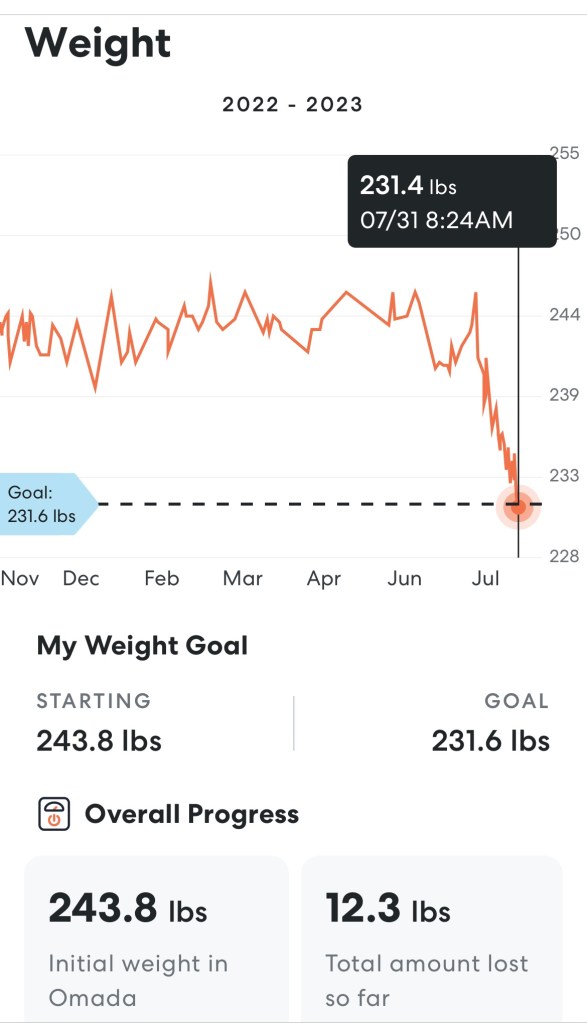
Last November, I signed up for a program called Omada through my online pharmacy. I posted about it here. The goal was to eat healthy and exercise to lose weight. I believe I posted a few things the first week, then promptly ignored the rest of the emails. I kept weighing myself and the mobile connected scale kept track. Here is my weight history. The original goal was probably lose 5% of my weight.

I started the SPR program on July 10th, which is the last high spike before the large drop. In three weeks, I have lost twelve pounds or about four pounds a week. My first goal was actually 200 pounds so if I keep losing weight at the same rate, I may be able to hit the forty-pound weight loss goal. Likely the weight loss will slow but I would be happy if I lost another fifteen pounds. That would bring me to 215 pounds or thirty off my high.

As for the program, I am still having issues with my burned fingers, and now my fistula is hurting. I can still feel the “thrill” a bit, but I cannot hear the fistula anymore. I hope it is temporary; I do not want to visit the vascular surgeon at this point post-transplant.

UCLA Appointment Postponed

I had a call schedule with UCLA Transplant Center about the Natera Prospera program. I was asked to join a study post-transplant, and this is the first time the sponsoring doctor has scheduled an appointment to talk about it. Here is a description from Natera’s website:

Covered by Medicare, Prospera is a transplant rejection assessment test that uses a simple blood draw to evaluate the risk of rejection of a transplanted kidney.

Through the use of advanced cell-free DNA technology, Prospera increases a provider’s ability to identify otherwise undetected rejection that might lead to kidney loss. Catching transplant rejection as soon as possible can help providers develop a treatment plan to best protect the donated kidney.

https://www.natera.com/organ-health/prospera-organ-transplantation-assessment/

I think it is informative that the first sentence tells patients that Medicare covers the cost of the test. Since Medicare coverage only lasts three years after the kidney transplant, maybe that is the topic of discussion today.

Anyway, I joined the call at 9:55 am for a 10:00 am call. I then waited for twenty minutes before another doctor called me on the phone saying the doctor I was supposed to speak with was delayed and we needed to postpone it to 11:45 am. Doctors are busy people so I totaly understand last minute schedule changes. I just wish they would have called me earlier, so I did not have to sit in front of my iPhone waiting for twenty-fine minutes.

Nephrologist Visit 20230428

I had my quarterly nephrologist visit today. It went well and I only had one prescription change to increase my Losartan dosage to 100 mL. I did my labs last week and the results were similar to previous tests. Here are some of the items that are still out-of-range:

  • Creatinine: 1.50 mg/dL
  • eGFR: 55
  • Potassium: 5.4 mmol/L
  • Urea nitrogen (BUN): 31 mg/dL
  • Hematocrit: 51.0%
  • Vitamin D: 27 ng/mL

All the other stuff were within Quest Diagnostic’s normal range.

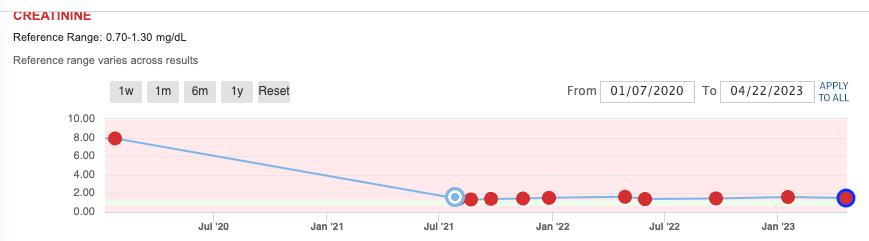
The most important test result is probably for creatinine. This is a major indicator of kidney failure. Normal range is below 1.30 mg/dL for males. Post-transplant, my results have been from 1.40 to 1.60. Both the UCLA transplant team and my local nephrologist are good with this result. They are more worried if the number changes quickly for the worse. My blood pressure has been higher lately hence the increased Losartan dosage.

My nephrologist is also giving me a referral for a sleep study. I have been a snorer for as long as I can remember, and my sister said I sometimes stop breathing when I sleep. I have been very tired post-transplant so maybe my undiagnosed sleep apnea and anti-rejection medication is preventing me from sleeping well at night.

==========

I also got a reply from my endocrinologist. I have not seen her in about a year and all my prescriptions are running out. Previously, her office sent my continuous glucose monitor (CGM) to Edgepark because the reader and sensor were considered durable medical equipment (DME). I hate Edgepark. It has been a huge struggle to get anything priced and delivered. I managed to get a reader and fourteen sensor discs from them over the past twelve months. Since my prescription ran out, they were unwilling or unable to get a refill and instead cancelled my order. Sigh.

In my endocrinologist’s reply, she said she sent refills for my insulin and regular glucose test strip to my online pharmacy. She also sent a CGM sensor refill order to the pharmacy instead of Edgepark. I hope that gets processed.

I think the DME part of the prescription was the dedicated Libre 2 reader. Ironically, there was a warning sent out as the reader’s Lithium battery may overheat and catch on fire. Now I am using the Libre app on my iPhone to read the sensor, which means that I did not need the dedicated reader in the first place. Stupid.

Medical Insurance: DEXA

Since I am taking prednisone for anti-rejection, my nephrologist asked me to get a DEXA scan to check my bone density. I read online that taking prednisone long-term has many side effects, including osteoporosis.

The National Osteoporosis Foundation (NOF) recommends obtaining a DEXA if a patient is on prednisone or an equivalent of 5 mg/day or greater for 3 or more months.

https://www.rheumatologyadvisor.com/home/decision-support-in-medicine/rheumatology/steroid-induced-osteoporosis/#:~:text=The%20National%20Osteoporosis%20Foundation%20(NOF,for%203%20or%20more%20months.

So today I called the St. Joseph outpatient pavilion to schedule an appointment. I get most of my scans done in the second-floor radiology department. After being put on hold for five minutes, I was told the diagnosis code provided on the order was not covered by Medicare. The code was Z94.0: kidney transplant status. The scheduler said Medicare needs a code like osteoprosis, high calcium, or something like that. I Just called my nephrologist’s office to let them know and hopefully they can change the order.

I have had many medical procedures and appointments in the past seven years, and I am pretty satisfied overall. The worst part of the experience was insurance. I have both Medicare and Blue Shield. I pay almost $600 per month for Medicare, and it only covers 80% and does not cover medication. My work insurance does not have any premiums and usually pays for most things. By having two insurances, I end up paying more, not counting Medicare premiums. Recently, Medicare rejected a claim due to me not meeting my deductible. Without Medicare, my work insurance would pay for it, but since it is secondary, Medicare gets to decide how much work can pay and it is less than if I did not have Medicare. WTF?

Repairing Damaged Kidneys

I saw an article in The Straits Times, a Singaporean newspaper, which says there is promising research on a protein (interleukin-11) that may be able to repair damaged kidneys.

Patients with kidney failure may be able to reverse the damage, if a new treatment is proven to be as good in humans as it is in mice. Safety trials in humans will start in 2023, and if all goes as well, clinical trials in patients will begin in the next two to three years.

That is amazing news. It seems like the average life of a live donor transplanted kidney is about fifteen years. If that is true, then I may need another kidney transplant when I turn seventy, or else go back on dialysis. I am hoping that there will be a medical breakthrough, either an artificial kidney, non-human kidney replacement, or this wonder protein.

2022 Kidney Ultrasound

Photo by MART PRODUCTION on Pexels.com

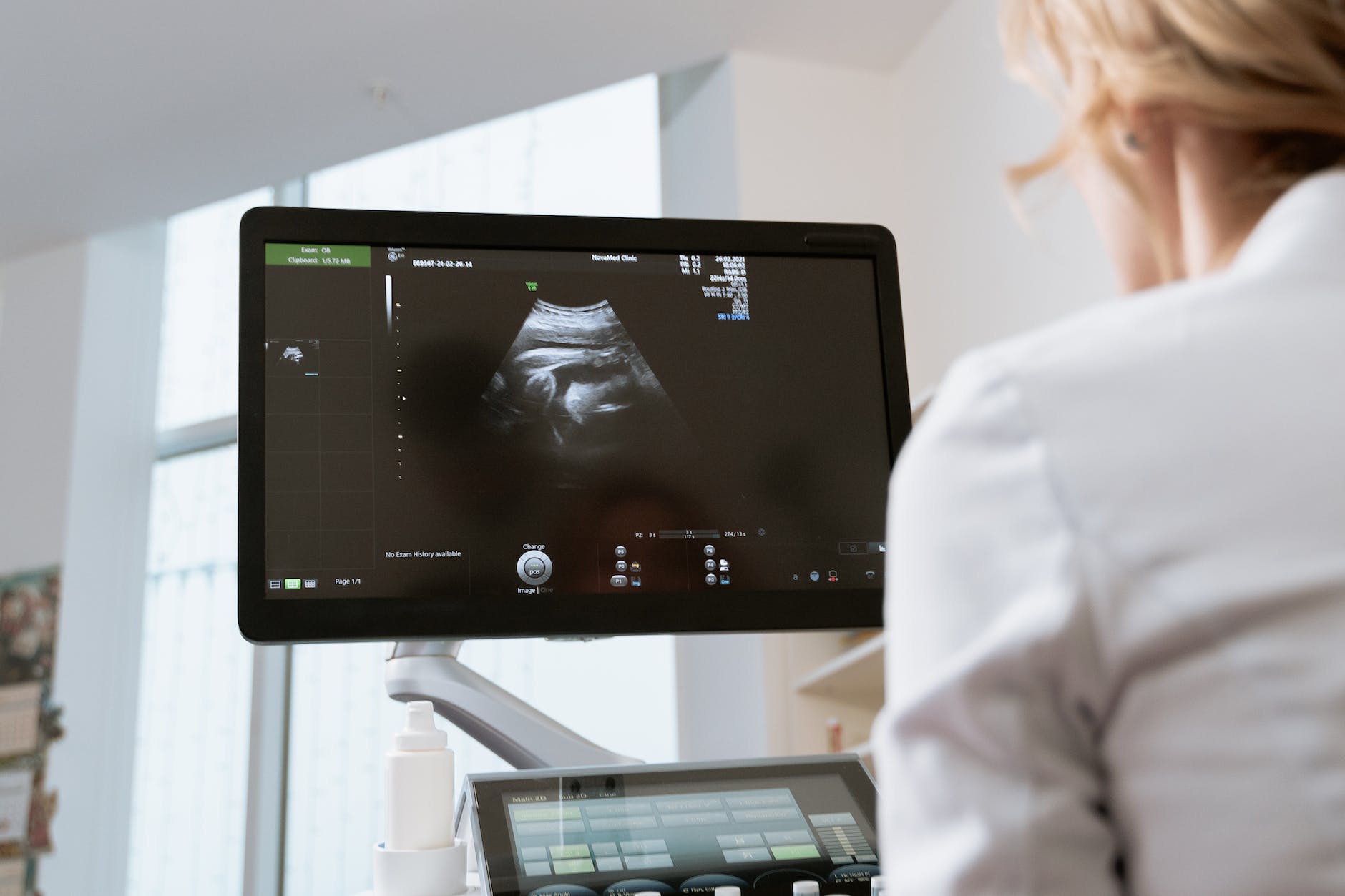
I went in for a kidney ultrasound this morning and the results are already available. A reminder that my sister’s donated kidney has a cyst that is buried deep within the kidney. The transplant team decided to leave it in the kidney instead of removing it, which means I need to get annual kidney ultrasounds. However, the UCLA nephrologist did say during the last appointment that if everything is normal, they may not need any more ultrasounds.

My appointment was at 10:00 am. I arrived early to check in but was stuck behind a very slow-moving Cadillac in the parking structure. It took me almost fifteen minutes to park my car. Once registered, the process was quick, and I was done in thirty minutes. The results were available online after about two hours. I believe there are no issues but I need to wait for my nephrologist to explain it to me.

Impression: Unremarkable left pelvic renal transplant aside from a stable slightly complex subcentimeter cyst.

I hope unremarkable is the same as negative for whatever they were looking for.

==========

I stayed home after the ultrasound appointment. My intention was to work from home, but I ended up taking an eight-hour nap. I am exhausted from working eleven-hour days plus a two plus hour commute.

UCLA Goodbye Letter

Date: 11/17/2022

Re: Important information about your post-transplant follow-up care

Dear Transplant Patients,

We are writing to share some important information with you. In order to continue providing excellent post-transplant follow-up care to all of our newly transplanted patients and those experiencing new urgent problems with their transplanted kidney, we will be requiring every post-transplant patient have their own local nephrologist (kidney doctor) who will follow you every two months with routine lab work, and a Primary Care Physician (PCP). This will ensure your needs can be addressed in a timely manner, once you are stable and transitioned back to your local nephrologist and PCP for management. This means we will no longer be able to provide primary nephrology care or handle medication refills after you are transitioned back to their care.

Our team will continue to see you annually to monitor your transplanted kidney function, and for any urgent kidney transplant issues you may develop.

We will be working with you to connect you to a local nephrologist and PCP based on your insurance and to ensure a smooth transition over the next few months. Once you are connected to a local team, and have scheduled an appointment with your nephrologist, a member of our team will reach out to them and update them on your care.

We will make sure they have all of your pertinent medical records in order to manage your care moving forward.

Please do not hesitate to ask our team if you have any questions. We are here to help during this transition process. Thank you for allowing us to continue to be part of your care.

Best regards,

Your UCLA Kidney and Pancreas Transplant Team

I received this automated letter from UCLA Transplant Center today. It is basically a goodbye letter handing me off to my local nephrologist. This was done about a year post-transplant, but I guess this notice makes it official. I am already on a two-month schedule with my local nephrologist, though I have not seen my PCP for a few years.

Dr. Jeffrey Veale. He is the surgeon that “installed” my sister’s donated kidney.

UCLA Lab Results November 2022

After all the difficulty with trying to get my labs done at UCLA, the results came back very quickly. Here are results as compared to my lab results from Quest at the end of September:

TestQuest (Sept 2022)UCLA (Nov 2022)
Creatinine1.46 mg/dL1.49 mg/dL
EGFR57 mL/min/1.73m^255 mL/min/1.73m^2
Urea Nitrogen (BUN)3430
Potassium4.7 mmol/L5.3 mmol/L
Phosphate3.3 mg/dL3.7 mg/dL
Calcium (two tests)10.1 mg/dL or 10.9 mg/dL10.1 mg/dL
PTH207 pg/mL
Hemoglobin17.6 g/dL17.2 g/dL
Hematocrit51.4%52.6

UCLA appears not to have tested my PTH levels. My tacrolimus levels were 10.5, which I believe is slightly higher than the desired range. At my local nephrologist, the value was slightly low. Strange.

The values from the two labs are different but they show the same out-of-range items. Even though creatinine was high for both, the readings are not that different from past tests.

==========

Huh. I guess I did not publish the post above so I will just continue. I had the actual appointment on 11/9 and it took only ten minutes. The only change was reducing the Tacrolimus from 7 mg to 6 mg since the UCLA lab result was high. The transplant nephrologist also asked me to get my annual ultrasound, and to get both the bivalent vaccine booster and then Evusheld. I will have to contact my local nephrologist and have her set up appointments with local providers.

November 2022 Transplant Center Appointment

I got labs done this morning for an appointment with the UCLA transplant center next week. It has been about nine months since I spoke with them. During the last appointment, the transplant nephrologist did ask if I wanted to wait six-months or twelve-months for the next appointment, so I am still ok on timing.

It was my second visit to the UCLA lab site this week. I originally scheduled the lab appointment for Wednesday morning. However, they were unable to find the lab order for me, so I had to cancel. I have done this same process many times, and this was the first time there was a problem. I am also very sure that I cannot make a lab appointment if there is no lab order in the system.

Long story short, the transplant center called me Wednesday afternoon while I was at work. They entered the lab order into the system, and I was able to reschedule the lab appointment for this morning. The blood draw was only three tubes instead of the normal six to seven tubes. All good, I hope.

Flowers in front of the UCLA Hematology/Oncology building where I got my blood drawn this morning.

Nephrologist Visit – September 2022

I finally saw my nephrologist today after five months. I was supposed to see her every two months. The appointment was scheduled for early July, after our Europe trip. However, due to COVID, I had to cancel all my appointments and I am catching up now.

There was not much change. We went over my labs and talked about how after two and a half years, there is still a lot of confusion about COVID prevention and treatment. She has patients from many different transplant centers, and each has different guidelines on vaccinations and preventative antibodies treatments. In my case, we are going to wait a few months, check my antibodies levels, and get either the bivalent vaccine or Evusheld again.

Here are some important test results:

Creatinine1.46 mg/dL
EGFR57 mL/min/1.73m2
Urea Nitrogen (BUN)34
Potassium4.7 mmol/L
Phosphate3.3 mg/dL
Calcium (two different tests)10.1 mg/dL or 10.9 mg/dL
PTH207 pg/mL
Hemoglobin17.6 g/dL
Hematocrit51.4%

Bold items are out of range. Most of them have been borderline high since the transplant so my nephrologist was not worried. She is holding off on having me take Sensipar for the high calcium, but she did increase my Losartan dosage from 25 mg to 50 mg to deal with the high hemoglobin. My blood pressure is a bit higher too so more Losartan will help.

Next step is to schedule an appointment with UCLA transplant center since I have not talked to them since February. They were okay with six to twelve months between appointments so no I should be okay.

Latest Test Results 5/19/2022

The last set of labs showed high creatinine and potassium. I told my nephrologist I may have been dehydrated, and I have not been too diligent on taking the Lokelma daily. So she gave me another lab order, just for a small subset of tests. Those results came back high as well, so I am now doing a third set of labs. I am still missing a few days of Lokelma since it is a powder you need to mix with water, and you cannot take it within a three-hour window of all the other medications. The creatinine levels were around 1.6. Not terrible but definitely high compared to the normal upper bound of 1.3.

I do not feel I have done anything different, although blood sugar has been harder to control. I am not sure if I am building a tolerance to insulin, or i just need to eat a lot less. I am still on the Natera Prospera DNA test program, but they have not mentioned any signs of kidney rejection.

Double Doctor’s Appointments

I had two doctor’s appointments yesterday morning. It was not planned, so fortunately they were at separate times. The first appointment was with my endocrinologist. My blood sugar has been slightly lower recently, but there is a lot of variability in the readings. She mentioned that I may have brittle diabetes, which is harder to control. The linked webpage does say that it is rare and typically found in type 1 diabetic s however. I may also have experienced rebound hyperglycemia that would raise my morning blood sugar readings even though I did not eat anything overnight. In the end, she just increased my insulin prescription again, and sent another referral for a CGM (continuous glucose monitoring) meter.

I was done at about 9:15 am but the next appointment was at 10:20 am. I sat in the parking lot checking my phone instead of driving home since I would be heading out right away again. The next appointment was with my nephrologist. She said my lab results were fine but asked me to take some vitamin D supplements since my level was low. We also talked about COVID vaccine, antibodies, and Evusheld availability.

At my previous appointment with UCLA transplant center, they said I should get Evusheld shots, but since I am not a high-risk patient, they do not have enough doses to offer it to me. My nephrologist said St. Joseph hospital only received 40 doses, and the transplant doctor is restricting access to only his patients. One of her other patients told her that UCI received 600 doses for some reason; their transplant program is not that large either. Anyway, her plan for me is to get an antibody test (I did that this morning). If I have zero antibodies after four Moderna shots, she will try and make a case for me to receive Evusheld at St. Joseph. If that is not possible, she will then refer me to UCI to try and get shots from there. I have not had an antibody test before so it will be interesting to see if I do have antibodies.

One Year!

Today is the one-year anniversary of my kidney transplant. On January 27, 2021, my sister and I were at UCLA Medica Center being prepped for surgery. At the time, we were in the middle of a huge COVID case spike that overwhelmed all the hospitals and ICUs in Los Angeles County. Little did we know that the Omicron spike would be much much worse.

However, the kidney is still working fine, and hopefully I will have many more kidneyverdaries.

Blog Tagline Update

I just noticed that my blog tagline still read “Life with Dialysis (and CABG).” Initially, it was only about peritoneal dialysis since I needed somewhere to vent my struggles with the process. Along the way, I needed a quadruple heart-bypass surgery, then switched back to in-clinic hemodialysis. Having this semi-anonymous blog helped me cope with all the health issues I was dealing with.

Anyway, I did not want to delete the dialysis part since it was a huge part of my life for ~4 years. I found a website that would generate strike-through Unicode text and I replaced “with Dialysis” with “post-transplant” and left the CABG bit. I did the same for the subtitle(?) as well.

Life is definitely easier with a kidney transplant than having to rely on dialysis to stay alive, but there are still struggles. Additionally, problems like diabetes or peripheral neuropathy do not go away just because I now have a working kidney.

==========

I still have not decided what to do with this blog and my old blog on Blogger. There is ~15 years of posts on the other blog, but lots on this WordPress blog too. I think the easiest is to make posts linking both blogs and continuing here.

No More Atovaquone!

During my (almost) one-year post-transplant call with UCLA this morning, the nephrologist said I could stop taking atovaquone in about a week. This was an anti-protozoa(!) medication usually prescribed to people who are immunocompromised. I was initially prescribed Bactrim(?) post-transplant but was switched to atovaquone after about a month after a test result. It is a liquid medication and tastes horrible. It also stained my bathroom sink yellow. I am super happy that I do not need to take it anymore.

ESRD Post-Transplant?

I guess not.

I always wondered about this. It makes sense since a kidney transplant restores almost all the functions of the original kidneys. Likely why Medicare cancels ESRD coverage three years after transplant.

I saw this paper recently: Electronic health record analysis identifies kidney disease as the leading risk factor for hospitalization in confirmed COVID-19 patients

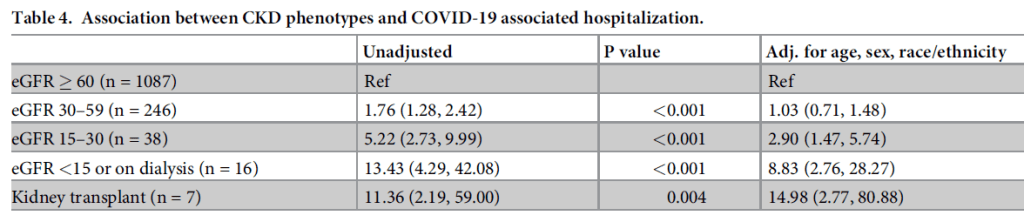
Even though kidney transplant recipients are no longer classified as ESRD patients, this study shows that they are still as susceptible to hospitalization as those with Stage 5 ESRD. Table 4 in the paper shows:

Additional analyses using eGFR and USRDS data confirmed our findings that patients with stage 4–5 CKD, ESRD on dialysis or with kidney transplant are at extremely high risk for severe complications due to COVID-19 (Table 4).

It appears that patients with eGFR < 15 are 13x more likely to be hospitalized with COVID-19 as compared to those without ESRD. The paper suggests that “physiological stress caused by excessive inflammatory response to SARS-COV-2 infection could destabilize organs already weakened by chronic disease” or “direct organ-specific injury from SARS-CoV-2 infection could act as a second-hit to these organs.” The article also mentions “consistent with this hypothesis, kidney and heart are among the tissues with the highest expression of ACE2, a SARS-CoV-2 receptor.”

So why is the results so high for kidney transplant patients? The n value is low at only seven cases, but the risk is about the same as Stage 5 ESRD or dialysis patients. The article does not discuss this finding, but my guess is the immunosuppressive medications weaking the patient’s immune system. That and a muted antibody response to COVID vaccines. This means even though I have a kidney transplant, the risks of COVID have not changed for me versus one-year ago while I was still on dialysis.

Kidney Ultrasound – Dec 2021

I finally got a kidney ultrasound two days ago. UCLA Transplant Center told me early on that I would need to get periodic kidney ultrasounds to check on the existing cyst in the donated kidney. This cyst was what held up my transplant for over three years.

I was scheduled to go in at 4:00 pm. By the time I checked in, the outpatient clinic building was deserted. The entire procedure took about 45 minutes, so I was out and home by 5:15 pm. Initially, there were some questions whether we were scanning the OG kidneys or the transplanted kidney. In looking up my records, the ultrasound technician mentioned that the last scan was five years ago, and she was the technician then as well; she has worked at the same clinic for 25 years. I have worked about 26 years since my last graduate degree, but it was spread over three (or four) companies.

My nephrologist called me up the next day and said the original cyst was fine. There were some other small cysts but nothing important. I am not sure if those were there before the transplant. There was also something that was a bit enlarged, but also nothing to worry about at this point. She will send the ultrasound to UCLA next week so they can evaluate the results as well.

So far so good after 10 months.

Anti-vax Transplant

UCHealth Denies Kidney Transplant To Unvaccinated Woman & Donor

AURORA, Colo. (CBS4) – A Colorado woman with stage 5 renal failure was months away from getting a new kidney. Now, she and her donor are looking for another hospital after learning UCHealth’s new policy.

According to UCHealth, the majority of transplant recipients and living donors are now required to be vaccinated against COVID-19. Neither woman has received their shots.

https://denver.cbslocal.com/2021/10/07/uchealth-kidney-transplant-covid-vaccine/

So when my transplant was scheduled in late January, I was not yet eligible for a COVID shot. Unlike the two women in the article, I was super worried about getting COVID in the hospital and losing the kidney after waiting 4+ years. As I posted before, UCLA was basically out of ICU beds, and I had to share recovery with another patient, both of us crammed into a room designed for one bed.

Further down, the article says:

“It’s your choice on what treatment you have. In Leilani’s case, the choice has been taken from her. Her life has now been held hostage because of this mandate,” said Fougner.

Fougner says she hasn’t received the vaccine for religious reasons. Lutali hasn’t gotten the shot because she says there are too many unknowns. Until last week, neither woman thought they needed to be vaccinated for the transplant.

You can tell they are anti-vax idiots by their hyperbole. Really, “held hostage!?” Nobody is forcing them to do anything. They are free to find another transplant center (good luck!) that will do the procedure without requiring vaccinations. Both the reason they give is totally bullshit as well. What religion forbids a mRNA vaccine yet allows for a complex surgical procedure with lots and lots of different drugs. Is she not going to take anti-rejection medication post transplant? Those have more side-effects than any COVID vaccine. The donor is also stupid with the “too many unknowns” crap. There are hundreds of things that can go wrong with both donor and recipient post-transplant. I am pretty sure they had to follow a bunch of appointments and test to get to this point in the process; for sure me and my sister did. Are they going to reject what their doctors and surgeons are telling them at the very last step? Ugh.

Another thought. What if the recipient is willing to get a vaccine? Will the donor say “fuck you” and not go through with the donation if she needs to be vaccinated?

“Here I am, willing to be a direct donor to her. It does not affect any other patient on the transplant list,” said Fougner. “How can I sit here and allow them to murder my friend when I’ve got a perfectly good kidney and can save her life?”

The women haven’t been able to find a hospital in Colorado that will do the transplant while they’re unvaccinated. They’re now looking at other states.

More hyperbole. It is not murder. If the transplant recipient values anti-vax nonsense over her own life, then so be it. My prediction? They will come crawling back to the initial transplant center as they will not fine anyone else to do the procedure.
Labs and Doctor Appointments Galore

Sometimes it feels like I have a second job managing all the doctor appointments, labs, and medications. I previously posted about two stressful mail-order medication deliveries. It is pretty much the same with appointments. I just spent about a hour on the phone trying to line up various doctor appointments and corresponding labs.

So here is my schedule for the next few weeks:

DateAppointment
9/24Labs for nephrologist (no appointment; walk-in)
9/30Nephrologist appointment
10/4Labs for endocrinologist
10/11Endocrinologist appointment
10/13Labs for transplant center
10/15UCLA Transplant Center video call

At least I do not have to drive to UCLA on a Friday afternoon since the appointment is a video call. Otherwise that will be a three+ hour roundtrip drive.

On top of all this, I need to make an appointment with my dentist. I chipped a tooth while flossing. Actually, there appears to be a large cavity and part of the tooth enamel just fell off. Good think I have a few hundred dollars on my FSA account that I need to burn before the end of the year. 😠

==========

That is also three labs in three weeks. Each one is likely 5-6 tubes plus urine. My left inner elbow is going to be hurting and bruising again.