UCLA Clinic Appointment 3/22/2021

I had another video call with UCLA this morning. The doctor I spoke with thought we had never met before, but I remember she was the nephrologist that evaluated me back in October 2019 for a possible transplant with my friend as the possible donor. Of course, I then had a heart attack/bypass surgery later in November so all that got put on hold.

My labs are pretty stable from the prior appointment. She did increase the tacrolimus dosage by 1 mg, so I am taking four pills in the morning and four pills in the evening. I was hoping they would cut down on that anti-rejection medication since there are many possible side effects. She did say that I can go to a two week appointment cycle so my next call is early April.

I also asked her about returning to work early. She basically said it was up to me. If I felt okay, then I can return to work (from home). She also said I can relax the raw/cold food restrictions, and meet with small groups of people as long as it it outdoors and everyone wears a mask. The risk of COVID-19 infection plus not knowing the effectiveness of the vaccine in transplant patients means I should err on the side of caution.

No Anti-Rejection Medications?

I had a video call earlier this afternoon in lieu of an in-person visit with the UCLA Transplant Center for a follow-up appointment. This time, it was another doctor that I have never met before; they must have a huge staff. He went through my lab results and basically made no changes to my medications. Again, my potassium (and calcium this time as well) was borderline high, so he asked me to watch my diet. Blood sugar was still high as well, but I told him my endocrinologist was managing it.

Right when we were about done with the call, he brought up another topic. He said a news crew just left UCLA. They were there to report on a story that UCLA was piloting a program to stop anti-rejection medications for kidney transplant patients after one year. He brought it up so I did not wonder why I did not have that option. From my understanding, essentially patients with a well matched donated kidney can overload on anti-rejection medications during the first year post-surgery, then not have to take any afterwards. Since I was a very good match to my sister’s kidney, they considered me for the program, but decided against it due to the tumor/cyst/growth that is still in the donated kidney. I guess there is a risk that if the object turns out to be cancerous, it may trigger my immune system, which could damage the donated kidney. They decided to err on the side of caution and did not approve me for the program. He did say that my dosage was pretty low already but wanted me to know about it.

Sigh. Not having to take anti-rejection medications would be awesome since that was the most negative part of getting a kidney transplant. However, I am not going to complain since having a working kidney is so much better than the alternative. I will have to have lots of scans periodically to check on the status of the tumor/cyst/growth, but it is a small inconvenience compared to dialysis.

==========

I could not find any mention of the program online. Maybe it takes a few days to edit and produce the news segment.

Hypotension

While I was on dialysis, especially after starting hemodialysis again after heart surgery, my blood pressure has been all over the place. I published many posts with a record of my blood pressure readings during dialysis, and it can range from over 200 to under 100. I usually do not feel anything when the blood pressure is high, but I would feel dizzy and nauseous when it drops below 110, especially when standing. I was taking three different medications for blood pressure, but it was still pretty much out of control.

Post transplant, my blood pressure would still fluctuate wildly, even though the new kidney was doing its job of clearing fluid from my cells and bloodstream. They kept me on 25mg of Metoprolol Tartrate and also 30mg of Nifedipine ER (extended release). Initially, my blood pressure would still reach 190-200, but some of it was due to the prednisone I was taking. As the doctors reduced my anti-rejection medication, I feel my blood pressure was becoming more stable. Earlier this week, I think it stayed within 110 to 160 for the systolic measurement. After Thursday’s clinic, they cut my prescription of Mycophenolate completely, so I am on the minimal dosage of prednisone, and about the same dosage of Tacrolimus as when I was discharged.

Since Thursday, my blood pressure has been pretty stable. I have only been taking the Metoprolol since I am very sensitive to Nifedipine, and I did not want to drop my blood pressure too much and have hypotension. Today at dinner, I measured 159 sitting and about 135 standing so I took the Nifedipine pill; I believe I have skipped it for the past two days. Anyway, I felt fine for awhile, but when I got home (from my sister’s house), I started feeling dizzy. My sitting blood pressure was about 95/60 which is super low for me. The earlier blood pressure reading must have been an error and I should have not taken the Nifedipine. I am trying to stay seated as much as possible since each time I stand up, I feel dizzy. Hopefully it will pass soon. At dialysis, it usually takes 30 minutes to recover if I have hypotension post-dialysis.

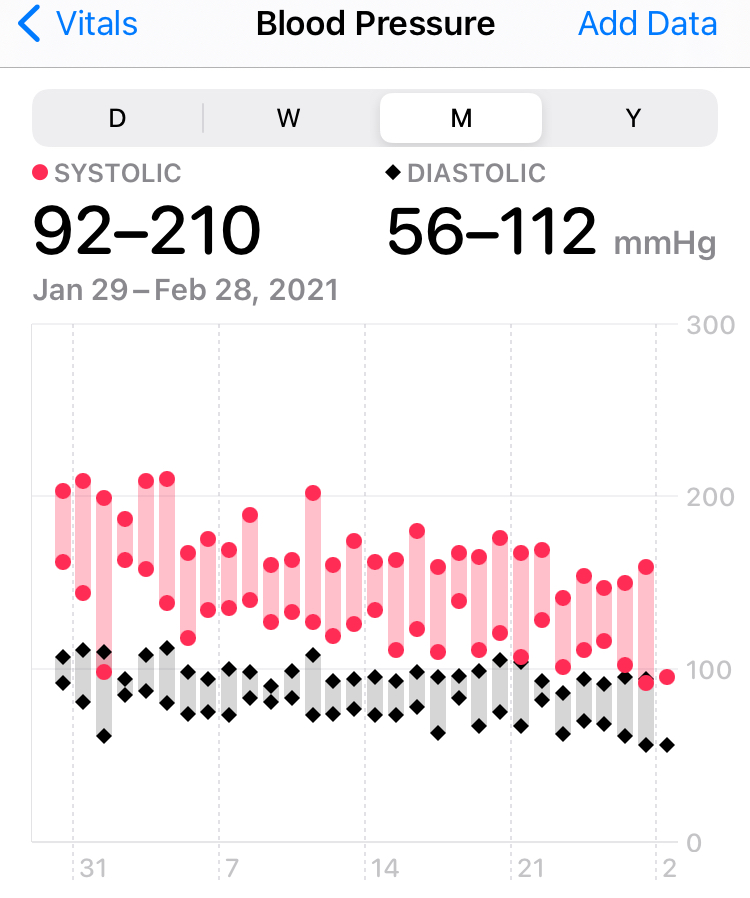
One month history of blood pressure readings. Since I measure multiple times a day, this gives the range of values. There is a definite, if slight, decreasing trend in the values for my systolic blood pressure readings.

Endocrinologist Appointment

I had a Zoom telehealth appointment with my endocrinologist. I had been sending her office email updates post-transcript but she wanted to discuss my blood sugar and medications. UCLA also has been asking me to see my endocrinologist too.

The appointment went well. I had given her assistant all my blood sugar readings for a week. Since I am already at the maintenance level for prednisone, she does not think my blood sugar will decrease further from reducing other medications. The pill I am taking, Januvia, does the same function as the HumaLOG, which is to control blood sugar due to food. Since my blood sugar is consistently above 200 during the day, she is replacing the Januvia with a long-lasting insulin. She had prescribed Toujeo previously but I never used it. Now I will need to inject two types of insulin each day. Ugh.

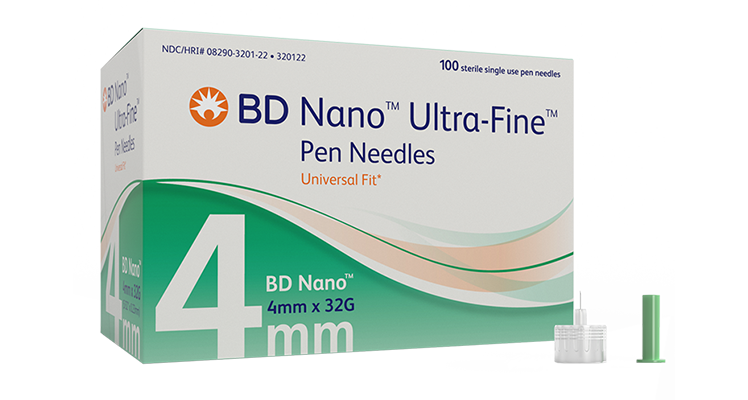
The pricing on the pen needles also suck. At UCLA, I had a copay of $30 for a box of 32 gauge 4mm needles. My local pharmacy wanted $44 as copay for the same needles. I have not checked my mail order pharmacy for prices. On Amazon, there are a lot of inexpensive options for the same size needles. However, none of them will deliver to my house, probably because you need a prescription in some states to order insulin needles. I did find another mail order diabetic supply company that has 100 needles of the same size for $11 per box of 100. Even with shipping, that is much cheaper than either of my pharmacies. Hopefully a needle is just a needle so as long as it is the same size, the needle will work with both pens.

==========

This is what I initially received from UCLA along with the HumaLOG pens. I looked at the pharmacy receipt and UCLA’s price was $71.50, and my copay was $30. On Amazon, the same item with 90 needles cost $45, but there are other sellers selling for as low as $15. Of course, I cannot order since no one will ship “prescription medical devices” out to patients. You probably have to be outside the USA to receive these items. Our medical insurance system is so corrupt.

I also tried getting needles at Albertsons pharmacy. My endocrinologist sent over a prescription for Droplet pen needles, same 32 gauge 4 mm needles as the BD ones above. Albertsons said my copay was $44 but this item clearly sells on Amazon for $13.89 a box. Again, I cannot order it from Amazon due to our corrupt medical insurance system.

Searching online, I found a company called Medical Supply Corner selling the Droplet needles for $9.99 for a box of 100. I ended up ordering three boxes to spread out the $6 shipping cost. They also have a four box pack for $40 that I did not see before ordering. I used my FSA debit card and the transaction went through. Hopefully the will ship the items to me but I am expecting the order to be blocked, or maybe the SWAT will come knocking to get the needles back.

Insurance Confusion

Ugh. Not only does the United States seem to have the most complex health insurance system, nobody seems to understand the nuances. When you have more than one insurance provider, the confusion seems to grow exponentially.

As mentioned before, due to ESRD and kidney transplantation, I have Medicare Part A and Part B. However, I do not have Part D for prescriptions because that’s not part of the ESRD coverage, and I have Blue Shield from work that covers prescriptions. All good so far. Well, post-transplant, Medicare is supposed to cover only the anti-rejection medications, but under Part B for services and supplies, not Part D for drugs or prescriptions. At UCLA, since they deal with this everyday, they billed Medicare Part B for the three anti-rejection medications, and Blue Shield for the rest. After transferring the prescriptions to my regular pharmacy (Albertsons) and mail order (Express Scripts), they both billed the anti-rejection medications to Blue Shield. Two problems: 1) there is no copay for Medicare but there is with Blue Shield, and 2) since our work insurance is self funded, my company ends up paying thousands for the prescriptions when they’re supposed to be paid by Medicare. I called both Albertsons pharmacy and Express Scripts and both said they only bill Medicare Part D and not Part B. Luckily, UCLA pharmacy said they will keep filling my prescriptions as long as the prescribing doctor sends the scripts there. I don’t know if this applies after UCLA hands off care to my regular doctors. The copay is not too bad, only $10 per prescription refill. Since I am paying >$500/month for Medicare, I should probably use it.

Post-transplant, Medicare pays for anti-rejection medications for three years. That was just changed to lifetime coverage. I am 52 so I will get regular Medicare in 13 years. If I am done with dialysis and already had a transplant, why do I need Medicare if my work insurance will pay for the anti-rejection medications? That means I have to keep working or buy my own insurance but surely it’s not efficient to pay a lot for Medicare if it only covers the three drugs. I need to find out more.

More Medication Changes

The doctors are pretty happy with my recovery. During the clinic appointment today, they reduced my dosage of prednisone to just one 5 mg pill every day. That’s probably the lowest and final dosage for me. By lowering the dosage, I also get to stop taking the nyastatin (anti-fungal mouthwash) and pantoprazole (acid-reflux). This is good. Out of the original 17 medications, I think I have stopped taking about six of them.

Progress.

Medication Side Effects

Every medication is a trade-off between the beneficial effects and the unwanted side effects. Some medications have very minor side effects, while others have more serious ones. I remember taking amiodarone after heart surgery to control my heart rhythm. After reading up on the side effects, I called my cardiologist trying to get off the medication as soon as possible. The list of side effects include pulmonary toxicity, hepatic injury, visual impairment and loss of vision, peripheral neuropathy, and others.

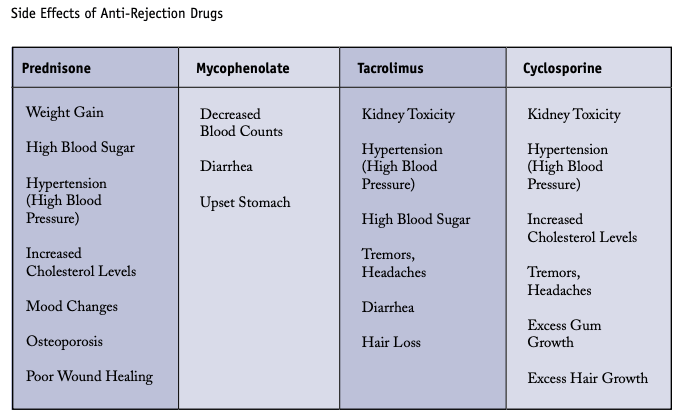
As mention previously, post-transplant surgery, I was given three anti-rejection medications: mycophenolate, prednisone, and tacrolimus. I started with 4 pills of mycophenolate and tacrolimus twice a day plus 4 pills of prednisone in the morning. The latest dosage is now 2 pills of mycophenolate and prednisone plus 4/3 pills (morning/evening) of tacrolimus. With all the side effects from these medications, I was prescribed several more to counted these side effects. Here is a short list:

I have not experienced any side effects yet, except maybe for high blood pressure and high blood sugar. I believe this is the primary reason I was prescribed an insulin pen, and why I am jabbing myself before every meal. As mentioned above, my prescription for mycophenolate and prednisone has been halved already, but the amount of tacrolimus are back to near initial dosage. I really hope they can further reduce the medication dosage so I can go back to pills to control my diabetes instead of relying on insulin shots.

High Blood Sugar

A kidney transplant is supposed to fix a whole host of sins. Most of my lab results are much better, but there are still a few problem areas: potassium, blood pressure, and blood sugar/glucose.

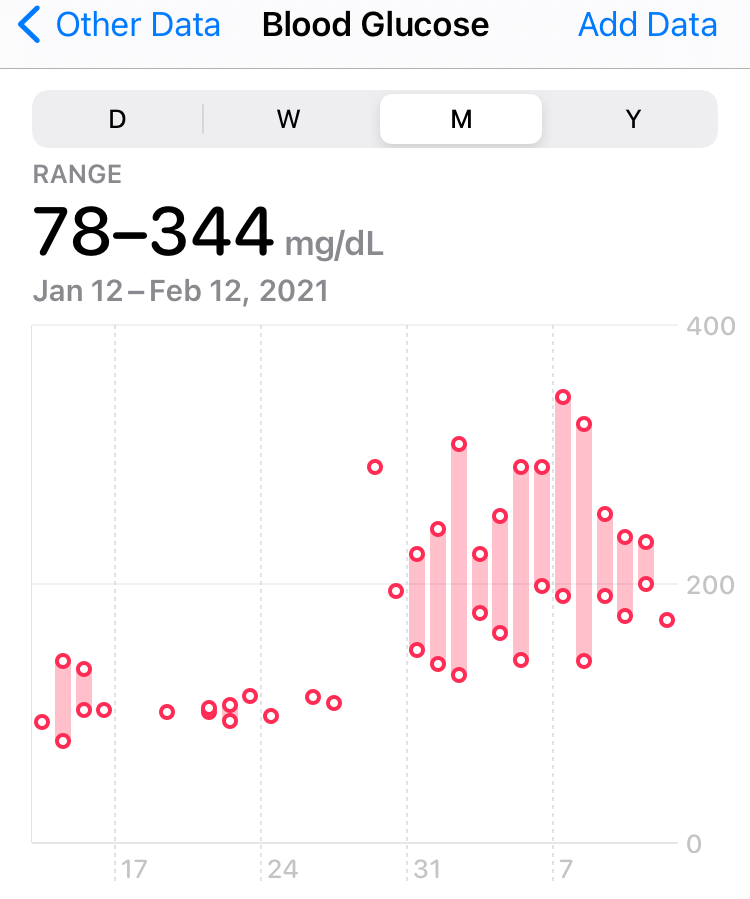
Here is a chart from Apple Health of my blood sugar readings downloaded from my Accu-Chek meter. It covers about a month of data. You can easily see when the transplant surgery occurred and I started taking the anti-rejection medications. Prior to surgery, I was measuring blood sugar once a day before breakfast so it’s probably the lowest reading of the day. Even taking that into account, the number are definitely higher post-surgery.

The issue is even with an insulin shot before each meal, the numbers are still pretty high. My endocrinologist doesn’t like the numbers being over 200, which appears to be all the time except in the mornings. She want me to do another injection that has all-day insulin. The HumaLOG I’m taking now is very quick acting but doesn’t last that long. Two insulin injection pens… great.

This either means my blood sugar was high while on dialysis but was getting dialyzed out, plus my old kidneys were not filtering out any natural insulin, hence the low numbers. Or my blood sugar was normal but now the anti-rejection mediations are spiking the sugar levels plus new kidney is getting rid of natural insulin, so I need more. Hopefully it’s the second and the eventual lower anti-rejection medication dosages will fix the problem.

Blood pressure is hight too but I haven’t been able to figure out any patterns yet.

Blood Pressure Variability

Out of all the labs results and vitals, my blood pressure (BP) has been hardest to control. It was like this before the transplant where I would take the exact same medications, but BP would vary from over 200 to below 100 for the systolic reading. Post-transplant, while recovering in the hospital, my BP has mostly been stable. However, after being discharged, it’s varying like crazy again.

Right now, I’m prescribed 25 mg of Metoprolol Tartate twice a day, plus 30 mg of Nifedipine ER in the morning. Instead, I’ve had to add an extra Nifedipine tablet at night since my systolic BP is nearly 200 at bedtime. It’s been mostly okay in the mornings before medication however. I guess with my orthostatic hypotension, it’s even harder to prescribe for. The last nurse practitioner I saw now wants me to measure my BP more often, and include sitting and standing readings.

I read online that some people take months to stabilize their BP post-surgery. I wonder why now that fluid balance is much better controlled.

Post-Transplant Clinic 2/4/2021

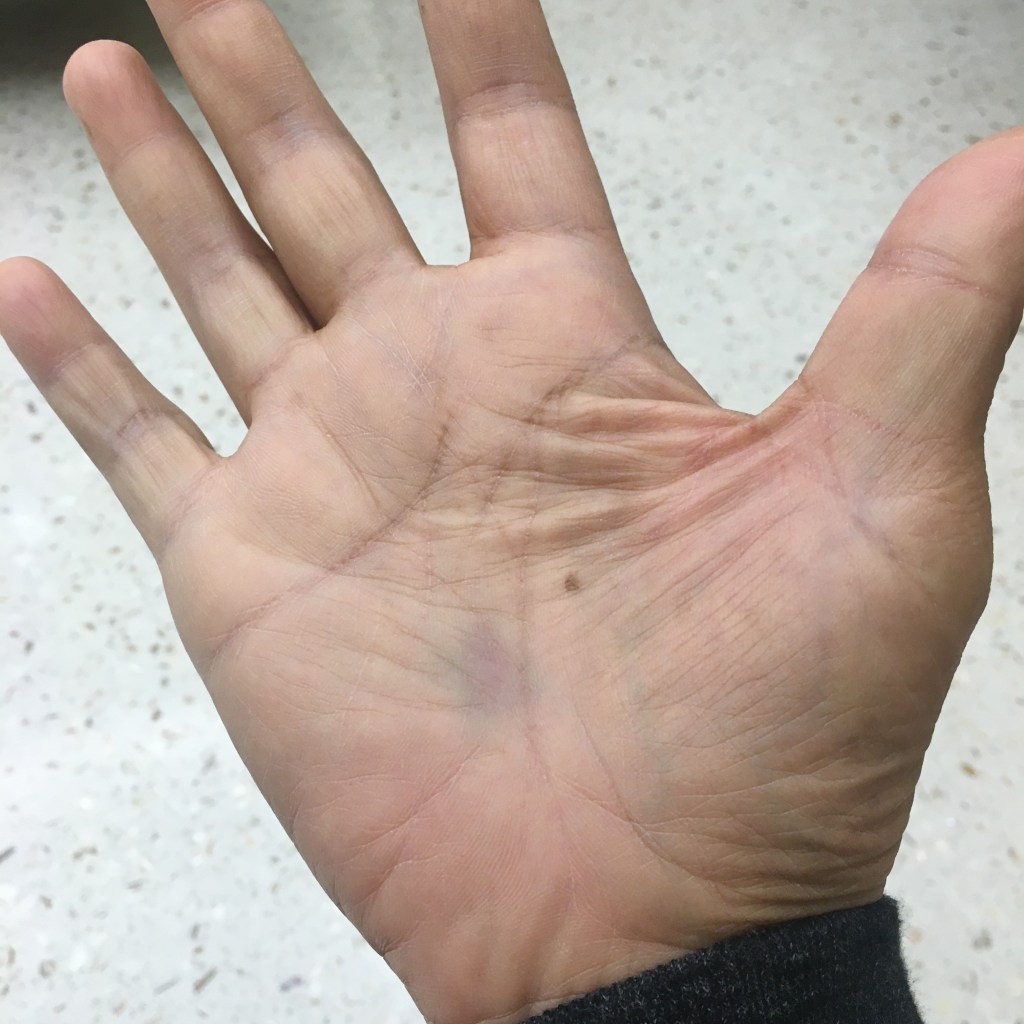
I woke up this morning at around 4:00 am and my knee was hurting pretty bad. I was worried about damaging the new kidney during my accidental fall, but I was still peeing all night so that seems fine. My knee however, hurts whenever I put weight on it so walking was pretty difficult. I also got a bruise in the middle of my right palm so that hand hurts too.

Hand bruise

I got to the clinic around 5:40 am and was done in about 10 minutes. Since the cafeteria did not open until 6:30 am, I sat downstairs and waited. At around 6:20 am, I slowly waddled over to the next building to get some breakfast. I looked like an old man, limping my way up some stairs into the cafeteria.

Instead of the same doctor, I saw a nurse practitioner that I have not met before. They have a huge team of people, and all seemed to be quite knowledgeable about my case. Again, everything looked fine. Most lab results out of normal range was expected, either from surgery or the new medication. My creatinine level came in at 1.4, which is just barely outside of the normal range of 0.7 to 1.3 for men. I don’t think I’ve ever seem my creatinine levels that low since when I found out about my kidney issues, I was already at stage 3 of ESRD.

They also reduced one of my anti-rejection medications. In fact, the attending physician wanted to remove that drug from my list but they decided to wait for another set of labs. My liver function was a bit off so we temporarily stopped two more medications. Potassium was about the same at the border between normal and high, and phosphorus dropped again to 1.7. I was told to try and adjust through diet before increasing the phosphate supplement. Other then my stupid fall, everything is going great.

The home health nurse may stop by today. It’s already 4:00 pm and I have not received a call yet. Due to my bum leg, I can’t go out for a walk anyway so I’ll just sit here and wait.

Post Transplant Lab Results

Pretty amazing. I know this is how it’s supposed to work but still unbelievable. The new kidney is filtering years of toxic waste out of my bloodstream. Lab results are approaching normal just after five days. Here are some examples:

Lab Test1/111/281/291/302/1
Creatinine10.496.743.642.812.2
BUN7139405343
Potassium6.25.46.05.25.1
Phosphorus5.98.06.03.82.7
eGFR59192533

I’m a bit unhappy with the phosphorus. Initially the doctor said it was dropping too fast and wanted me to get supplements. That was when it was at 3.8. The supplements had a co-pay of $50 with insurance. I know that’s small compared to the hundreds of thousands for the transplant, but still. I had the pharmacist double check but the doctor insisted, so what was I to do? Anyway, it’s now 2.7 and she said that’s fine. First she said to stop, then said to reduce from two pills to one per day.. I could have just eaten more milk, cheese, and tofu. Dang it.

Next lab is Thursday. I’m already at only two meetings per week when I thought it was going to be three or more. Probably spent too much $$$ on this apartment but probably good to be nearby in case there’s an unlikely emergency.

Post-transplant Medications

Wow, I got a total of 15 prescription medications from the hospital before I left yesterday. They had to give me a large shopping bag to carry it all. The schedule is complex too. They gave me a pill organizer that has 7 days and four boxes per day. Each medication has a different schedule but most fit within the 8:00 am and 8:00 pm requirement. However, the initial dosage is high for everyone, then over time, they should decrease, especially for me since the kidney is almost a perfect antibody match. It just means the number of pills will change daily for a few weeks.

The scariest pills are of course, the anti-rejection medications. Two are immunosuppressants plus a steroids medication. the immunosuppressants are mycophenolate and tacrolimus; the steroids is prediSONE. Since I’m taking these pills, my immune system is weaker plus the drugs tend to increase my blood sugar so I also received three anti-infection medications plus an insulin injection pen for HumaLog. There are a bunch of other stuff too. This is about 90% of the 8:00 am medications:

Sigh…

Most of these drugs, especially the anti-rejection ones, are needed for the life of the new kidney lest your body kills it off. The co-pay for all that mediation post Medicare’s 80% payment was about $125, with $50 just for a phosphorus supplement. Hope that goes away, as well as some the ancillary medications. I can get them at UCLA for three months, then I have to figure it out with my doctors and pharmacist. It would be nice if UCLA can keep mailing me the meds but I think they need to move on to new patients.

==========

In order to keep track of all this, I created an Excel sheet with all the medications and will put in all the meds needed for the twice daily times. Otherwise I’m going to lose track of what to take when.

Blood Glucose 1/1/2021

Because I don’t want to start insulin injections, I’ve been testing my blood glucose levels quite often, sometimes 6-7 times a day. My endocrinologist wrote a prescription for test strips. The supply order is probably for a month with three tests per day, so about 100 test strips. Even with insurance, the pharmacy is charging me $70. I still have hundreds of strips so I’m going to reject the prescription until I figure out the pricing. Unfortunately, the new year started so I have to pay the out-of-pocket amount again. Not sure what this does to my share of prescription orders. I’m still on Tradjenta, which is costing my work insurance about $10/day.

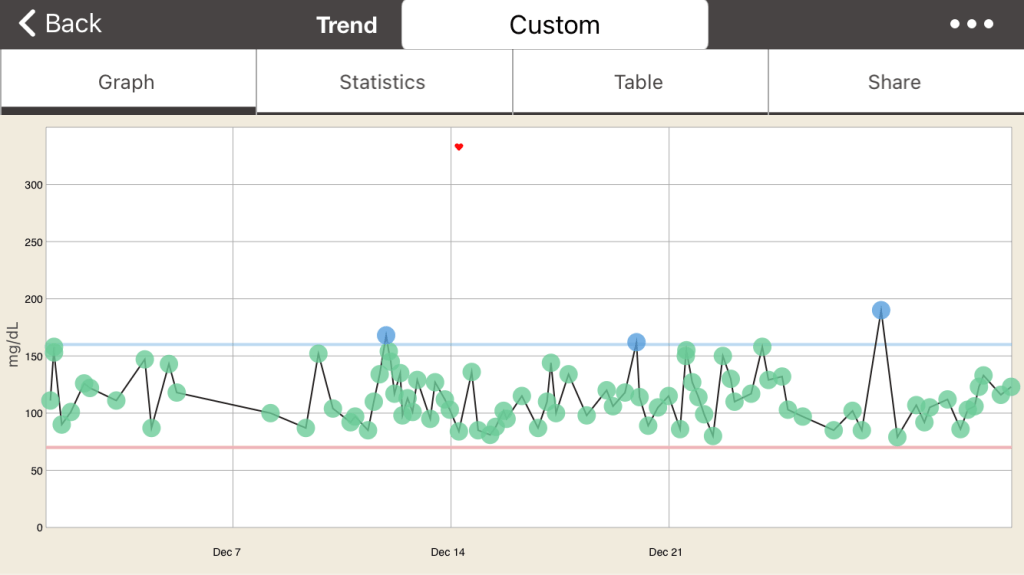
Back to my blood glucose, the above is a screenshot of the past 30 days as recorded by my meter. The upper/lower limits are 160 and 70 respectively. With the one measurement that was taken too soon after a snack, all the numbers look fine and within normal guidelines. I sent this data to my endocrinologist during Christmas weekend and she was fine keeping me off insulin if the numbers are consistently normal.

Good News From Medicare

The US Senate passed a bill yesterday to provide immunosuppressive drugs post-transplant for life. Previously, Medicare only pays for three years of medication post-transcript. For patients that won’t qualify for Medicare after that date, they have to find their own insurance or risk losing their transplanted kidney. I read that about 375 patients die each year from losing Medicare and not being able to afford the needed medication. This is supposed to save $400M over 10 years since thousands of patients can avoid a return to dialysis, which is also paid for by Medicare.

For me personally, this means I can consider retiring post-transplant. I’m in my early 50’s so if I go through the transplant soon, I will run out of Medicare coverage in my mid-50’s and need to find insurance coverage for 10+ years. That typically means getting a job and work-provided insurance. I do need to find out if Medicare will only pay for immunosuppressive drugs or will they continue as my primary health insurance, paying for 80% of all claims.

Insulin Reprieve, Part III

I received a reply from my endocrinologist this morning. She agreed that my blood glucose readings were pretty good. I am to continue taking six readings per day and if the readings remain in the normal range, then I won’t need the insulin shots. She said I should be between 90-130 mg/dL before meals and <180 mg/dL two hours after meals.

I already picked up the first order from the pharmacy however. It’s something called Toujeo® Solostar®. I’ve used insulin briefly in the past, and I had to fill my own syringes from a glass vial for each injection. In this case, Toujeo comes in pre-filled pens filled with insulin, and you can adjust the dosage administered. I also got a bag of injector tips so you have to replace that part each time. The box comes with three pens, each with 450 units, and my prescription is for 15 units/day. Each pen is good for a month of injections so she gave me a three month supply. Since it’s late in the year, I already met my out-of-pocket maximum for my work health insurance so I did not have to pay anything. However, my work did paid about $400 for the box, which comes to ~30¢/unit or $4.50 per dose. Here is a list of prices for different insulin brands:

I guess that sounds expensive but a three month supply of my other glucose medicine, Tradjenta 5 mg, costs over $1,000. I understand that drug companies need to make money, but even I find these prices ridiculous. Even worse in my case, I’m not even using the Toujeo yet. The directions on the box says it will keep until the expiration date (November 2022) if I keep it in the refrigerator so I have two years to use it.

Colonoscopy Prep Day

Okay, I started the process. I haven’t drank any of the solution yet; I just added water to the provided jug and put it in the refrigerator. There was a lemon flavor packet stuck to the jug. I debated whether or not to add it but based on some Internet browsing, I put in the flavoring right before mixing it.

The time is about 1:00 pm. I’m leaving for dialysis at 4:30 pm and will hopefully be done by 9:00 pm. I will start on the solution as soon as I get home. I’m supposed to drink 8 oz every 10 minutes and it takes about an hour to start working. Assuming that what goes in comes out and directions says to drink 2 liter tonight. The entire jug holds four liters so two liters is ~68 oz or about 8 1/3 cups. That means it should take about 90 minutes or an hour and a half to drink all of it, and two and a half hours for it to flush though. Hopefully I can get about 3 hours of sleep before getting up again to drink the rest of the solution.

So far, I’ve only had some sips of water and a small bag of CapriSun apple juice. I just opened a can of 7up plus another bag of apple juice to mix. Right now I’m about 80.0 kg with a sweatshirt on so I don’t have much more room for fluids prior to dialysis.

==========

It’s 8:56 pm and I’m back home from dialysis. I’m mentally prepping myself to start drinking the Golytely solution at 9:00 am. My parents bought me a container of apple & white grape juice. I think I’ll drink some then use it as a mouth rinse after each cup. Or maybe I should use mouthwash?

==========

Okay, first cup down. I followed it by a sip of the apple & white grape juice, then a quick rinse with 10 year old Scope mouthwash. Before starting, I weighed myself with sweatpants and slippers at 78.4 kg. I want to make sure that I don’t weigh a lot more at the end of the process. I drank the first cup at 9:10 pm and set an 10 minute timer on my Apple Watch.

Truthfully, there wasn’t much taste. There was a hint of lemon flavor but it was mostly water so pretty bland. Maybe I’ll drink slower and try to taste some of it next cup.

==========

9:24 pm and second cup gone. Really, it doesn’t taste that bad. The only weird feeling so far is drinking that much fluid after being on fluid restrictions for the past 3 years.

==========

9:37pm and third cup gone. I just weighed myself at 79.3 kg. I probably drank about 800 mL of the solution so there is a bit of the juice as well. I don’t feel much yet. There are some very slight rumblings in my stomach but I don’t know if that’s from the solution or from hunger. Instruction says it may take an hour to feel the effects.

==========

I’ll keep it short. Had a bowel movement after about 1 1/2 hours. Was on toilet for 20 minutes. I am a bit worried since the first round seems to be over. I only drank seven 8 oz cups so not exactly 1/2 the prep solution. I’m stopping anyway so I can get some sleep and continue tomorrow morning. My weight now is 79.4 kg after drinking about 1.75 liters of the solution so about a liter of water was absorbed. I could be hallucinating but I think I’m getting a slight swelling in my lower leg and ankles. If that repeats tomorrow, then I’ve used up two liters of my fluid allowance for prep even though it’s suppose to go right through you.

==========

It’s 2:58 am and I just started round two of drinking the prep solution. I ended up going to the bathroom several times during the night but was able to sleep for a few hours. I just weighed myself and like magic, I am back at 78.4 kg, so all the solution either was metabolized or excreted (more likely). Now I have to finish the remaining solution and hope it all passes through me by the time I have to leave the house.

==========

I ended up drinking eight cups of the solution and left one cup behind. This time, the reaction seemed to come much faster. It pretty much tapered off by 5:00 am so I was able to get another hour of sleep. My final weight was 78.4 kg again so likely I did not absorb any of the water in the solution.

Insulin Reprieve, Part II (updated)

I sent an email to my endocrinologist with my blood sugar readings for the past 3 days as instructed. There was only one highish reading of 168, and I think that was taken soon after eating some late night snacks. Most of the morning/fasting readings were ~90-100 and post-meal reading were mid-100’s. If we use the CDC guidelines and assuming that my glucose meter is accurate, then 80-130 before meals and <180 two hours after meals is normal. I just want to be normal.

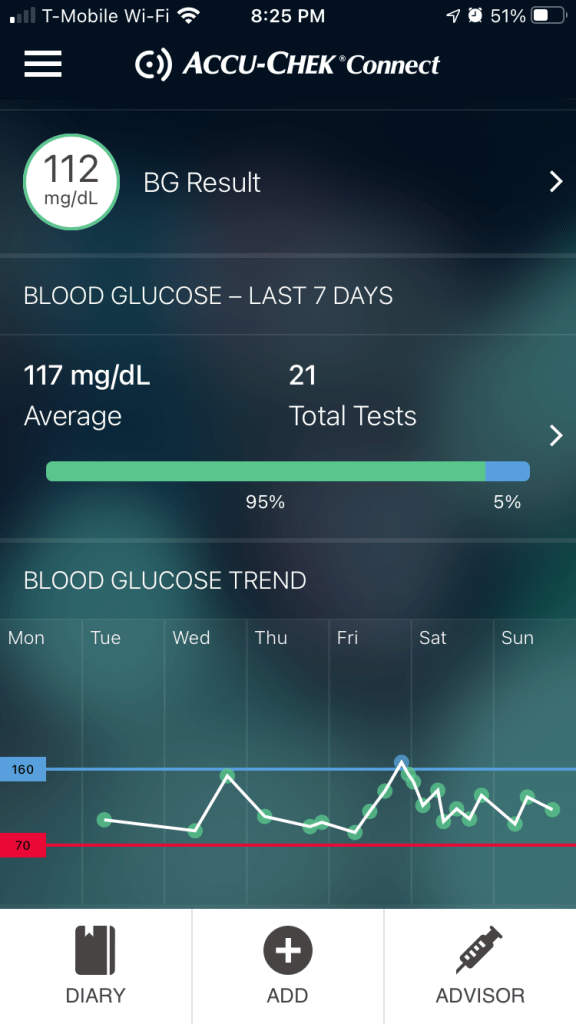
I also sent this screenshot from my glucose meter iOS app. The average over seven days was 117 mg/dL. I hope the readings are sufficient to delay the insulin injections, or at least convince the endocrinologist to order another fructosamine test to verify the first set of results.

While we’re talking about lab results, I also did a lipid panel at the same time. The results were all in the normal range except I have low LDL.

My results are:

  • Total Cholesterol = 130 mg/dL
  • Non-HDL = 71 mg/dL
  • LDL = 57 mg/dL
  • HDL = 59 mg/dL
  • Triglycerides = 71 mg/dL

The chart above doesn’t mention triglycerides but the Mayo Clinic defines normal as <150 mg/dL. I’ve been on the highest dose of Crestor (40 mg) for many years so it’s probably the drugs doing the heavy lifting. I do want to talk to one of my doctors to see if they can lower the dosage. I don’t believe I’m experiencing any side effects but it’s always better to cut down on medication if possible.

==========

Updated: 12/15/2020 6:35 am

Blood glucose reading from last night before bedtime was 103 mg/dL and 84 mg/dL this morning. That’s well within the normal range.

Blood Pressure Fluctuations

My blood pressure (BP) has been pretty unstable since the ablation procedure. Some mornings I would get a low reading around 110/70, and other days I would get something around 180/100. If I take my morning BP medication when the readings are low, invariable I would be dizzy while walking into dialysis. However, since some of the drugs get filtered out during dialysis, my BP would usually rise during the session instead of dropping as fluid is removed from my bloodstream.

On Thursday morning, the BP reading was kinds of normal so I skipped taking the BP medications. My BP ranged from 120/70 to 180/100 during the course of the dialysis session. Prior to going to see the endocrinologist, I think I measured about 156/90 at home so I took the two morning pills before going to the doctor’s office. Imagine my surprise when the assistant measured a 186, followed by a 201. I told her that due to dialysis, my BP numbers are very unstable, and I have nephrologists and cardiologist looking at it. I was surprised that the endocrinologist didn’t mention anything during an otherwise very thorough office visit. She did end up calling me later to tell me she wants to discuss my BP. I hope she doesn’t issue me any more super expensive medications. I already have three other doctors prescribing BP meds and it seems none of them coordinate.

New Diabetes Medication

The endocrinologist I saw on Thursday didn’t like the fact that I’m not on any diabetes medications. She said that due to some of the drugs administered during dialysis, my glucose meter and A1C readings will be lower than actual. She ended up prescribing a newish drug called Tradjenta. We placed the order with my online pharmacy so I can get a 90 day refill. I just saw the invoice online. Since I’m over my out-of-pocket maximum for the year, I don’t have to pay anything. However, my work insurance plan paid $1,256.72 for the 90 pills. That’s $14 dollar for one pill.

I’m beginning to think the medical system in the United States is seriously broken. Why can the rest of the world pay nothing for drugs while we (Americans) pay ridiculous amounts for the same pills? Trump wants to pass a MFN (most favored nation) clause for prescription drugs. I think that means Medicare automatically gets the lowest price negotiated for the specific drug worldwide. That would likely shift the cost burden immediately overseas if drug companies have to charge the same price everywhere. I’m all for it since we (Americans) have been subsidizing the world’s medication costs.

Meanwhile, I’m not sure why I’m taking this expensive pill. Even if the glucose meter is low, I’m getting reading in the 80’s already. If I take the medication and I get readings in the 60’s and 70’s, I would be freaking out about hypoglycemia. If there is no difference in blood sugar readings, then how do I know the drug is doing anything? I can buy an awesome lunch or dinner for $14.

==========

The doctor’s office gave me a 7-pill sample pack of Tradjenta since the online prescription order takes a few days to get here. That’s like getting $100 for free! The drug companies must be making huge profits if they’re just handing out “$100” everywhere.

Mail Order Prescriptions

My work health insurance offers a mail order prescription option. The online pharmacy would send me a three month supply of the medication for one co-payment. However, you have to get your doctor to fill out one of their forms and fax it in. I haven’t done this for any of my prescriptions yet since most of them are still changing. Right now I get all my medications from the Sav-On pharmacy located inside the local Albertson’s supermarket. It’s really close but still a pain since all of them refill at different times and I (or my parents) end up going there 5-6 times each month.

I just noticed in the pharmacy app that I can have them ship the medication to me. If I wait 2-3 days, it’s also free. Since these aren’t urgent refills, I asked the pharmacy to ship the latest batch of medications. If this works out, I’ll probably have them ship everything in the future so I can avoid going into the market.