New Computer

I just ordered a new computer. It is the new 14″ MacBook Pro with the M1 Pro chip. I was going to buy it in early December, but my sister was going on a trip to Oregon and wanted to see if she could find it at a Costco up there. Oregon does not have sales tax. At the time, I could have picked one up at a local Apple Store. By the time she went to Oregon, every MacBook is sold out, everywhere.

I ended up just ordering from the Apple Store website today. The computer won’t arrive until 3-4 weeks later. I do not know whether the new MacBooks are super popular or if production is affected by the semiconductor supply chain issues. Anyway, this is the model I bought:

https://www.apple.com/shop/buy-mac/macbook-pro/14-inch-space-gray-10-core-cpu-16-core-gpu-1tb#

I did not purchase any additional software or peripherals, so the price was $2,499 plus $4 recycling file and sales tax. Total was about $2,700. It is a nice computer, but that feels really expensive. It is to replace my old mid-2012 MacBook Air that has been running slow, and it does not even have the latest OSX version.

I mention this because I would not have purchased it several years ago. It seems way too expensive. But after going through dialysis, heart surgery, and kidney transplant, I am less concerned about being too frugal.

Life Expectancy Post-Transplant

I read on Reddit that each year of dialysis shortens your lifespan by five years. I am fairly sure someone just made that up, but I tried googling anyway. There was nothing that substantiated that claim, but I did find this paper from 2010.

The expected mean survival of a 55-year-old American is 26 years.
According to the United States Renal Data System (USRDS) 2009
report, the expected survival for a 55-year-old person with a kidney
transplant is 15 years, but the expected survival of a 55-year-old
person on dialysis is only 5 years.

https://www.ncbi.nlm.nih.gov/pmc/articles/PMC3116337/#:~:text=The%20mean%20survival%20for%20all,is%20somewhat%20over%2065%20years.

I am 53 years old. Not counting the three and a half years I was on dialysis, if we add 15 years, then I can expect to live to sixty-eight. If I were still on dialysis and waiting for a deceased donor kidney, chances are I would be dead before receiving a transplant. Sobering.

The most important question for me now is when I should retire. Since the study was more about frequent versus conventional dialysis, there is not much more detail on post-transplant life expectancy. If we use seventy-five as a stretch goal, I have 22 more years to live. A while back, I estimated that I can live comfortably on $50k-$60k per year. I do not have any debt: house, car, and student loans are all paid-off, and I pay my credit card balance in full every month. If we use $60k, then that is about $1.3M without inflation. If we assume a 2% inflation, then the total is $1.6M. At 5% inflation, the total I will need for 22-years is $2.3M.

Finally, the elephant in the room is health insurance. If I retire before sixty-something, I will need to purchase my own health insurance. Pretty sure that will be a lot with all my health issues. No idea what to do about that yet. Move to Canada?

Conflicting Mask Guidelines

Due to the large increase in numbers of COVID infections, Los Angeles County has resumed a mask mandate for indoor interactions. Accordingly, my work sent out an email Saturday reminding all employees that masks are required again starting Sunday. So far so good.

Last night, another email comes out after hours and basically says the county mandate is inconsistent with the science and recommendation of the CDC, so anyone that is vaccinated does not need to wear a mask indoors. Huh? There is no “company policy” exemption in the county’s order. What the heck is going on?

Obviously, the second email came from our CEO. Even though the email came from HR, there is no way some random employee sends out an email that advocates violating a county health order. Our CEO often says controversial things on Twitter, but this is no joke. More people are getting infected again, likely due to the Delta variant. You can’t have people sending mixed messages. Someone in my department just tested positive for COVID last week and they were fully vaccinated. What if that was me? Would I feel anything? Lose my transplanted kidney? Have to go to the ICU? Or even die from a number of complications?

This just means there’s no way I am heading into the office anytime soon.

House + Dog Sitting

I just dropped my sister (the kidney donor) and her family off at the airport this morning. They are going to Florida for a soccer tournament and the flight was leaving from Ontario airport. We left Irvine at 3:50 am to get to a 6:15 am flight. Out of all the airports in the metro Los Angeles area, I have never been to Ontario and Burbank airports. However, I did used to travel a lot out of Los Angeles and John Wayne (Santa Ana), and I flew to Las Vegas from Long Beach once a long time ago.

Anyway, the soccer tournament is for my older niece. Most of the teams are from West Coast, but when the tournament was being organized, they did not know if California would be open due to the pandemic. Of course Florida never really closed, so the organizers chose Florida. They will be gone for 11 days, and I have to stay at their house to let in a few service people and watch/feed their two dogs.

Waiting for breakfast

It is now 7:15 am and I did not receive a call so mostly likely everything was fine and their flight took off from the airport. Since there were four of them plus luggage, we drove my sister’s Acura MDX. I wanted to take my Tesla Model S, but likely could not fit everything. Coming back by myself from the airport, driving an internal combustion engine (ICE) car was terrible compared to an electric vehicle (EV). I kept over-revving the engine, even with a 9-speed automatic transmission. Also, I kept expecting the car to slow down when I release the accelerator due to electric regeneration, but an ICE car will coast for quite a distance. I also use Tesla’s AutoPilot all the time on the freeway, so it was weird to have to constantly steer and brake while driving. I know, first world problems.

Finally, since I am still working full-time, but my sister wants me to stay at their house, I had to bring over my work computer setup: notebook computer, dock, keyboard/mouse, wireless headset, and some cables. Luckily, she has a home office with dual monitors I could use. I also had to bring my old MacBook Air for personal stuff, and set that up in a separate office (they have two). I am pretty much set except their microwave oven is broken, and repair guy will not be here until Tuesday. I will probably go back to my house to eat, since it is only a five minute drive.

So, what do you call it if you are working from home, but at someone else’s home?

==========

My niece made me a two-week calendar with all the “events” I need to watch out for, along with a bunch of notes. She also created a couple of instruction pages in PowerPoint about doggie care. At first I was thinking, “I managed cash for a multi-billion company, surely I can watch two dogs.” However, you would be surprised how much goes on in a family with two kids and two dogs. I may need to call my parents to come and help if work gets busy for the next two weeks.

10 Year Anniversary

A coworker wished me a happy 10 year work anniversary. I started at my current job on June 20th, 2011. Since I took two medical leaves and worked 3/4 time for a few months, it is more like I worked here 9.5 years instead of the full 10 years. At my last job before this one, I worked for about 11.5 years, so 10 years is not even the longest I have been at one company. Unfortunately, my marriage was shorter than either of my last two jobs.

My current boss also hired a bunch of our coworkers from the prior company during 2011 so there will be a few 10 year work anniversaries coming up. Some companies give out pretty substantial gifts of mementoes or major tenure milestones. Our company does not. I basically got nothing for my 5 year anniversary.

==========

For the first few years, I worked a lot of hours. I was basically the only person in my function for the entire company so I had to fix a lot of bad processes and come up with new ones. I did hire a few people early on, but there were a handful of coworkers. Today, there are about 40 people doing the same work, though obviously with more scope and in more detail. Since the commute was up to three hours each day roundtrip from my house, I rented a room from a friend close to work. It cut the commute down to about 10-15 minutes each way on local streets. I stayed there for about 2-3 years until the friend got married and booted me out. During that period, I would regularly stay until after 9:00 pm at work, and often eat all three meals in the work cafeteria. I would also go into work on weekends if I did not go back “home” in Orange County. Life is kind of monotonous if you are single when all your friends are married with children. My life was work and sleep, with the occasional Saturday off to watch TV. More recently, it was work, sleep, and dialysis, even on Saturdays. Life is better definitely better post-transplant, but I still sit around at home a lot.

I-405 = Freeway Hell

So I went to the main UCLA campus for a couple of kidney ultrasounds today. The appointment was at 2:00 pm. Since it is Friday, I knew traffic would be bad. Still, I spent a total of 4 hours driving today. I left my house at noon-ish, and arrived at UCLA at 1:20 pm. Since I needed to pick up a prescription, that worked out well. The radiology lab was super busy today. With half the seats blocked off due to COVID measures, the waiting room was almost fully occupied. Surprisingly, I did get called at the appointed time, and the ultrasounds took about an hour. The tech was very nice and talkative, so much so that I thought about telling him to pay attention to the procedure. 😀

I paid for parking ($14!) and left UCLA at around 3:00 pm. At first both Tesla navigation and Waze showed a two hour drive back home. As I drove, that slowly grew to two and a half hours. While the Tesla onboard navigation told me to stay on I-405, even though it was basically a parking lot, Waze kept trying to route me off the freeway and onto surface streets, all to save a few minutes. I ignore Waze. With Autopilot in heavy traffic, the Tesla can really drive itself. There are no intersections or pedestrians on the freeway, and it is trivial for the navigation computer to hold the lane and keep distance. IMHO, it is much more work to drive on local streets. I did cheat a bit in Long Beach by driving in a few off-ramps that merged back onto the freeway, along with probably thousands of other drivers. That saved about three minutes according to the nav computer.

One think I did notice though is there are a lot of terrible drivers. Either they are incompetent, or being intentionally dangerous. When Autopilot is engaged in my Tesla, I usually relax more, and get to “spectate” a bit. You really notice how aggressive or entitled some drivers are. I would bet that a lot of the actual traffic slowdowns are caused by inconsiderate drivers forcing others to brake so they can save a few seconds, or jump one space in line. I also saw several cars driving on the shoulders at fairly high speeds while the regular lanes are stopped. Super dangerous.

I guess I am spoiled from not driving to work for the past 15 months. One silver lining of unknown vaccine efficiency for transplant recipients is still having a (good) excuse for avoiding crowds. I will likely not have to go into work until we start having COVID vaccine booster shots.

==========

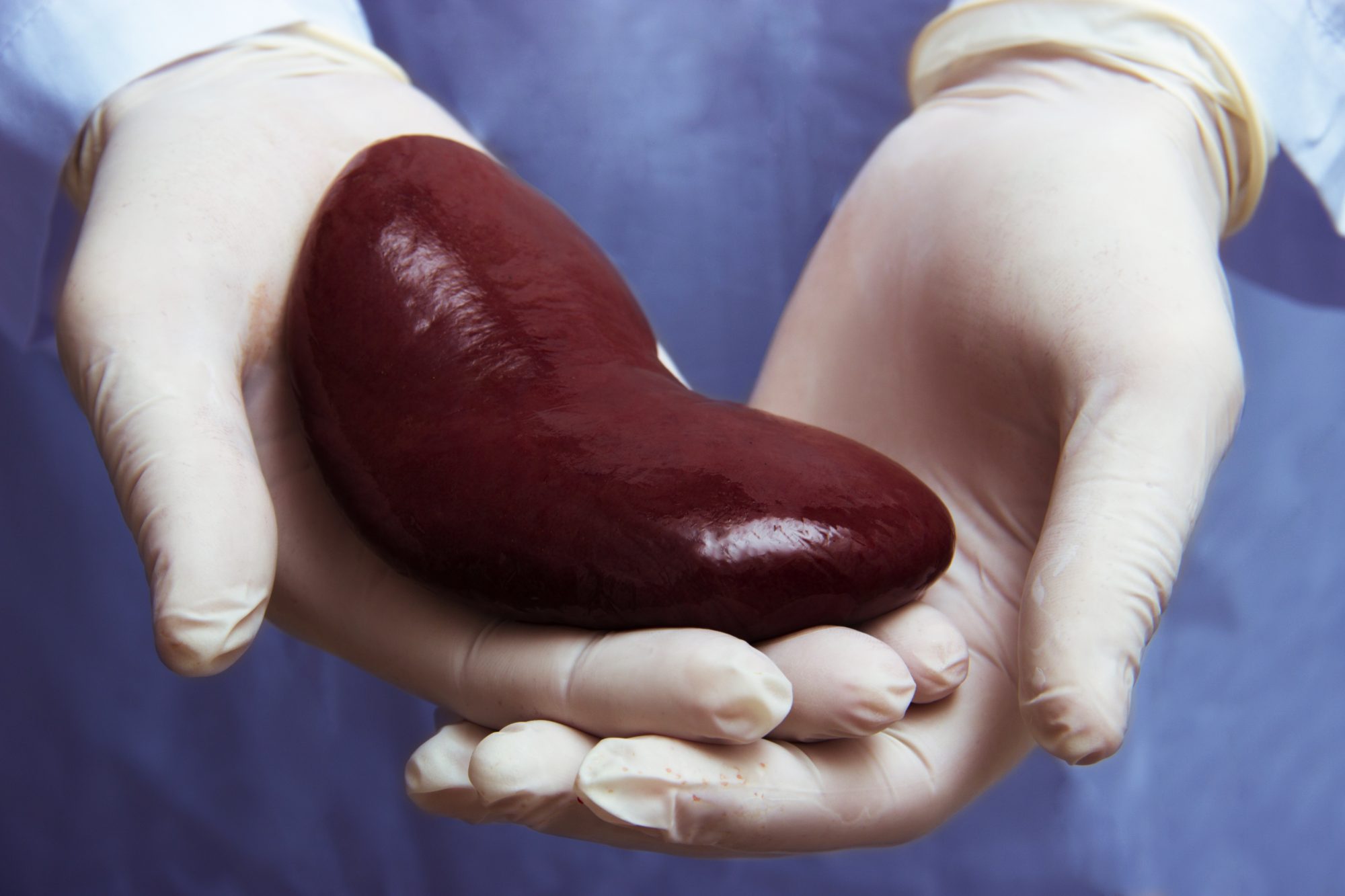
Almost forgot. Since the ultrasound took about an hour, the tech turned the computer screen towards me so I could see the actual images and videos. He also explained a few things to me. It was pretty interesting to see the actual kidney and blood/urine flow in/out of it. Too bad I did not take a photo; my phone was stashed on a chair along with the other stuff in my pockets. I also did not realize how big a kidney was. A few people were posting pics of their “new” kidney. Maybe these were deceased donor kidneys? UCLA certainly did not show me my sister’s kidney before they transplanted it in me.

https://www.openaccessgovernment.org/tackle-kidney-disease/76397/

Not sure if that is a real kidney or just a model for a stock photo, but it is pretty large. I have three of them now. Doctors said bad kidneys will atrophy so maybe my two old kidneys are taking up less room.

Time Management

Now that I am four months post-transplant surgery, I have almost forgotten how much time dialysis take up.

My first hemodialysis (HD) experience started with 3.5 hours twice a week. It eventually changed to three time a week. My scheduled time was from 12:30 pm to 4:30 pm Tuesday/Thursday/Saturday. This was before COVID so I drove to work Monday/Wednesday/Friday, and worked from home Tuesday/Thursday mornings. I would bring my laptop and cell phone, and managed to do some work with the help of my analyst in the office. For weeks where I was too tired to work in the mornings, I took a PTO day to cover.

When I switched to peritoneal dialysis (PD), I started going into the office daily, but that meant zero free time during the week. I could watch TV or use my computer after connecting to the cycler, but would have a 20 foot tube attached to me. I found out later that during dwell times between cycles, I could disconnect the tube, and reconnect before the next cycle. This however, increased the risk of infection each time I disconnected, but I could move around the house for an hour or so.

After the bypass surgery and returning to HD, my schedule was now T/T/S from 5:30 am to 10:00 am. This was fine while I was out on medical leave, but not so good once I returned to work. I ended up doing the same thing as before: going into work 3 days and working from home for 2 days, except in the afternoon. After COVID hit in March 2020, I started working at home full-time. I still took a vacation day here and there to cover for missing hours, but that got tedious too. Finally, I switched to a part-time schedule (30 hours/week) that allowed me to keep my health insurance, but with a 25% pay cut.

Post-transplant, I took about 9 weeks of medical leave, and returned to work full-time starting April 2021. Since I am taking anti-rejection medications, I am working from home every day. I have got used to not seeing people from work, but it is difficult. I think I work better if I can talk to people in person, but realized that society has changed, perhaps permanently, due to COVID. Most of my staff were working from home this past year (all computer related), and will likely work a few days from home each week after things return to “normal.:” For me, after 3.5 years of dialysis, it is still hard to think about the next treatment session. Some days, I lose track of what day of the week it is, and try to join conference calls that are scheduled for another day. In addition, as California is opening up in a few weeks, I do not know what my work expects from office workers that do not need to be there physically. Since I do not know if my Moderna vaccine shots are effective, I will likely stay home for a few months more.

More Training

So I finally finished the Harassment Prevention training that started weeks ago. It was super tedious since I have just went through the exact same material months ago. Overall, it is a good thing to bring more awareness and train people to identify and prevent harassment. However, many times I felt there was definitely a political agenda. Additionally, the material often makes statements that start with “Research shows…” but never has any references to the research. I feel if you are going to pull out the expert authority card, you need to footnote the source.

The next course is Global Trade Controls, where we learn about export controls. I did the export compliance job at a previous company for several years and it sucked. We did hire an external law firm to help, but I think the company employee should also have a law degree or background. The most interesting part of the training is a list of embargoed countries. There are the usual suspects like China (the communist one), Cuba, Iran, North Korea, Russia, Venezuela, et cetera, but now Hong Kong is also on the list. I am not sure when Hong Kong was added; I do not remember seeing it on the list the last time I took this course. I am pretty positive that it is in response to the insane National Security Law that was forced on to Hong Kong recently. I used to love Hong Kong, even though most of the time I was just transiting through the airport. I have only been in the city three or four times, and looked forward to visiting again. Well, that is on indefinite hold now that China has basically trashed Hong Kong. Sad…

Crazy Traffic

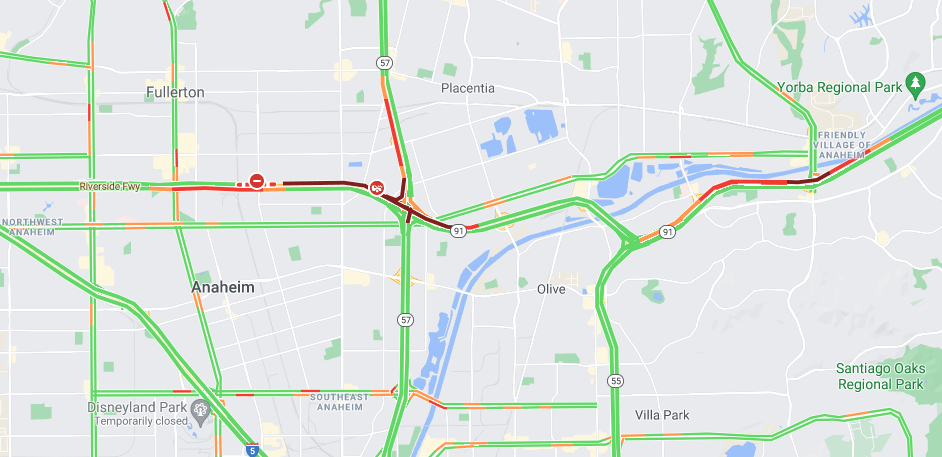
I had a phone meeting at 9:30 am this morning with a coworker (actually my manager since I returned from medical leave). I got on the call at 9:25 am and he did not call in until just now. Turned out he was still driving. He lives in Orange County and takes the 91 freeway to work, but part of it was closed this morning. Caltrans rarely shut down freeways during rush hour so something big must have happened. Next, the off-ramp we need to take to get to work is shut down too for some reason. I just checked Google maps and you can see both closures.

Even worse, he said his Tesla is almost out of charge. Usually you have to get to work before 9:00 am to get a charging spot since there are more EV’s than chargers. He will probably need to find an open Supercharger before commuting home if he cannot find a level 2 charging spot in our parking lot.

Happy that I am working from home.

==========

Aftermath from an earlier police pursuit.

Donor Billing

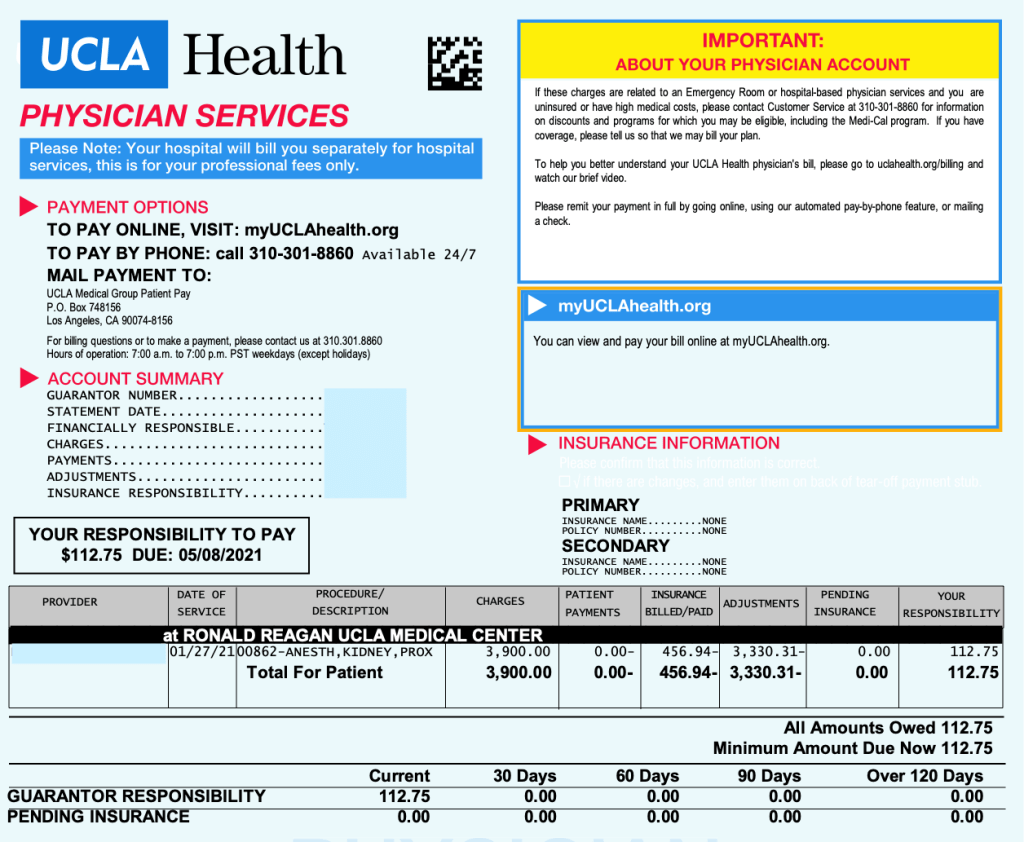
I received my first bill from UCLA for the kidney transplant. The amount due was ~$112 and it was for some pre-op charges for my sister, the donor. I checked my work insurance’s website and there was no rejected claim for that amount. Since I still have Medicare, they did pay for most of the bill, and UCLA billed me for the rest. I checked with my work insurance and they said transplant donor medical expenses are covered, before and after surgery. I also messaged UCLA’s billing department on Monday and they finally answered me today. Evidently, they do not have my secondary insurance information, yet the medical center has billed Blue Shield over a dozen times for doctor charges, hospital fees, tests, and pharmacy co-pays. It it a different account since the charge is for my sister? I believe they use a common patient number across all billing accounts so why are they missing insurance information?

To make things worse, you cannot include attachments to a message reply. You can attach pictures to the initial message, but only two files or something. Anyway, I ended up copying all the information on the insurance card in the reply message. Strange, they can perform a perfect kidney transplant in 3-4 hours but cannot coordinate medical data within the same building. I hope this resolves this billing issue.

==========

Here is the billing statement. The initial amount was $3,900 but there was an adjustment of $3,330.31, which is probably reducing the billed amount to the Medicare price of $569.69. Medicare then paid ~80% (not sure why it is not exactly 80%) which leaves a $112.75 balance.

Again, if I do not have insurance and pay for the transplant out-of-pocket, would I then be billed the full $3,900? That is messed up!

TGIF!

It is Friday! I survived my first week back at work. It has been a week full of meetings via Microsoft Teams, and lots of dead time. I still have a lot of stuff to catch-up, specifically training and a few tasks that have no one backing me up. Thankfully, I was keeping up with work email while I was out on leave, mostly deleting junk mail, so I am fairly current on new messages.

Since my 11:00 am meeting was postponed, I think I am going to finish the final late training course: Sexual Harassment Prevention for Supervisors. Since I did not have anyone reporting to me for a few months, I was told to complete the staff (non-manager) version of the training. Now that I have some staff reporting to me, I have to go through the supervisor version. Estimated time of completion is 120 minutes. 🥱

Every two years…

More Medicare Questions

Ugh. It is pretty cool that Medicare covers dialysis and transplant costs, but everything is so confusing. It is even worse if you have a secondary insurance from work or somewhere else. I endured several months of claim confusion and screwups during the time when Medicare switched to be my primary insurance.

Anyway, the rules state that I can keep Medicare for three years post-transplant. Since Medicare paid 80% of all my medical bills, except for prescriptions, while my work insurance paid the rest, I assume that arrangement will stay the same for the next three years. However, due to my prior salary, my monthly Medicare premiums for Part B is ~$500/month or ~$6000/year. Under coordination of benefit rules, I had to get Medicare since my work insurance will not pay for dialysis after 33 months. They did pay for the remaining 20% of medical bills and all prescriptions.

The premiums for my work insurance is $0; it is covered by the company. I do have a $3400 out-of-pocket maximum, which I hit in January each year due to dialysis. Post-transplant, Medicare continues to pay for 80% of my medical appointments, while my work insurance pays for the rest. Since they are secondary, the $3400 out of pocket max does not apply so I have not paid any medical bills this year, except for co-pays on medications.

So the question is whether I should continue to pay $6000/year for Medicare. If I cancel coverage, then my work insurance will cover everything, subject to the $3400 out-of-pocket max. Without dialysis, I have never come close that number so I will save a few thousand dollars a year. I cannot think of any downsides, other than if I lose my job. I also need to make sure there are no weird rules that says I have to have Medicare while eligible. I would make sense for my work insurance since they (or our company since we are self-insured) end up paying less if I keep Medicare. Also, if I quit or get fired, Medicare will keep covering 80% of my medical bills for three years; I am not sure how long COBRA lasts and it probably cost more than Medicare.

I posted this question on Reddit. Hopefully someone more knowledgeable has experienced the same issues and can help. I will probably call my work insurance too to see if they have any advice.

Back To Work

During my last appointment, I asked the doctor if I could return to work. She said as long as I felt okay, she is fine with me working from home. I followed-up with a medical release form required by my work, got it signed by UCLA, and they faxed it in. Everything has been approved so I am officially back to full-time work starting Monday, April 5th.

My boss, the company CFO, made some organizational changes recently. He did not show me the new org chart, buy a co-worker took a photo and sent it to me. There were a lot of changes, but the one that impacts me the most is adding two layers of managers above me. During the past 10 years, I mostly worked directly under the CFO. However, now it is CFO > Senior Director of Accounting > Director of Finance > me. It is kind of weird since I have the same title as my direct manager but I have been there much longer. The good thing is that all four of us worked previously at the same company for a long time and have known each other for over 20 years. The CFO did say that the reason for my org tree shuffle is because I need to pick up some new responsibilities. Once that’s done, I should be reporting directly to him again. I spoke to the director above me and he did not mention that fact. For now, I do not care that much since my salary did not change, and my “management” will likely stay out of my business.

I also got back the three employees that used to report to me before I switched to part-time last year. I am fine with this since I know them already and they are pretty good employees. I just do not like doing formal performance reviews since I usually talk to my staff daily.

Since most people at work are not vaccinated yet, I will work from home full-time. I am not sure when I will actually go into the office, but it will be several months out if it happens. There is probably about a half-dozen new hires that I have not met yet. Strange to think 10 years ago I was the only corporate finance employee other than the CFO.

Potential Cost of Medicare For All

I have been sleeping pretty well last few days, but for some reason, I cannot fall asleep tonight. It is 3:45 pm and I have not slept at all. Instead, I have been browsing Reddit and came across this post. It is nothing new; there is probably something about “free healthcare” posted every minute. Since Reddit users are mostly young and liberal, you can guess how these discussion usually go.

Politically, I am probably more liberal socially (for an American) and more conservative fiscally. Basically people should be able to do what they want, as long as I do not have to pay for it. Also, the post above is asking doctors for their opinion. I am not a doctor, just an experienced patient, but I feel qualified to discuss the financial impact of “universal” healthcare.

First, some data. Medicare was 14% of the US federal spending in 2019, or about $644 billion. Next, the medical insurance recorded medical costs of $632 billion and administrative costs of $88 billion. Overall, the industry only has a 3% profit margin, or about $22 billion. If we enacted “free’ healthcare, in the short-term, Medicare costs will increase by 100% or more since costs will not change much initially, but demand will likely increase. In 2019, insurance companies collected $735 billion in premiums so I guess companies/individuals can just pay that as a tax. However, since half of the population do not pay taxes, the impact of any new “healthcare” tax will impact middle and upper class Americans. Another issue is Medicare reimbursement rates are much lower than private insurance. A lot of doctors either do not take Medicare or limits the number of Medicare patients. What happens when Medicare is the universal insurance? Will doctors and hospitals agree to what essentially a huge pay cut?

Finally, as mention above, I really hate the word “free” because it is not free. In reality, it just means someone else is paying for it. Reddit comments like to say that insurance profits will save lots on medical costs. Yes, $22 billion is a lot of money, but it is tiny compared to the size of the healthcare market. The solution is probably to focus on preventive medicine and force doctors and hospitals to make less money. Will that work?

==========

Since I am missing a lot of demographic data, I will use my company as an example. We are self-funded, which means the company pays an insurance company (Blue Shield) a small fee ($40 PEPM*) to use their provider network and negotiated prices. Our costs are around $850 PEPM, and some employees pay a premium. If we use $800/month, that works out to $9,600 per employee annually. If the company pays that to the government as a corporate healthcare tax, then I am agnostic. However, I know from speaking to our insurance broker that $850 PEPM is very low, as our employee base is pretty young. Most other companies in the industry spend more. Our company switched to a self-funded model to save money, but a universal healthcare tax may just spread costs based on averages and we would pay more. Even worse, if our company just gave everyone $10k to cover the new healthcare tax, I am pretty sure my tax increase will be a lot more than the $10k since I am in the group that pays taxes.

Sigh. I see the benefit of universal healthcare. People do not have to worry about going bankrupt from medical bills, and it will probably increase the health of poorer Americans. However, if we cannot control costs, then we could have worse health outcomes and a damaged economy. I have a lot of relatives in Canada. They pay a lot more taxes for their “free” healthcare, and while it seems like a better system for small health problems, it is absolutely terrible for serious illnesses.

*PEPM = per employee per month.

Work Laptop Security

Security is good. There seems to be computer hackers everywhere trying to steal your identity or information. Our work is hit especially hard, since we have hostile foreign nations trying to break into our computer systems daily.

Just today, I got a popup window on my work laptop to enter a password/PIN to enable bitlocker. This is something that blocks the computer from booting up if the password/PIN is not entered correctly at startup. Again, having security is good, but this is approaching overkill. To get to my work files, I now have to enter the bitlocker password/PIN when booting up the computer, then log into Windows 10 with my userid and password, then enable our VPN, which requires the same Windows password plus a six digit code from Microsoft Authenticator. If I need to remote in to my desktop at work, I need to run Remote Access and enter my Windows password one more time. All this is made harder with restrictions on our work password. I think it needs to be at least 20 characters and cannot repeat eight prior passwords.

No wonder people write down userids and passwords on a Post-It and stick it on their monitor.

More Critical Illness Insurance Update

In a previous post, I mentioned that Allstate approved and paid me $50,050 for my kidney transplant since it was covered under the critical illness insurance I enrolled in at work. They were also reviewing some older illnesses that I assume they found in the backup documents for the transplant claim.

Since then, Allstate approved my claim for ESRD, which also pays out $50k. I just received the check in the mail yesterday for $49.790; I think I missed a few premium payments while I was out on medical leave for my heart surgery. When I called Allstate a few months ago regarding this “potential” claim (I had not filed a claim yet), they said usually claims are limited to one-year after starting dialysis, but to try anyway. I guess 3.5 years is not too late.

That leaves an open claim for my heart surgery from November of 2019. Again, I did not file any claims but Allstate started on anyway. I did send in some requested backup documents a few weeks ago. In the benefits document, CABG surgery was covered at 25% so I was expecting $12,500 if the claim was approved. Well, this morning, Allstate sent me a message that the claim was approved for $50k again. I was confused so searched and found the EOB (explanation of benefits) document for that claim, and it turned out it was for both a heart attack and the bypass surgery. Heart attacks are paid out at 100%, so that is where the $50k came from. The CABG surgery was denied since it was considered the same “event” as the heart attack. So all together, Allstate is sending me $150k in total claim payouts. I sure hope this is not taxable.

==========

I wonder if I waited for 90 day after the initial ER visit in November 2019 for the CABG surgery, would Allstate treat that as a separate event/claim and pay out another $12,500? I would probably be dead now though.

Allstate Critical Illness Insurance Update

As I mentioned before, I signed up for this extra insurance since the beginning of 2017, but never bothered to fill out any claims. Based on the recommendation of our company’s benefit department, I even chose the highest coverage level, which is $50k per incident.

When my kidney transplant surgery was scheduled, I made sure I printed out all the claim forms since I did not do so for dialysis and heart surgery. I handed the documents to the post-transplant coordinator who then gave it to a social worker. She managed to get the attending doctors to fill out the form and return them to me. I still do not know how Allstate received the claim but they entered three claims into their system: kidney transplant, heart bypass surgery, and ESRD/dialysis. The weird thing is that the UCLA social worker said I needed to fill out some sections of the form so she is returning them to me. Did she also file them with Allstate? Why did Allstate start three claims instead of one? How did they even find out about the other two incidents if I did not file any claims? Weird.

By the time I found out that the claims were filed, Allstate had already approved the kidney transplant claim. They approved the entire $50k amount and when I got home from two weeks in Westwood, the check was already in my mailbox. Today, I got an email saying that another claim status was updated. Allstate had wanted some documentation on the ESRD/dialysis start date and an operative report for the bypass surgery; I sent those in last week by mail as well as uploading files to their website. Well, evidently they also accepted the ESRD/dialysis claim, so another $50k is coming. All we are waiting for now is the decision on the heart surgery, which only pays out $12,500.

I just checked my paystubs and the critical illness insurance premium is $47.08 per pay period. Assuming 26 pay periods per year over four years, the total cost of the insurance is $4,896. Taking the total payout so far of $100k, the return is 510% annualized. Not bad.

There is another supplemental insurance I am paying for but the premiums are only $6 per pay period. I do not even know what is covered. I should go take a look to see if anything covered has happened to me since I spent so much time in hospitals and clinics the last few years.

Insurance Confusion

Ugh. Not only does the United States seem to have the most complex health insurance system, nobody seems to understand the nuances. When you have more than one insurance provider, the confusion seems to grow exponentially.

As mentioned before, due to ESRD and kidney transplantation, I have Medicare Part A and Part B. However, I do not have Part D for prescriptions because that’s not part of the ESRD coverage, and I have Blue Shield from work that covers prescriptions. All good so far. Well, post-transplant, Medicare is supposed to cover only the anti-rejection medications, but under Part B for services and supplies, not Part D for drugs or prescriptions. At UCLA, since they deal with this everyday, they billed Medicare Part B for the three anti-rejection medications, and Blue Shield for the rest. After transferring the prescriptions to my regular pharmacy (Albertsons) and mail order (Express Scripts), they both billed the anti-rejection medications to Blue Shield. Two problems: 1) there is no copay for Medicare but there is with Blue Shield, and 2) since our work insurance is self funded, my company ends up paying thousands for the prescriptions when they’re supposed to be paid by Medicare. I called both Albertsons pharmacy and Express Scripts and both said they only bill Medicare Part D and not Part B. Luckily, UCLA pharmacy said they will keep filling my prescriptions as long as the prescribing doctor sends the scripts there. I don’t know if this applies after UCLA hands off care to my regular doctors. The copay is not too bad, only $10 per prescription refill. Since I am paying >$500/month for Medicare, I should probably use it.

Post-transplant, Medicare pays for anti-rejection medications for three years. That was just changed to lifetime coverage. I am 52 so I will get regular Medicare in 13 years. If I am done with dialysis and already had a transplant, why do I need Medicare if my work insurance will pay for the anti-rejection medications? That means I have to keep working or buy my own insurance but surely it’s not efficient to pay a lot for Medicare if it only covers the three drugs. I need to find out more.

Short-Term Disability, Again

This is the second time I am on medical leave in the past 12 months. The last leave was for my heart surgery when I was out from November 2019 to January 2020. FMLA only provides 12 weeks of leave for a 12 month period. Since the transplant surgery was at the end of January, I qualified for another 12 weeks of medical leave. In fact, my company contracts a third-party company to managed leave administration. After sending in some paperwork, they approved my leave.

This year, our company made a change in the way we manage short-term disability. In the past, employees would need to apply for disability payments directly with the Employment Development Department (EDD). I had to do this last time and the process was very frustrating. The EDD website is terrible, and there is no way to reach a human for help. It took several weeks for me to get my disability application approved by EDD and to receive payment. This year, the third-party company does all the work, and I was just approved for $1,357 per week. The payment is 60-70% of your weekly pay, but maxes out at $1,357 starting in 2021. Our company also provides supplemental disability but the total amount (with state disability) is capped at $1,600 per week. That works out to an equivalent annual salary of $83,200. Working only 30-hours per week and receiving 75% salary did not have any impact on disability payment amounts.

Initially, I did not want to take medical leave since I thought I could “go back” to work within weeks since I am working from home. However, there are a lot of clinic visits and other appointments that it would be difficult to work full-time at the same time.

City of Orange Business License Tax

Highway robbery!

For several years, I was helping my friend with his company in China. Every quarter, I would take a week of vacation from my day job, travel to China, and help with some finance stuff like planning and fundraising. Anyway, he pays for my airfare, but there are some other travel expenses out-of-pocket, so I file is as business expenses on my taxes. Typically it’s no more than a few thousand dollars a year. This hasn’t been a problem until I moved to the City of Orange. I guess either the IRS or FTB (California Franchise Tax Board) shares my tax data with the city. They came with a demand letter for me to get a business license and pay taxes on my business expenses. Since I have no revenue from my “business”, I end up paying the minimum, which is still $65 or something, and file paperwork. It’s total bullshit. The city does exactly ZERO for me. I don’t have any customers or suppliers. It just expenses from business travel that were not reimbursed.

As I’m cleaning out years of old mail, I found a folder of paperwork related to the business license. I finally got tired of the bureaucratic nonsense and stopped reporting expenses on my taxes. That didn’t matter for the City of Orange. Even though I filled out paperwork to end the business, each year, they would come and demand their license tax. I even found a OMC Violation/Notice of License Due citation. This is several years after I filed multiple times to terminate my “business”. They want me to renew my license (no way) and pay a $50 non-compliance fee. Otherwise they will fine me $1000 and throw me in jail for 6-months, all for $65 for a business tax on a non-existent business. This was back in 2017; I think I ignored it because what else can I do after filing the same paperwork multiple times with no effect.

As I go through old mail, almost every piece of mail from the City of Orange is for more money. I just got something about landscaping going up 14% for the next four years or something. Sewer costs have gone up, as well as a paramedic tax. In fact, I’ve paid the paramedic tax for 10 years. The first time I needed the ambulance, they promptly charged me $1900. It took months to get them to look at their records and acknowledge that I’ve been paying the insurance. I think they just charge you and see who complains. Super corrupt and incompetent.

That is why for every election, in the section for City of Orange, I will chose a random person that is not the incumbent. Sure it probably has no effect on the results, but it’s my protest vote against these corrupt a$$ holes.