Hurricane Elsa

https://www.nhc.noaa.gov/refresh/graphics_at5+shtml/120029.shtml?cone#contents

Information from the National Hurricane Center

So the reason I am dog-sitting for my sister is because they are in Florida for a soccer tournament. They are near Clearwater, which is on the Gulf of Mexico side, about half way up the peninsula. From the map above, it is right next to the black dot marked “2 AM Wed”. Their plan is to fly back on Thursday, July 8th, which is after the hurricane passes. Typically you want to get out before the hurricane.

Of course, days before and after the eye of the hurricane passes, there are high winds and lots of rain, not exactly outdoor soccer weather. They do not know how the tournament will be affected, and how it will impact their schedule. I may be here at their house a few days more.

==========

Also, one of my staff analysts at work travelled to Miami last Thursday night. I think she is flying back Monday so maybe the effects and impact will be minimal. The last hurricane I experienced was probably when I was much younger in Taiwan so ~45 years ago?

Meanwhile, it is 90°F and not a cloud in the sky here in Irvine.

USB Cable Woes

I have purchased a whole lot of USB cables on Amazon. Most were for charging, but I have some USB 3.0 cables for data transfer as well. If you search Amazon, there is literally a million different listings (ok, maybe not one million). They came in different lengths, colors, material, and connectors, but it is likely 99.9% of them are made in China. China makes a lot of stuff, but quality control is usually terrible. Sometimes if you have a Western brand name that cares about quality, they will spend extra money on improving processes and auditing to make sure the products do not suck. If it is a local Chinese manufacturer selling, then all bets are off.

For example, I bought a set of six USB-A to Lightning charging cables. They were color coded by length, and covered in a braided nylon looking material. At first, they worked well, but it is very difficult to screw up a charging cable. Over time however, the cables started failing one-by-one. I just had the fourth cable out of six fail, as in plug in to AC adapter, plug into iPhone, and… nothing. I believe I bought the set of cables less than a year ago. I cannot be sure because the listing was removed. It was still there when the third cable failed a few months ago. I know this because I tried to find the listing to leave a one star comment, but there was something wrong with Amazon’s site so nothing happened. Now the listing is gone so I cannot even leave a nasty message for the shitty vendor.

I have always had good luck with Anker for chargers and cables so I will likely stick with them in the future, even though it is a bit more expensive. That is worth not having to buy new cables every time the cheap stuff fails. I know this does not fit the theme of this blog, but I need to vent so here we are…

==========

Each time a cable from this batch fails, I get a message on my iPhone that says “This accessory may not be supported.” The only option available is Dismiss. I think the connectors in the USB-A connector are either designed wrong, or manufactured poorly. Some of the conductors in the plug must be interfering with each other, leading the iPhone to think you are plugging in a mysterious accessory instead of just a dumb charging cable.

==========

Instead of search through my order history, I searched the entire site and could not find the same cable set. Maybe too many people complained about buying crap that Amazon had to remove the seller. Good riddance.

This Is Water (updated)

What the hell is water?

Someone posted a link to this YouTube video on a Reddit thread. I do not even remember what the discussion was about, but saved the comment. I just watched it, and it was very thought provoking. I will freely admit I often judge people by outward appearance. Not by race or gender, but typically by perceived class and education. I think that comes from a place of arrogance regarding my worldly achievements, some of which are really attributable to more luck than skill.

There is also the reality that I have failed quite often in life. Typically the big three life components are health, relationships, and career. I can probably only claim moderate success in career. For health, this entire blog is testament to all my health issues. Of course, I am in a much better place post-transplant, but that is purely due to my sister’s generosity and the skill of UCLA’s transplant team. For relationships, I basically have zero dating experience growing up, and my ex-wife left me after seven years of marriage. Together with my health issues, I have pretty much given up on finding another partner. Who would want to invest time in a relationship with an old man with a bunch of health issues?

For career, I have worked pretty much constantly since 1995 after receiving my MBA. Before that, I have worked on-an-off since middle school, starting with a cashier position at my uncle’s convenience store. I can understand the rat race mentioned in the video. For most of my finance career, I have worked pretty long hours. It does vary depending on the month, but averaging 60+ hours for months is not uncommon. When I was married, it was “for the family.” But now that I am pretty much permanently single, I do not have a reason to work that hard. The house and car are paid off, and I have saved enough from working so hard for so long that I can retire tomorrow if I wanted to. However, the same question about work also applies to retirement: What am I going to do with my life if I do not work?

Back to the video. Most of that is common sense. If you believe everything revolves around you, you are going to be sorely disappointed. Instead, if you view yourself more as an observer, then I feel you will be less invested in small things around you that do not even matter. The best analogy is something I have posted about several times. I used to drive pretty fast and aggressively. If I do not pay attention, some of that surfaces when there is another asshole driver on the road. You feel like you are in a strange competition, and you have to drive like a madman to win. My way out is to use the AutoPilot feature in my Tesla. I am still paying attention, but the perspective becomes “the car is driving” and I am just along for the ride. If you remove yourself from the competition, then it all seems petty and unimportant. I find my aggression and frustration drops a lot if I relax and let AutoPilot do 90% of the driving.

If there was just an AutoPilot function for life.

==========

Here is the full commencement speech by David Foster Wallace. He is an American author, and unfortunately passed away in 2008. I think I need to find out more about his writing.

==========

Updated: November 3, 2022 @3:20 am

Well, videos about David Foster Wallace’s commencement speech keeps getting removed. I guess he registered the speech with Zebralution, a German digital media distribution company. I hope he puts out his own YouTube video or something. The speech is inspiring and will be a shame if he just locks it up behind copyright walls.

This will probably get flagged too and removed.

==========

Oh, he published a book. He just wants your $10. Go buy his book.

Here is a transcript of the commencement speech.

“Greetings parents and congratulations to Kenyon’s graduating class of 2005. There are these two young fish swimming along and they happen to meet an older fish swimming the other way, who nods at them and says “Morning, boys. How’s the water?” And the two young fish swim on for a bit, and then eventually one of them looks over at the other and goes “What the hell is water?”

This is a standard requirement of US commencement speeches, the deployment of didactic little parable-ish stories. The story thing turns out to be one of the better, less bullshitty conventions of the genre, but if you’re worried that I plan to present myself here as the wise, older fish explaining what water is to you younger fish, please don’t be. I am not the wise old fish. The point of the fish story is merely that the most obvious, important realities are often the ones that are hardest to see and talk about. Stated as an English sentence, of course, this is just a banal platitude, but the fact is that in the day to day trenches of adult existence, banal platitudes can have a life or death importance, or so I wish to suggest to you on this dry and lovely morning.

Of course the main requirement of speeches like this is that I’m supposed to talk about your liberal arts education’s meaning, to try to explain why the degree you are about to receive has actual human value instead of just a material payoff. So let’s talk about the single most pervasive cliché in the commencement speech genre, which is that a liberal arts education is not so much about filling you up with knowledge as it is about “teaching you how to think.” If you’re like me as a student, you’ve never liked hearing this, and you tend to feel a bit insulted by the claim that you needed anybody to teach you how to think, since the fact that you even got admitted to a college this good seems like proof that you already know how to think. But I’m going to posit to you that the liberal arts cliché turns out not to be insulting at all, because the really significant education in thinking that we’re supposed to get in a place like this isn’t really about the capacity to think, but rather about the choice of what to think about. If your total freedom of choice regarding what to think about seems too obvious to waste time discussing, I’d ask you to think about fish and water, and to bracket for just a few minutes your scepticism about the value of the totally obvious.

Here’s another didactic little story. There are these two guys sitting together in a bar in the remote Alaskan wilderness. One of the guys is religious, the other is an atheist, and the two are arguing about the existence of God with that special intensity that comes after about the fourth beer. And the atheist says: “Look, it’s not like I don’t have actual reasons for not believing in God. It’s not like I haven’t ever experimented with the whole God and prayer thing. Just last month I got caught away from the camp in that terrible blizzard, and I was totally lost and I couldn’t see a thing, and it was 50 below, and so I tried it: I fell to my knees in the snow and cried out ‘Oh, God, if there is a God, I’m lost in this blizzard, and I’m gonna die if you don’t help me.’” And now, in the bar, the religious guy looks at the atheist all puzzled. “Well then you must believe now,” he says, “After all, here you are, alive.” The atheist just rolls his eyes. “No, man, all that was was a couple Eskimos happened to come wandering by and showed me the way back to camp.”

It’s easy to run this story through kind of a standard liberal arts analysis: the exact same experience can mean two totally different things to two different people, given those people’s two different belief templates and two different ways of constructing meaning from experience. Because we prize tolerance and diversity of belief, nowhere in our liberal arts analysis do we want to claim that one guy’s interpretation is true and the other guy’s is false or bad. Which is fine, except we also never end up talking about just where these individual templates and beliefs come from. Meaning, where they come from INSIDE the two guys. As if a person’s most basic orientation toward the world, and the meaning of his experience were somehow just hard-wired, like height or shoe-size; or automatically absorbed from the culture, like language. As if how we construct meaning were not actually a matter of personal, intentional choice. Plus, there’s the whole matter of arrogance. The nonreligious guy is so totally certain in his dismissal of the possibility that the passing Eskimos had anything to do with his prayer for help. True, there are plenty of religious people who seem arrogant and certain of their own interpretations, too. They’re probably even more repulsive than atheists, at least to most of us. But religious dogmatists’ problem is exactly the same as the story’s unbeliever: blind certainty, a close-mindedness that amounts to an imprisonment so total that the prisoner doesn’t even know he’s locked up.

The point here is that I think this is one part of what teaching me how to think is really supposed to mean. To be just a little less arrogant. To have just a little critical awareness about myself and my certainties. Because a huge percentage of the stuff that I tend to be automatically certain of is, it turns out, totally wrong and deluded. I have learned this the hard way, as I predict you graduates will, too.

Here is just one example of the total wrongness of something I tend to be automatically sure of: everything in my own immediate experience supports my deep belief that I am the absolute centre of the universe; the realest, most vivid and important person in existence. We rarely think about this sort of natural, basic self-centredness because it’s so socially repulsive. But it’s pretty much the same for all of us. It is our default setting, hard-wired into our boards at birth. Think about it: there is no experience you have had that you are not the absolute centre of. The world as you experience it is there in front of YOU or behind YOU, to the left or right of YOU, on YOUR TV or YOUR monitor. And so on. Other people’s thoughts and feelings have to be communicated to you somehow, but your own are so immediate, urgent, real.

Please don’t worry that I’m getting ready to lecture you about compassion or other-directedness or all the so-called virtues. This is not a matter of virtue. It’s a matter of my choosing to do the work of somehow altering or getting free of my natural, hard-wired default setting which is to be deeply and literally self-centered and to see and interpret everything through this lens of self. People who can adjust their natural default setting this way are often described as being “well-adjusted”, which I suggest to you is not an accidental term.

Given the triumphant academic setting here, an obvious question is how much of this work of adjusting our default setting involves actual knowledge or intellect. This question gets very tricky. Probably the most dangerous thing about an academic education–least in my own case–is that it enables my tendency to over-intellectualise stuff, to get lost in abstract argument inside my head, instead of simply paying attention to what is going on right in front of me, paying attention to what is going on inside me.

As I’m sure you guys know by now, it is extremely difficult to stay alert and attentive, instead of getting hypnotised by the constant monologue inside your own head (may be happening right now). Twenty years after my own graduation, I have come gradually to understand that the liberal arts cliché about teaching you how to think is actually shorthand for a much deeper, more serious idea: learning how to think really means learning how to exercise some control over how and what you think. It means being conscious and aware enough to choose what you pay attention to and to choose how you construct meaning from experience. Because if you cannot exercise this kind of choice in adult life, you will be totally hosed. Think of the old cliché about “the mind being an excellent servant but a terrible master.”

This, like many clichés, so lame and unexciting on the surface, actually expresses a great and terrible truth. It is not the least bit coincidental that adults who commit suicide with firearms almost always shoot themselves in: the head. They shoot the terrible master. And the truth is that most of these suicides are actually dead long before they pull the trigger.

And I submit that this is what the real, no bullshit value of your liberal arts education is supposed to be about: how to keep from going through your comfortable, prosperous, respectable adult life dead, unconscious, a slave to your head and to your natural default setting of being uniquely, completely, imperially alone day in and day out. That may sound like hyperbole, or abstract nonsense. Let’s get concrete. The plain fact is that you graduating seniors do not yet have any clue what “day in day out” really means. There happen to be whole, large parts of adult American life that nobody talks about in commencement speeches. One such part involves boredom, routine and petty frustration. The parents and older folks here will know all too well what I’m talking about.

By way of example, let’s say it’s an average adult day, and you get up in the morning, go to your challenging, white-collar, college-graduate job, and you work hard for eight or ten hours, and at the end of the day you’re tired and somewhat stressed and all you want is to go home and have a good supper and maybe unwind for an hour, and then hit the sack early because, of course, you have to get up the next day and do it all again. But then you remember there’s no food at home. You haven’t had time to shop this week because of your challenging job, and so now after work you have to get in your car and drive to the supermarket. It’s the end of the work day and the traffic is apt to be: very bad. So getting to the store takes way longer than it should, and when you finally get there, the supermarket is very crowded, because of course it’s the time of day when all the other people with jobs also try to squeeze in some grocery shopping. And the store is hideously lit and infused with soul-killing muzak or corporate pop and it’s pretty much the last place you want to be but you can’t just get in and quickly out; you have to wander all over the huge, over-lit store’s confusing aisles to find the stuff you want and you have to manoeuvre your junky cart through all these other tired, hurried people with carts (et cetera, et cetera, cutting stuff out because this is a long ceremony) and eventually you get all your supper supplies, except now it turns out there aren’t enough check-out lanes open even though it’s the end-of-the-day rush. So the checkout line is incredibly long, which is stupid and infuriating. But you can’t take your frustration out on the frantic lady working the register, who is overworked at a job whose daily tedium and meaninglessness surpasses the imagination of any of us here at a prestigious college.

But anyway, you finally get to the checkout line’s front, and you pay for your food, and you get told to “Have a nice day” in a voice that is the absolute voice of death. Then you have to take your creepy, flimsy, plastic bags of groceries in your cart with the one crazy wheel that pulls maddeningly to the left, all the way out through the crowded, bumpy, littery parking lot, and then you have to drive all the way home through slow, heavy, SUV-intensive, rush-hour traffic, et cetera et cetera.

Everyone here has done this, of course. But it hasn’t yet been part of you graduates’ actual life routine, day after week after month after year.

But it will be. And many more dreary, annoying, seemingly meaningless routines besides. But that is not the point. The point is that petty, frustrating crap like this is exactly where the work of choosing is gonna come in. Because the traffic jams and crowded aisles and long checkout lines give me time to think, and if I don’t make a conscious decision about how to think and what to pay attention to, I’m gonna be pissed and miserable every time I have to shop. Because my natural default setting is the certainty that situations like this are really all about me. About MY hungriness and MY fatigue and MY desire to just get home, and it’s going to seem for all the world like everybody else is just in my way. And who are all these people in my way? And look at how repulsive most of them are, and how stupid and cow-like and dead-eyed and nonhuman they seem in the checkout line, or at how annoying and rude it is that people are talking loudly on cell phones in the middle of the line. And look at how deeply and personally unfair this is.

Or, of course, if I’m in a more socially conscious liberal arts form of my default setting, I can spend time in the end-of-the-day traffic being disgusted about all the huge, stupid, lane-blocking SUV’s and Hummers and V-12 pickup trucks, burning their wasteful, selfish, 40-gallon tanks of gas, and I can dwell on the fact that the patriotic or religious bumper-stickers always seem to be on the biggest, most disgustingly selfish vehicles, driven by the ugliest [responding here to loud applause] — this is an example of how NOT to think, though — most disgustingly selfish vehicles, driven by the ugliest, most inconsiderate and aggressive drivers. And I can think about how our children’s children will despise us for wasting all the future’s fuel, and probably screwing up the climate, and how spoiled and stupid and selfish and disgusting we all are, and how modern consumer society just sucks, and so forth and so on.

You get the idea.

If I choose to think this way in a store and on the freeway, fine. Lots of us do. Except thinking this way tends to be so easy and automatic that it doesn’t have to be a choice. It is my natural default setting. It’s the automatic way that I experience the boring, frustrating, crowded parts of adult life when I’m operating on the automatic, unconscious belief that I am the centre of the world, and that my immediate needs and feelings are what should determine the world’s priorities.

The thing is that, of course, there are totally different ways to think about these kinds of situations. In this traffic, all these vehicles stopped and idling in my way, it’s not impossible that some of these people in SUV’s have been in horrible auto accidents in the past, and now find driving so terrifying that their therapist has all but ordered them to get a huge, heavy SUV so they can feel safe enough to drive. Or that the Hummer that just cut me off is maybe being driven by a father whose little child is hurt or sick in the seat next to him, and he’s trying to get this kid to the hospital, and he’s in a bigger, more legitimate hurry than I am: it is actually I who am in HIS way.

Or I can choose to force myself to consider the likelihood that everyone else in the supermarket’s checkout line is just as bored and frustrated as I am, and that some of these people probably have harder, more tedious and painful lives than I do.

Again, please don’t think that I’m giving you moral advice, or that I’m saying you are supposed to think this way, or that anyone expects you to just automatically do it. Because it’s hard. It takes will and effort, and if you are like me, some days you won’t be able to do it, or you just flat out won’t want to.

But most days, if you’re aware enough to give yourself a choice, you can choose to look differently at this fat, dead-eyed, over-made-up lady who just screamed at her kid in the checkout line. Maybe she’s not usually like this. Maybe she’s been up three straight nights holding the hand of a husband who is dying of bone cancer. Or maybe this very lady is the low-wage clerk at the motor vehicle department, who just yesterday helped your spouse resolve a horrific, infuriating, red-tape problem through some small act of bureaucratic kindness. Of course, none of this is likely, but it’s also not impossible. It just depends what you want to consider. If you’re automatically sure that you know what reality is, and you are operating on your default setting, then you, like me, probably won’t consider possibilities that aren’t annoying and miserable. But if you really learn how to pay attention, then you will know there are other options. It will actually be within your power to experience a crowded, hot, slow, consumer-hell type situation as not only meaningful, but sacred, on fire with the same force that made the stars: love, fellowship, the mystical oneness of all things deep down.

Not that that mystical stuff is necessarily true. The only thing that’s capital-T True is that you get to decide how you’re gonna try to see it.

This, I submit, is the freedom of a real education, of learning how to be well-adjusted. You get to consciously decide what has meaning and what doesn’t. You get to decide what to worship.

Because here’s something else that’s weird but true: in the day-to-day trenches of adult life, there is actually no such thing as atheism. There is no such thing as not worshipping. Everybody worships. The only choice we get is what to worship. And the compelling reason for maybe choosing some sort of god or spiritual-type thing to worship–be it JC or Allah, be it YHWH or the Wiccan Mother Goddess, or the Four Noble Truths, or some inviolable set of ethical principles–is that pretty much anything else you worship will eat you alive. If you worship money and things, if they are where you tap real meaning in life, then you will never have enough, never feel you have enough. It’s the truth. Worship your body and beauty and sexual allure and you will always feel ugly. And when time and age start showing, you will die a million deaths before they finally grieve you. On one level, we all know this stuff already. It’s been codified as myths, proverbs, clichés, epigrams, parables; the skeleton of every great story. The whole trick is keeping the truth up front in daily consciousness.

Worship power, you will end up feeling weak and afraid, and you will need ever more power over others to numb you to your own fear. Worship your intellect, being seen as smart, you will end up feeling stupid, a fraud, always on the verge of being found out. But the insidious thing about these forms of worship is not that they’re evil or sinful, it’s that they’re unconscious. They are default settings.

They’re the kind of worship you just gradually slip into, day after day, getting more and more selective about what you see and how you measure value without ever being fully aware that that’s what you’re doing.

And the so-called real world will not discourage you from operating on your default settings, because the so-called real world of men and money and power hums merrily along in a pool of fear and anger and frustration and craving and worship of self. Our own present culture has harnessed these forces in ways that have yielded extraordinary wealth and comfort and personal freedom. The freedom all to be lords of our tiny skull-sized kingdoms, alone at the centre of all creation. This kind of freedom has much to recommend it. But of course there are all different kinds of freedom, and the kind that is most precious you will not hear much talk about much in the great outside world of wanting and achieving…. The really important kind of freedom involves attention and awareness and discipline, and being able truly to care about other people and to sacrifice for them over and over in myriad petty, unsexy ways every day.

That is real freedom. That is being educated, and understanding how to think. The alternative is unconsciousness, the default setting, the rat race, the constant gnawing sense of having had, and lost, some infinite thing.

I know that this stuff probably doesn’t sound fun and breezy or grandly inspirational the way a commencement speech is supposed to sound. What it is, as far as I can see, is the capital-T Truth, with a whole lot of rhetorical niceties stripped away. You are, of course, free to think of it whatever you wish. But please don’t just dismiss it as just some finger-wagging Dr Laura sermon. None of this stuff is really about morality or religion or dogma or big fancy questions of life after death.

The capital-T Truth is about life BEFORE death.

It is about the real value of a real education, which has almost nothing to do with knowledge, and everything to do with simple awareness; awareness of what is so real and essential, so hidden in plain sight all around us, all the time, that we have to keep reminding ourselves over and over:

“This is water.”

“This is water.”

It is unimaginably hard to do this, to stay conscious and alive in the adult world day in and day out. Which means yet another grand cliché turns out to be true: your education really IS the job of a lifetime. And it commences: now.

I wish you way more than luck.

https://fs.blog/david-foster-wallace-this-is-water/

More Insulin v2.0

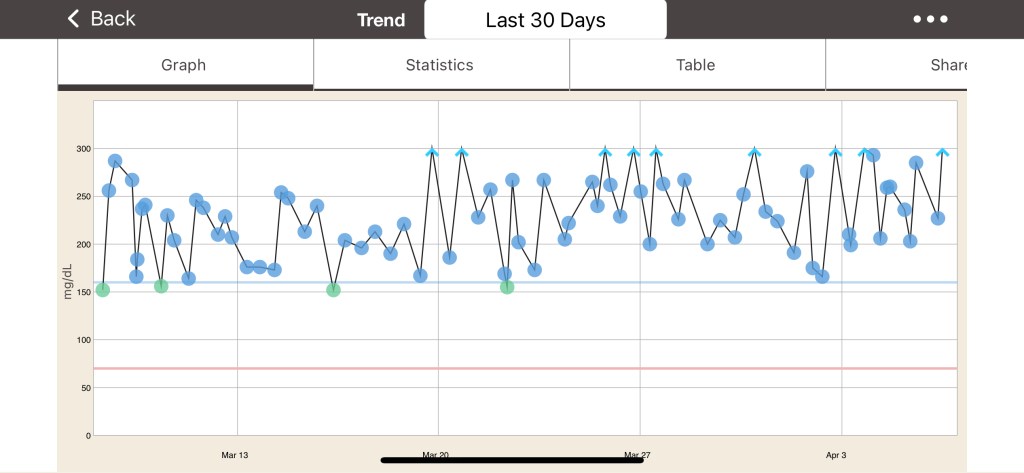
My endocrinologist got back to me today. I sent her my blood sugar readings for the past two weeks a few days ago. Based on the numbers, she decided to increase my insulin dosage again. The daily shot of Toujeo has gone up from 13 units to 18 units, and she added one unit to the baseline Humalog dosage from 5 units to 6 units. Even though my blood sugar is trending lower, it is still not consistently below the magic 130 number.

If you compare this to the previous post, the data points do appear lower, but not enough. I copied the old chart below for easier comparison:

I was hoping the blood sugar situation would improve over time, but it appears I may need insulin for the rest of my life. It does not look like my anti-rejection medications will be reduced further, so any blood sugar effects will remain. Also, maybe my type II diabetes has gotten worse during the past five years, but it was masked by the effect of dialysis on blood sugar levels. Now that I have a working kidney, old problems are becoming more noticeable again.

==========

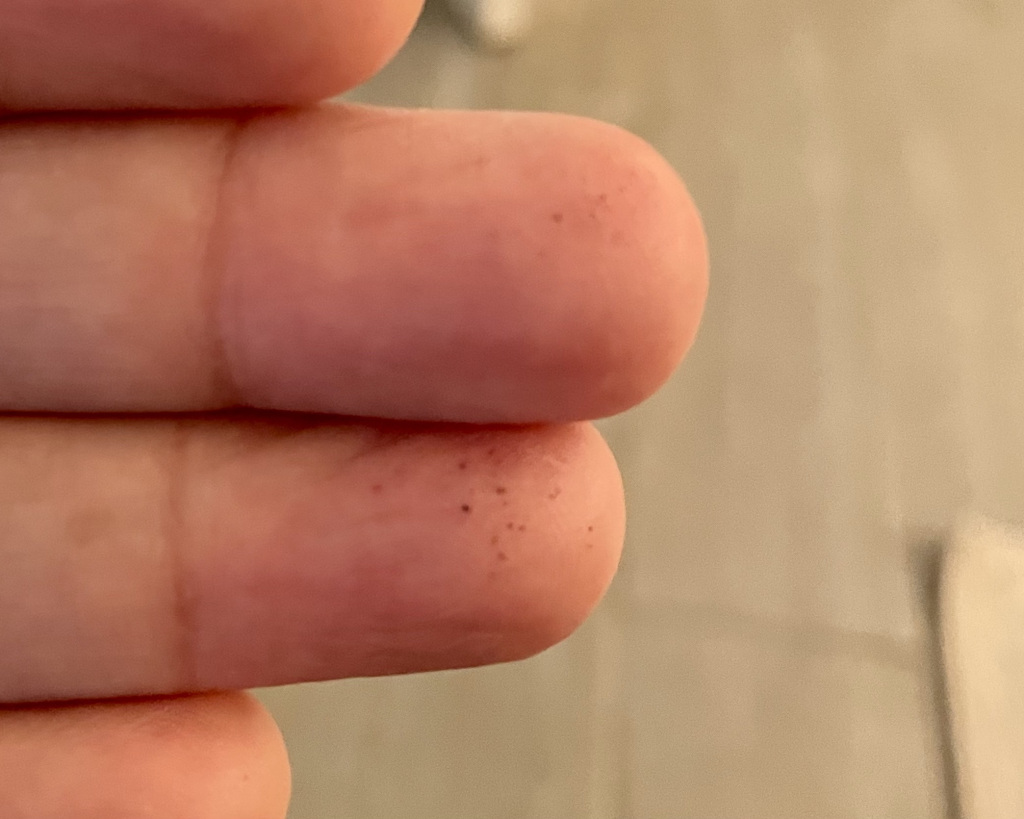
Another frustrating part of diabetes is the number of lancet finger-pricks needed for blood sugar tests. I do three or four tests daily, and since I am right-handed, almost all the blood is coming from my left hard fingers. It is hard to take a photo with the iPhone due to the focusing distance, but you can see a lot of tiny block dots on my ring finger:

The way around this is either not test, or getting a continuous glucose monitoring (CGM) solution. Two of my cousins are using the FreeStyle Libre system, and they really like it. It does contain a sensor will a spike that you have to insert in your arm for the duration. When I was taking blood sugar readings once a day, it was not worth it. Now that I need to monitor it up to four times a day, maybe it is time to reconsider.

Nice PR video. It is painfully obvious Abbott wants to avoid showing patients the huge ass needle on the back of the sensor patch. Maybe you will not feel it after getting used to it, but I would think the needle will hurt for some time. Not as big as dialysis needles, but not tiny like glucose meter lancets or insulin needles.

OG Nephrologist

I just saw my “local” nephrologist. She is not really OG since she is the third or fourth nephrologist I have seen outside a hospital. When I was initially asked to see a nephrologist due to deteriorating kidney function, I found someone close to all my other doctors. I think she was an Indian woman and I saw her for quite awhile. At some point, she left the practice and I was assigned to the main nephrologist, but he was an ass. As soon as they hired a replacement, I was transferred to him, a Korean man. That went on for awhile, but my kidney function kept decreasing. He also left the practice to move to San Diego, so I got a referral from my primary care doctor, and ended up at the current medical practice. I was supposed to see the primary nephrologist, but was scheduled for another doctor who was more available, and she has been my nephrologist for five or six years now.

The was my first appointment with her since my transplant. UCLA was supposed to send a package with all my notes, medications, and test results. Of course, she has not received anything. I was low-key expecting this since UCLA has probably thousands of active patients, and you are monitored by a team of doctors instead of just one. Good think I had all my records on MyChart on my phone. Long story short, she did not change anything in terms medication or care, but she did have lots of questions for UCLA. The big surprise to her was how fast UCLA stopped my prescription for mycophenolate (Cellcept). She said many patients are on that medication for life, yet it was discontinued for me only after a month. She also said that patients typically get more anti-infection medication for longer periods, while I was only one one, atovaquone.

Even though my nephrologist has worked with UCLA before, I believe she refers most of her patients to St. Joseph Hospital for transplant. I also started there, went through orientation and tests, and met the transplant surgeon. Unfortunately, their transplant social worker was terrible, and rejected by sister as a donor for basically no reason. When I retold the story to my nephrologist and dialysis social worker, they both wanted more information so they could refer the transplant social worker to the licensing board for review. We did not follow through however, and just transferred my case to UCLA. It does sound like the St. Joseph transplant surgeon is much more risk adverse, and keeps transplant recipients on high doses of anti-rejection medications for many years. UCLA seems like the opposite. Hopefully I chose correctly.

Microwave Oven Repair

The appliance repairman finally showed up today. He was scheduled to come by from 11:00 am to 3:00 pm, but did not get here until 4:30 pm. I had a bunch of work calls so my mom ended up coming by and sitting in the dining room waiting for him, since my sister did not want to leave him by himself.

He pulled out the in-counter microwave (it was huge), took it apart, and replaced the transformer. However, that was also masking a problem with the capacitor so now he needs to order that part too. All this just means no microwave at my sister’s house for a few more days. That sucks because instead of staying here 24/7, I have to drive home every night for hot meals, since nobody know how to reheat using a stove anymore. Luckily, it is only a 5 minute drive, and I can charge my Tesla at my sister’s house.

Since their microwave is a custom in-counter model, the replacement transformer was $315. If you add tax and $165 of labor, the total was just above $500. An average microwave oven on Amazon is around $100. If you buy a large name-brand model, it is more like $200. They really do not want any small appliances sitting on the counter.

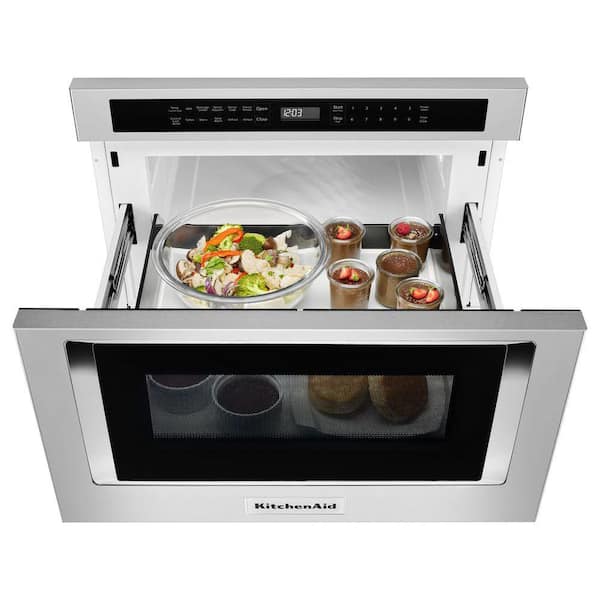
I do not this this is the exact model or brand even, but it is the same ideal. A drawer microwave that does not take up counter space. I do not like it since there is no rotating plate to even out the heating. Also the door takes forever to open and close. Now I find out they are crazy expensive to fix too. If I had a $100 microwave and it broke, I would just toss it and buy another.

ProPublica Kidney Transplant Article

Initially, I ended the previous post with a paragraph regarding an article on ProPublica written by the same journalist that contacted me nine months ago. However, as I read the first few paragraphs of the story, I felt it needed its own post for discussion.

ProPublica is a nonprofit newsroom that investigates abuses of power.

ProPublica begins all their stories with the above line. It pretty much tells the reader their biases and how they will tell the story. After reading the first few paragraphs, I was not wrong.

First, there are plenty of things that are wrong with the dialysis industry. I came up with the following just from memory (no Google):

  • Two for-profit companies control 70% of the market
  • Medicare coverage provides distorted incentive to maintain the status quo and milk the system for profit
  • Very little public awareness on the impact of dialysis on ESRD patients
  • Even less awareness on the need for organ donation

Just from the recent ballot proposition fights in California between the for-profit dialysis companies and SEIU (employee union) demonstrates even the industry cares only about profits and not patients.

Having said that, ProPublica is obviously biased against dialysis and transplant providers. First, if I assume my interview request in September 2020 is related to this story, the timing is a bit off. The actual article was published on December 15, 2020, but the subject of the article passed away earlier in August. So, by the time I was contacted, they already had most of the information needed for the article. What did they need my story for? A supplemental article about how getting a transplant suck for everyone?

If you read about the life of JaMarcus Crews, it is definitely a more compelling story than if they had written about me. JaMarcus was was black, living in Alabama, and likely experienced a lot of discrimination/racism in life and the whole dialysis/transplant process. Me, being a middle class Asian in California and getting relatively good care, will be a boring subject for the story ProPublica wanted to tell.

I found a few questionable items at the very beginning of the article.

When it was over, and all anyone wanted was sleep, JaMarcus drove to the wide parking lot at Target to wait for his cashier’s shift. He missed working at the bank, but a nine-to-five was no longer possible.

It is true that in-center hemodialysis takes up a lot of time, but many people work full-time. ProPublica just says this without any sources or statistics. I worked full-time for the first two years of hemodialysis and during peritoneal dialysis. If JaMarcus was a teller, then he must be at the bank in person, which makes it difficult, but not impossible. He could be assigned different tasks during dialysis days. It heavily depends on how willing employers are to accommodate the employee’s dialysis schedule. I was lucky but also essential to my company, so they were very accommodating.

JaMarcus didn’t tell his wife or son that he was making calculations in his head: most people didn’t survive five years on dialysis. He was nearing seven. His mother had died in year eight.

This one is totally false and can be researched with a quick Google search. I posted on this topic a lot, and most sources say that mortality is 20% after the first year of dialysis, and 50% after five years. That is definitely not “most people didn’t survive five years on dialysis.” The statistics are also skewed by older dialysis patients with multiple medical issues. JaMarcus was 36. That does not mean there is no risk, since JaMarcus did pass away, but the statement is absolutely false.

Having gone through all of this, ESRD and dialysis is definitely a huge problem that needs more attention and research. JaMarcus’s story is sad, and not even unique. I know my comments may be premature based on the first few paragraphs, but one-sided stories like these just entrench people and hinder progress. I am still amazed that I am not dead after years of ESRD and dialysis. If you browse through r/transplant on Reddit, there are lots of anniversary stories from transplant recipients. Of course, the process could be better, but I am hugely grateful and satisfied with my experience. Everyone I have engaged with, from my nephrologist, dialysis nurses and techs, transplant coordinators, surgeons, post-care doctors, to phlebotomists, have been compassionate and caring. The main issue is the scarcity of transplant organs that causes all these issues downstream. ProPublica should focus on that part of our society, but that does not fit their mission of investigating the abuse of power.

Maybe I will change my mind after reading the entire article.

==========

Just saw these lines at the very top of the story:

For years, JaMarcus Crews tried to get a new kidney, but corporate healthcare stood in the way.

He needed dialysis to stay alive. He couldn’t miss a session, not even during a pandemic.

That is lame. Whatever you think about “corporate healthcare” in general, JaMarcus weighed 400 pounds and had heart problems. There is no way he was going to get on any transplant list when healthy people must wait 8-10 years. I can see him getting a transplant if there were lots of organs available, but with only 10% of people on the waitlist transplanted each year, he needs to improve his health situation. No way this is the fault of “corporate healthcare.” Also, WTF is “corporate healthcare?” Of course, it is large hospitals (corporations) doing transplants. You do not want the procedure done in someone’s garage, for fuck sakes.

I also do not understand the second sentence. I had to go to my clinic during COVID pandemic. That is the only place I went outside of my house. Even without a pandemic, dialysis patients cannot miss sessions since that will mess up your health even worse. Is this the fault of “corporate healthcare” too? How is this racism? I thought ProPublica was like NPR: a good news source that leans a bit left. But so far, this seems like a total hit piece.

In hindsight, I am glad the journalist did not follow-up. I would be really pissed off if I were part of this story the way it was told.

Dialysis Interview

I gave an interview yesterday regarding my dialysis experience. It was not with a new organization, but rather a student in the medical field. One of their instructors assigned a project to interview a current or prior dialysis patient. The student said they did not know anyone on dialysis so they posted a post on Reddit r/dialysis for volunteers. I actually see quite a few of these requests, from interview with medical school and bio-mechanical engineering students, to surveys regarding mental health and dialysis patient comfort. Hopefully this interest will lead to better care and improved treatment, including a functional artificial kidney.

Anyway, the interview was over Zoom (no cameras), and took about 40 minutes. Mainly it was about my experience with ESRD and dialysis, and what my pros/cons were with each type of dialysis. Even though I was not on dialysis that long compared to some other patients, I went through a lot of changes and medical procedures in the process, and can compare life before, during, and after (transplant) dialysis. Maybe I can give a decent TED talk.

==========

So about nine months ago, I receive a request from a ProPublica journalist for an interview about kidney transplant wait times. Like above, the request came through Reddit, probably because of my comments about my waiting experience. At the time, I agreed to an interview but wanted to be anonymous since I did not want to risk any negative out-of-context comments affecting my transplant chances. The journalist agreed but never got back to me, and I do not know what happened to her project.

Alkaline Phosphatase

There was a post recently on Reddit’s r/transplant subreddit about high alkaline phosphatase (ALP), and what it means for the transplant.

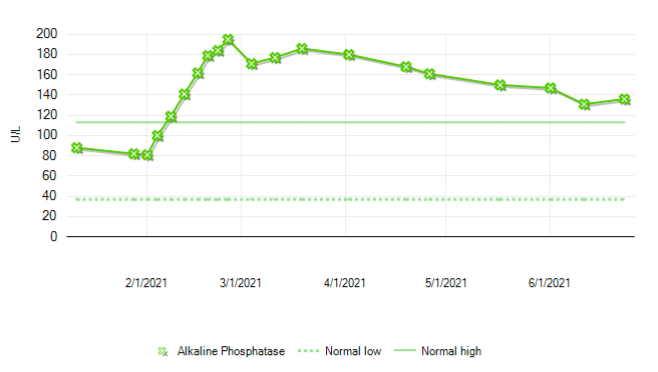
I have wondered about this test as well. My numbers were low post-transplant, but have been above the high limit since mid-February. However, at all my clinic appointments with UCLA, none of the doctors has ever mentioned my ALP results. After a few months, I also just ignored this result in a sea of numbers.

Here are my results. Since the high at the end of February, ALP levels have been steadily decreasing. The OP in the reddit post said his number was around 300; that is much higher than my result results.

I had no ideal what ALP was, other than it was an enzyme from the “ase” ending. MedlinePlus (.gov) had this description:

ALP is an enzyme found throughout the body, but it is mostly found in the liver, bones, kidneys, and digestive system. When the liver is damaged, ALP may leak into the bloodstream. High levels of ALP can indicate liver disease or bone disorders.

https://medlineplus.gov/lab-tests/alkaline-phosphatase/

If you search for ALP and post-kidney transplant, most of the results are from academic papers, which are usually more narrowly focused on something specific and much harder to read/understand. I did find one webpage on NKF, but it mainly focused on bone disease.

There are several comments on the Reddit thread, but I find the level of intelligence on Reddit is generally pretty low. Hopefully, people that comment on medical questions have either medical training or personal experience, but neither has access to the OP’s medical records. I think there is a lot of fear and uncertainty around medical issues, but I would not trust some random comment on an Internet forum. Maybe this is a more worrisome trend of people not trusting their own doctors? Or maybe they want validation on a life choice (illegal drugs, smoking, alcohol use) not recommended by their transplant doctors?

Back to my results, the UCLA doctors were pretty thorough when reviewing my test results each week, so maybe being a bit high on ALP levels is no big deal for now.

Dog Sitting, Day 2

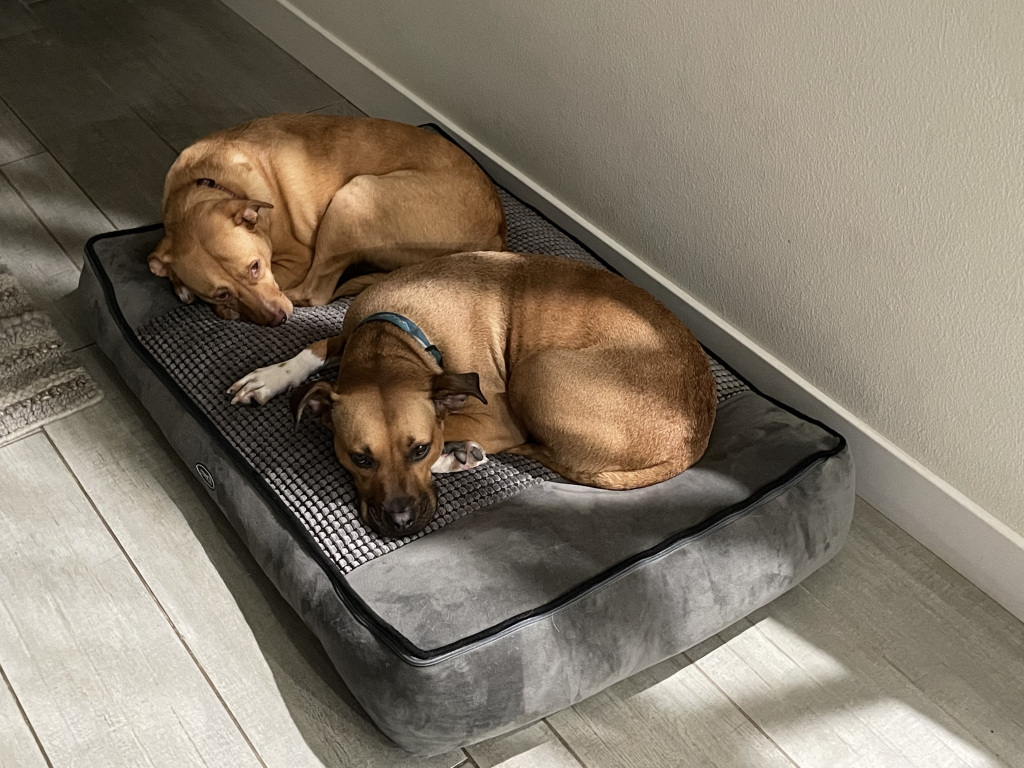
First day went pretty well. The two dogs are pretty well behaved so not much disciplining. However, they are huge attention hogs so they are always coming up to you. One likes to bring squeeze toys, and the other will lick you legs below the knee if you are wearing shorts.

The transplant team did ask me several times if I had pets, and it sounded like an infection risk post-surgery. It seems that healthy dogs appear to be pretty safe per the CDC. I think I just need to be more careful when picking up their poop. There is a side path at my sister’s house where the dogs can pee and poop, but after letting them out several times with no results, I had to walk them down the street to a grassy area so they can sniff around. They both took the biggest dump, so I had to bring doggie poop bags and pick up after them. My sister also has a rule that they get a treat after pooping so they were looking at me expectantly when we got back home.

It really is like taking care of two small children that cannot talk. Just 10 more days to go.

House + Dog Sitting

I just dropped my sister (the kidney donor) and her family off at the airport this morning. They are going to Florida for a soccer tournament and the flight was leaving from Ontario airport. We left Irvine at 3:50 am to get to a 6:15 am flight. Out of all the airports in the metro Los Angeles area, I have never been to Ontario and Burbank airports. However, I did used to travel a lot out of Los Angeles and John Wayne (Santa Ana), and I flew to Las Vegas from Long Beach once a long time ago.

Anyway, the soccer tournament is for my older niece. Most of the teams are from West Coast, but when the tournament was being organized, they did not know if California would be open due to the pandemic. Of course Florida never really closed, so the organizers chose Florida. They will be gone for 11 days, and I have to stay at their house to let in a few service people and watch/feed their two dogs.

Waiting for breakfast

It is now 7:15 am and I did not receive a call so mostly likely everything was fine and their flight took off from the airport. Since there were four of them plus luggage, we drove my sister’s Acura MDX. I wanted to take my Tesla Model S, but likely could not fit everything. Coming back by myself from the airport, driving an internal combustion engine (ICE) car was terrible compared to an electric vehicle (EV). I kept over-revving the engine, even with a 9-speed automatic transmission. Also, I kept expecting the car to slow down when I release the accelerator due to electric regeneration, but an ICE car will coast for quite a distance. I also use Tesla’s AutoPilot all the time on the freeway, so it was weird to have to constantly steer and brake while driving. I know, first world problems.

Finally, since I am still working full-time, but my sister wants me to stay at their house, I had to bring over my work computer setup: notebook computer, dock, keyboard/mouse, wireless headset, and some cables. Luckily, she has a home office with dual monitors I could use. I also had to bring my old MacBook Air for personal stuff, and set that up in a separate office (they have two). I am pretty much set except their microwave oven is broken, and repair guy will not be here until Tuesday. I will probably go back to my house to eat, since it is only a five minute drive.

So, what do you call it if you are working from home, but at someone else’s home?

==========

My niece made me a two-week calendar with all the “events” I need to watch out for, along with a bunch of notes. She also created a couple of instruction pages in PowerPoint about doggie care. At first I was thinking, “I managed cash for a multi-billion company, surely I can watch two dogs.” However, you would be surprised how much goes on in a family with two kids and two dogs. I may need to call my parents to come and help if work gets busy for the next two weeks.

AirTags Recveived

That was amazingly quick. My sister ordered a four-pack of the Apple AirTags for me last Sunday with customized engraving, and they just arrived this morning. They had to be engraved near Shanghai, then shipped halfway around the world in about five days. Since Apple shipped via FedEx, the package was sent to the FedEx Memphis hub, then shipped back to the West Coast.

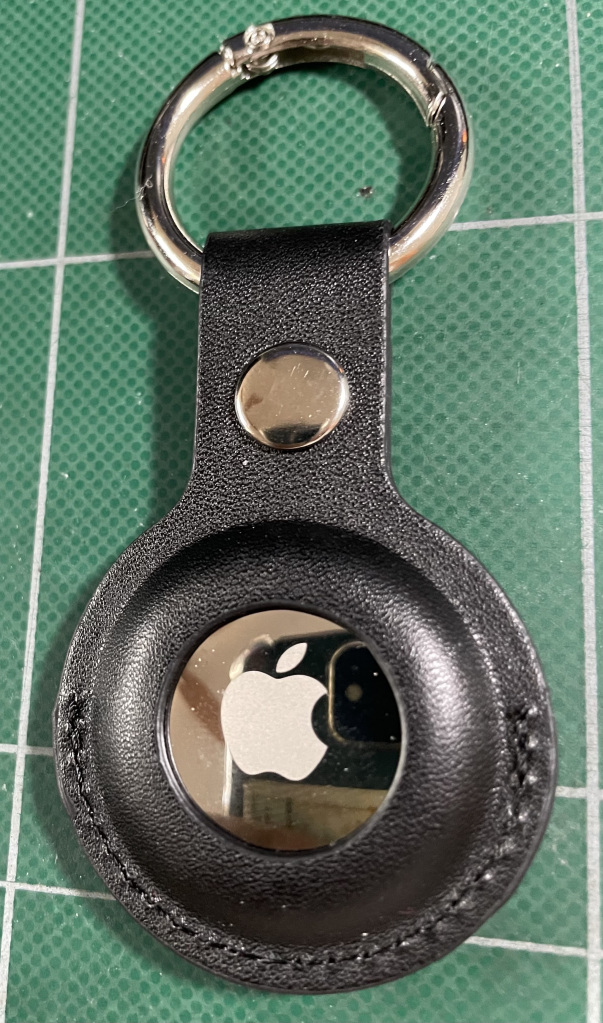
Since I already bought some non-Apple AirTag leather key fobs, I put all four in the holders and activated them. Like most Apple products, the packaging was clean and cool looking, and setup was very easy. I soon had three tags set up for my car key, my mom’s purse, and my dad’s keys. I did a few quick tests and they seemed to work quite well. The Precise Finding feature does not work on my dad’s older iPhone 6S+ since it requires an iPhone 11 or 12. The fourth and final AirTag will probably go on one of my sister’s dogs this weekend.

It is not perfect though. There is a glaring functionality missing in not allowing multiple devices to link to a specific AirTag. For example, if I misplaced my keys with an attached AirTag, and I could not find my phone or the battery is dead, I cannot use another iOS device to locate my keys. I guess the process is to first locate my phone with the existing phone, then use the AirTag connected phone to find the tag. But what if another device is unavailable, broken, or the battery is fully discharged? Hopefully there is a good reason for this omission.

Stopping Sensipar®

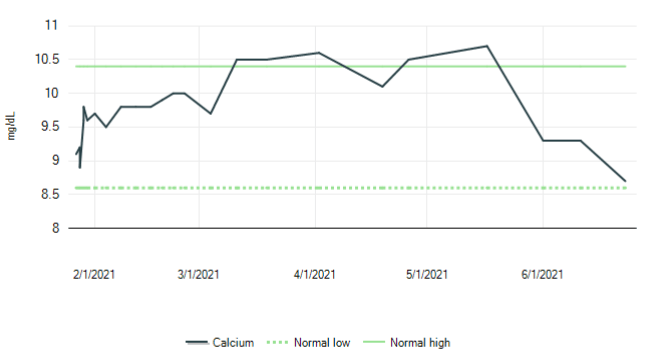
This has been bothering me since yesterday. I was prescribed Sensipar, or cinacalcet hydrochloride about a month ago due to high calcium test results. I ran out of the medication right before yesterday’s appointment at UCLA, so I ordered a three-month refill with my online pharmacy. Here is the latest historical test result trend for calcium:

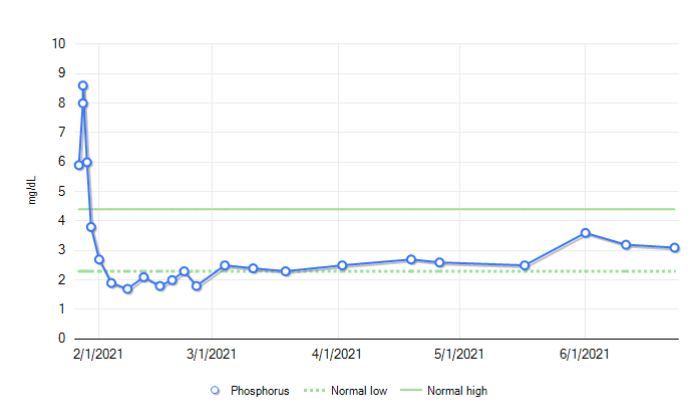
Everything was normal until mid-March, then above normal for the next three months. The only comment I received was to consume less dairy, while at the same time, I needed dairy to keep up my phosphorus levels. Often, I feel like I am an unwilling participant in a game where I need to achieve certain outputs by adjusting a few inputs that are connected via a black box. I my case, the inputs are food, exercise, and medication. The black box is the biological process inside my body, and the output is test results. The frustration is that the black box algorithms do not seem consistent over time. Sometimes test results change significantly without any obvious reasons, like the sudden increase/decrease in my creatinine. Here is my phosphorus result history:

It was too low post-transplant so I was prescribed a potassium/phosphorus supplement. Once the results were consistently above the low limit, I was told to stop taking the supplement. Since then, my phosphorus levels have continued to increase, with a huge jump in early June. That seems to have leveled off in the past few weeks. I do not remember any diet changes over the past month so I do not know what to do different if the numbers start changing rapidly again.

P.F. Chang’s Chicken Pad Thai

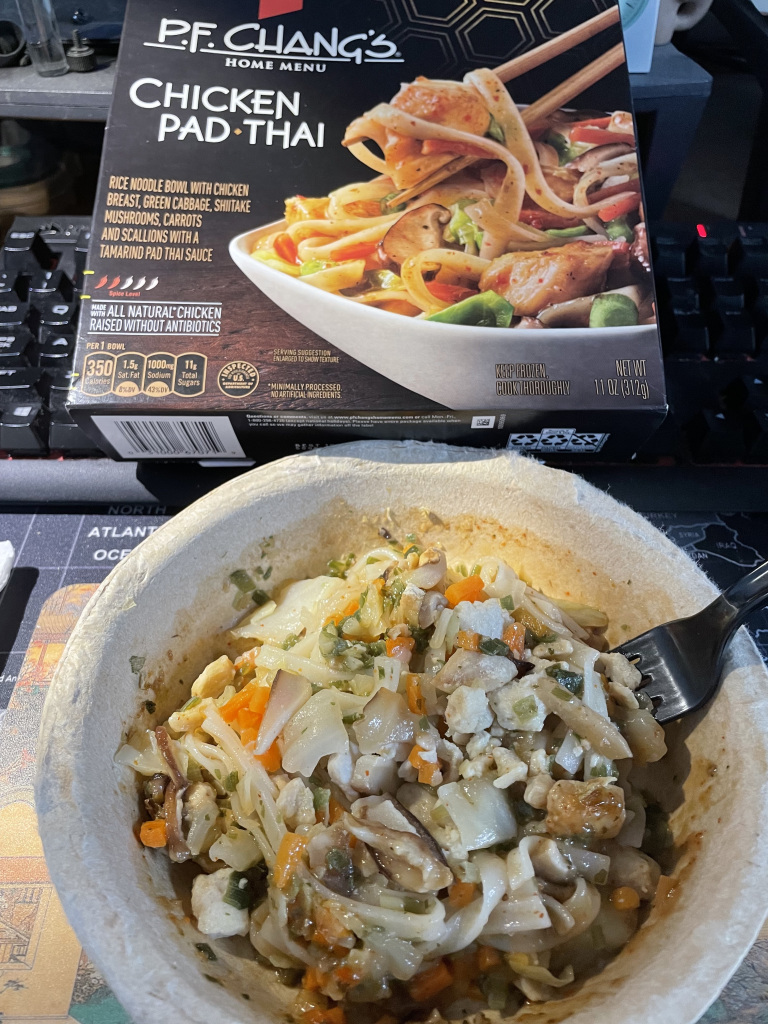
Speaking of not getting a Costco hot dog, I had this for lunch when I got home. It has been sitting in our garage refrigerator for about a month, so I decided to eat it before letting it sit for another month. If you have never heard of P.F. Chang’s, it is a high-end Chinese restaurant chain. Their website says they have 217 locations in the US, with the most in California, Florida, and New York. I have eaten at the Irvine and the Newport Beach locations, and the food is definitely Americanized and quite expensive. It does not mean the food tastes bad or anything, but you will not confuse the flavor with more authentic restaurants, like Sam Woo for example. P.F. Chang’s is more like a fine-dining Panda Express.

I do not know when P.F. Chang’s started their Home Menu line, but I guess it is the frozen entree version of their restaurant dishes. It is either going to taste like a typical frozen entrée, or taste like the restaurant original, which is hardly a complement. I do not remember the actual food in the restaurant, so I cannot really compare flavors. The only think I recall is that all the wait staff were white (i.e., no Asians).

Back to the frozen Pad Thai. Here is what it looked like coming out of the microwave:

I do not typically have high expectations for frozen entrées, but this was not inexpensive. It is currently “on sale” at Albertsons for $4.79, but the regular price is $5.99. For six dollars, at least use something better than a flimsy paper bowl. All that aside, the taste was not that great. In fact, it was too spicy for me so all I tasted was the spiciness, and nothing else. The box rated it as two peppers. Maybe they were using an authentic Thai spiciness scale so one pepper would have been too much for me. Perhaps someone else would like the taste better. There were a lot of ingredients, and at least I could feel the different textures while eating. Too bad I could not really taste any of it.

Also, I followed the heating instructions closely. The box said heat for 4 to 5 1/2 minutes, which is a huge range for a 1100 watt microwave. I heated for 3 1/2 minutes, checked the temperature with a probe thermometer (110°F), then added another minute. Instructions said the target temperature was at least 165°F, but it was up to 190°F after 4 1/2 minutes in my microwave. The result was that the needles were somewhat harder and chewier than what I expected. Maybe my crazy microwave overcooked the entrée. I did managed to eat the entire bowl, and my mouth was burning for about 30 minutes. I have also tried their frozen Chicken Mini Egg Rolls and there were just meh as well. Based on the mediocre taste and expensive price, most likely I will not buy frozen entrées from P.F. Chang’s in the future. Sticking with my $10 for 3 roasted turkey from Marie Calendars. 🍗

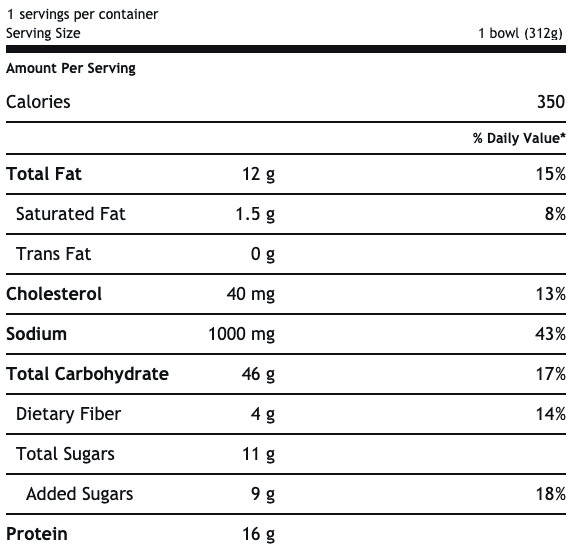
Nutritional information if anyone is interested. Salty and too much added sugar.

Costco Shopping 6/23/2021

Since I took the entire day off for the UCLA Transplant Center appointment, I had the afternoon off. I went with my parents to Costco to do some shopping. The plan was also to get a famous Costco hot dog/soft drink combo for $1.50, now that phosphorus is not a worry. However, I felt strangely guilty standing in the food line so I skipped on the hot dog.

Costco was surprisingly crowded at 1:00 pm on a Wednesday. When I went last month, everyone I saw had a mask on. Today, only about 1/3 of the customers were wearing masks, which was higher than I expected, with the Costco located in Tustin/Irvine. All the employees were still fully masked. My parents and I still had our masks on, and no one cared.

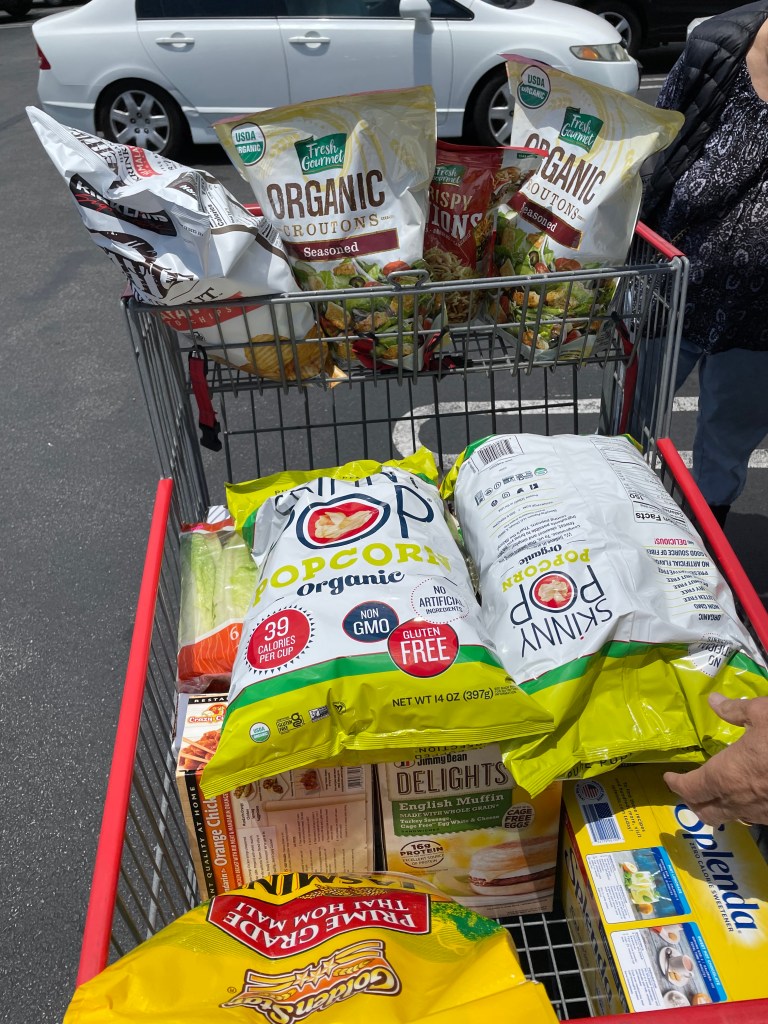
The cart was full at checkout. This is what $300 of Costco groceries look like:

The items in the plastic bags were not that expensive. Hugh bag of popcorn were ~$4/each, and two bags of croutons were $7/each. What was expensive was $50 package of flank steak and $15 box of Splenda.

==========

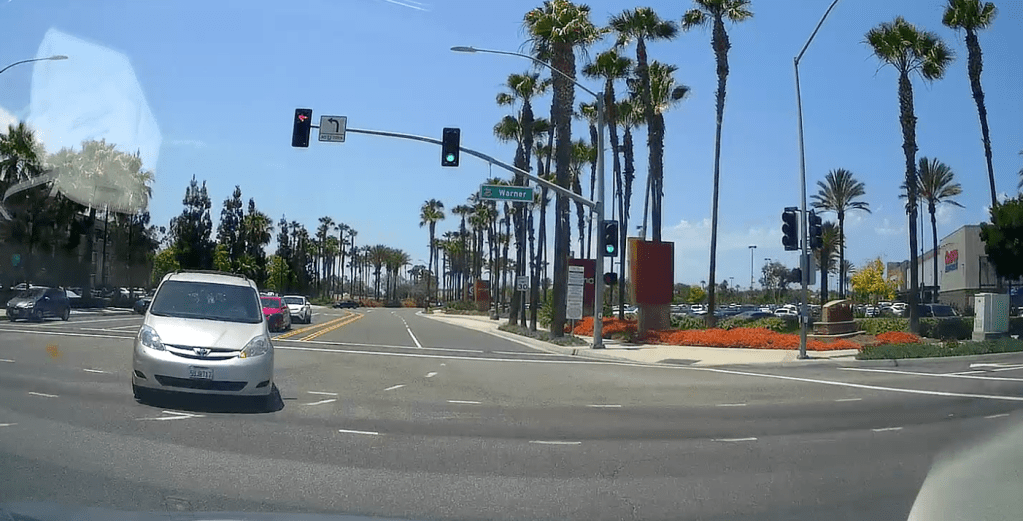
We almost got into a head-on accident driving to Costco. My dad was driving straight through an intersection with a green light. A minivan (old Toyota Sienna) coming in the opposite direction made a left turn on a red arrow. Luckily my dad was able to swerve to the unoccupied right lane. Since the lap portion of the seatbelt goes right over my kidney transplant site, a head-on collision at any speed would be really bad. We captured the incident on the carcam in my dad’s car, but WordPress does not allow video uploads on a free account so here is a screencap. You can see the Costco at The District on the right.

The wide angle lens in the carcam distorts distances. The minivan looked a lot closer in real life.

Final Post-Transplant Appointment

Well, kind of. I had an in-clinic appointment this morning to discuss my transplant at UCLA, and they did agree to turn me over to my regular nephrologist. They tried to do this several times, but there was always a test outside of normal range. I guess all the test results looked good enough for them to finally release me, but I do have a follow-up appointment with UCLA in four months.

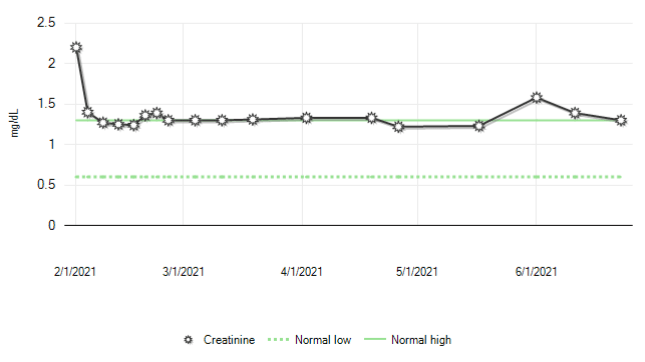
I was a long morning. My appointment was at 9:30 am, which meant I had to be there by 7:30 am to draw labs. Both Waze and Tesla navigation said about 90 minutes, so I left the house at 5:30 am, did not arrive until 7:20 am. The clinic was pretty deserted so I was called almost immediately by the phlebotomist, but that left me with a full two hour wait until the clinic appointment. I ended up at the main hospital cafeteria, ate some breakfast, and basically sat around for 90 minutes. Back at the clinic, the appointment was pretty quick. The lab results turned out fine: my creatinine levels dropped down back to 1.30, or within normal range. My calcium levels were a bit too low this time, so the doctor told me to stop taking Sensipar*. Of course, I just placed a refilled with my online pharmacy for a three-month supply, arriving in two days. They are keeping me on the Lokelma since it appears to help with my high potassium. The hemoglobin levels have fallen to normal range so we did not go over any of the issues I posted about here.

UCLA nephrologist unsure what happened to cause the sudden rise. He said sometimes a test result will come back all weird so they will test a few more times to verify.

I asked the doctor about the kidney ultrasounds again. He repeated that the findings were pretty normal. My old kidneys have atrophied slightly, which was typical, and there are some benign cysts but nothing to worry about. For the new kidney, the arterial flow is a bit high, which usually indicates some blockage (renal artery stenosis). However, since the kidney is working well, they there is no concern.

I got back to my car at around 10:00 am, and the drive home took about an hour and was pretty uneventful. Traffic northbound on the 405 was still very bad, even at 10:30 am. On the way to UCLA, an American Airlines Boeing 777 flew over the freeway right in front of me near LAX. It looked really huge in real life, but the fisheye lens on my carcam made it look small.

==========

*The Sensipar prescription refill cost me a $10 copay, but my work insurance (or my company since we are self-funded) had to pay ~$2,000. If you divide that out assuming a 40 hour work week, it is about $4/hour for the medication. For minimum wage workers, that is >50% of their gross salary. I am all for free markets, but some of these drug prices are ridiculous.

상상더하기

This is a five year old song by a Korean girl group called Laboum. I am not sure of the English title. I see “Journey to Atlantis” a lot, but the official music video says “Fresh Adventure.” Regardless, this was one of my favorite K-Pop songs when it came out. Laboum has a decent discography with lots of great songs, but they were hugely underrated and never super popular.

The K-Pop industry is very competitive, with new artists debuting all the time. Song promotion cycles are really short, usually just weeks or months, and public attention will jump to the next new song. That is why when an older song becomes popular again, it is a big deal. The best example is probably 위아래 (Up & Down) by EXID, and more recently, 롤린 (Rollin’) by Brave Girls. Both songs did just okay when they first came out, but years later became super popular and hit #1 song in sales and music shows.

For EXID, if was a fancam of a performance that went viral. It was fortunate this happened as it help EXID gain lots of popularity. They went on to release several more great songs. Likewise, Brave Girls were on the verge of disbanding when a video of their performance at a military base went viral and Rollin’ shot up to #1. EXID has since disbanded, but Brave Girls are still riding the popularity wave, and just released a mini-album.

For Laboum, I think their sudden popularity was that their song was featured on a popular variety program called Hangout with Yoo. The show revolves around Yoo Jae-suk, probably the most popular MC in Korea. The show started with just filming random stuff he did on his “day off” but became super popular, and have done several music projects. The latest project is forming a boy band, and they sang 상상더하기 on the show (see below). I just started watching past episodes of the show, so I have not watched the most recent project/episodes yet.

I am really happy that these groups get another chance at success. Laboum is back on music shows performing their old song. All three groups mentioned should have had more success initially, but a lot of talented artists never make it as K-Pop idols. I am actually a big fan of Laboum overall, not just the song 상상더하기. I even bought a signed copy of another album from South Korea a few years ago.

Here is a recent performance from about two weeks ago on MBC. The girl in the preview picture is Solbin; her signature is in the upper right on the above album cover. I believe she has been doing more acting than singing but that may change for a little while.

Apple AirTag (updated)

I am a sucker for technology gadgets. When the Tile first came out, I bought a couple of them to keep track of stuff. It works fine when the tag is within range of your phone. If you lose the attached item out in the real world, then finding stuff depends on other people’s phones. The Tile user base was too small to be effective. Also, the original Tile tags ran out of battery pretty quickly and they were not user replaceable. Did they expect people to buy another Tile tag each time the battery ran out?

So I was excited to see Apple’s solution to this problem. Since you would not want to use cellular or WiFi connection for locator tags, we are limited to using Bluetooth. It was pretty smart to utilize Apple’s locate my stuff app since all iOS users are familiar with it. Hopefully there are enough iPhones out there for good coverage, and lost AitTags can be located quickly.

I ended up buying the four pack and got them engraved with some emojis. Because of the personalization, the AirTags will take 2-3 weeks to arrive. They are likely still made in China so they need to be engraved in the factory, packaged, and shipped overseas. This used to take only days, but with COVID still a risk worldwide, the number of airfreight flights is very limited.

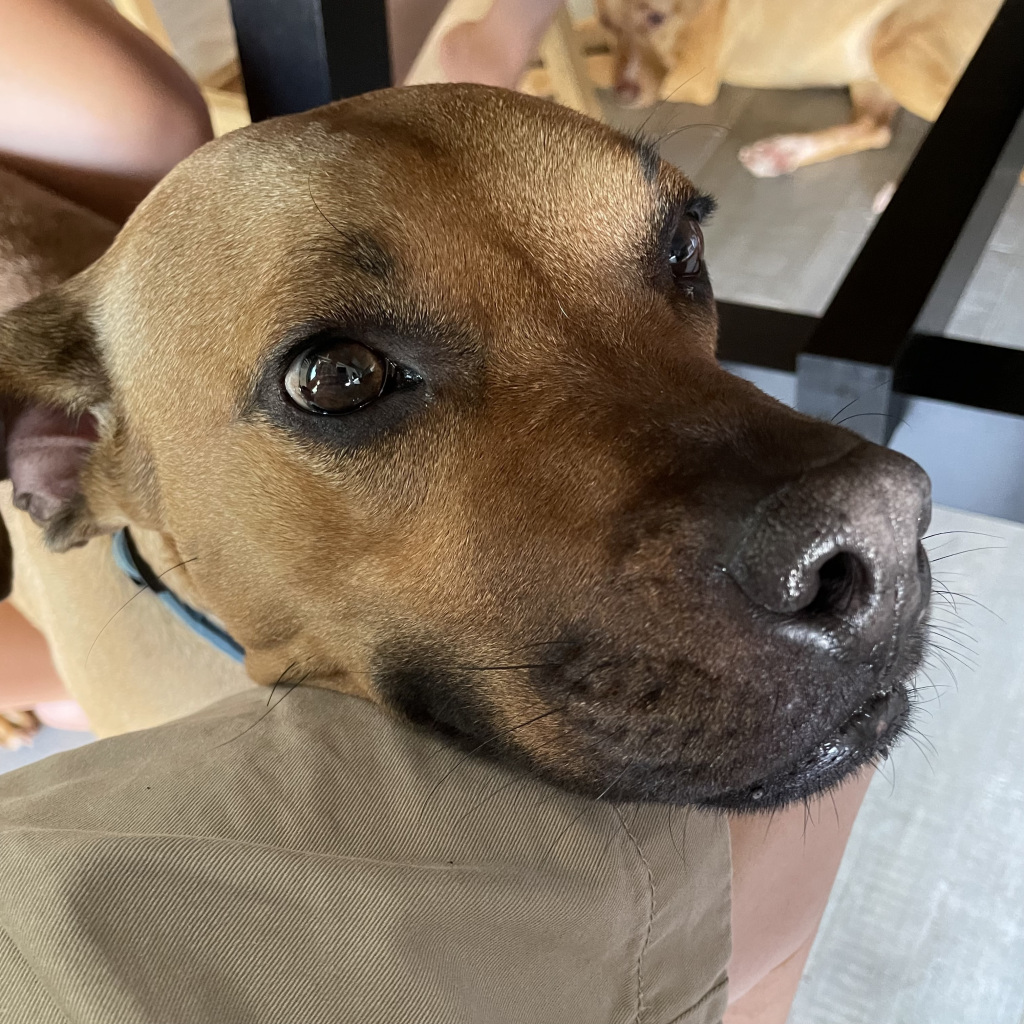
One of my sister’s dogs sometimes runs out of the house when you open the door. I may put one on her to see if the tracker works outside the house.

==========

Updated: 6/22/2021 6:00 pm

I got a text message from FedEx saying a package for me has shipped. I thought it was a prescription or the monthly Natera Prospera blood test, but the package is coming from Kunshan, China, so it is probably the Apple AirTags. Kunshan is right outside of Shanghai. I could not find the address on Google Maps, but it is likely located in one of the high tech industrial parks found in every Chinese city. I also got an email from Apple just now with estimated delivery date of June 29th. That is next Tuesday. I thought shipping would take longer, but FedEx has their own planes and do not depend on commercial passenger flights for cargo shipments.

10 Year Anniversary

A coworker wished me a happy 10 year work anniversary. I started at my current job on June 20th, 2011. Since I took two medical leaves and worked 3/4 time for a few months, it is more like I worked here 9.5 years instead of the full 10 years. At my last job before this one, I worked for about 11.5 years, so 10 years is not even the longest I have been at one company. Unfortunately, my marriage was shorter than either of my last two jobs.

My current boss also hired a bunch of our coworkers from the prior company during 2011 so there will be a few 10 year work anniversaries coming up. Some companies give out pretty substantial gifts of mementoes or major tenure milestones. Our company does not. I basically got nothing for my 5 year anniversary.

==========

For the first few years, I worked a lot of hours. I was basically the only person in my function for the entire company so I had to fix a lot of bad processes and come up with new ones. I did hire a few people early on, but there were a handful of coworkers. Today, there are about 40 people doing the same work, though obviously with more scope and in more detail. Since the commute was up to three hours each day roundtrip from my house, I rented a room from a friend close to work. It cut the commute down to about 10-15 minutes each way on local streets. I stayed there for about 2-3 years until the friend got married and booted me out. During that period, I would regularly stay until after 9:00 pm at work, and often eat all three meals in the work cafeteria. I would also go into work on weekends if I did not go back “home” in Orange County. Life is kind of monotonous if you are single when all your friends are married with children. My life was work and sleep, with the occasional Saturday off to watch TV. More recently, it was work, sleep, and dialysis, even on Saturdays. Life is better definitely better post-transplant, but I still sit around at home a lot.

Amazon Prime Shipping

In general, my experience with Amazon Prime shipping has been pretty good. I was an early Prime member; I think I signed up as soon as it was offered. I know I was one of the first Amazon Echo buyers. I got the original model for $99 back in January of 2015.

Anyway, back to shipping. Our house front door is kind of at an angle so it is hidden from the street. Amazon, and other delivery services like UPS and FedEx, would usually drop off packages at the door, and in the 11 years I’ve lived here, I have never had a package stolen. Since the neighborhood is full of single family houses, there is always an Amazon truck making deliveries each day.

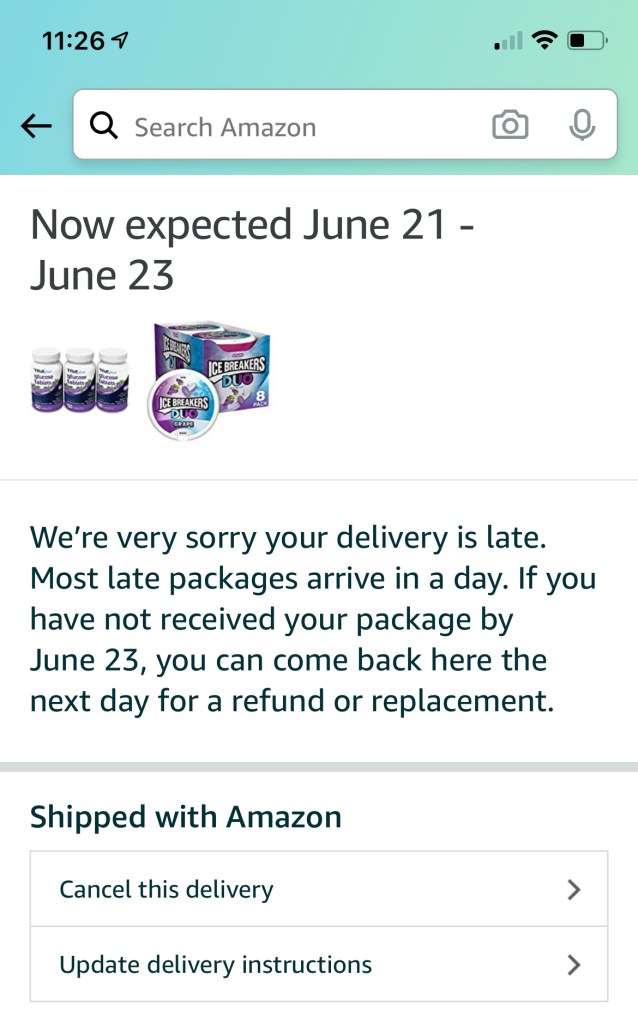
The only problem I have had is with Amazon’s one-day shipping. I do not think I have ever needed something delivered the next day. There is an Albertsons about a mile away so I can always go there if it is something urgent. However, if Amazon offers free one-day shipping on an item, of course I am going to select it. In fact, Amazon’s website usually selects the one-day shipping by default if available. I just said I had no issues with two-day shipping, but have had multiple failures with one-day shipping. Just yesterday, I ordered some grape flavored mints and glucose tablets. One-day shipping was offered so I selected the option, with a delivery deadline by 10:00 pm today. Welly, it is ~11:30 pm now, and no package. When I checked the Amazon app at 11:00 pm, it said that there was a problem, and I should wait until the 23rd before doing anything. So instead of one-day shipping, it is now two-to-four-day shipping.

This actually happens quite often. I do not get stuff shipped next-day normally, and this is the third time in the past few months that the package has not arrived. The frustrating part is that even at 8:00 pm, the tracking page still said package was arriving by 10:00 pm. The logistics of one-day shipping for thousands of products is hard. Likely, my insignificant items did not even make it on the truck, if to the distribution center at all. The computer knows this, but Amazon still let’s me believe I am getting my mints until after the delivery deadline. Why? I am perfectly fine with two-day shipping, which has been very reliable for me. Instead, Amazon inflated my expectations just to fail. What if it was something important, like toilet paper during a pandemic?

Oh well, I was expecting some grape mint tonight, but I will have to wait another 1-3 days.

==========

Speaking of the Amazon Echo, I have four of these devices; only two are currently activated however. I have the OG Echo in my bedroom, and a 5″ Echo Show on my office desk. I also bought two Echo Flex, mainly as gifts, but I still have them on my bookshelf.

==========

Today and tomorrow is Amazon Prime Day. I got a coupon for my last order for $10 off during Prime Day. I saw the 4th generation Echo Dot for $25 and almost bought it. After adding a few low carb/low sugar snacks, I deleted the Echo Dot since I have too many Echos already. I was able to order $35 of snacks so the items are coming today since it is 1:30 am already. I am not confident that all the products will get here. Even if they are delivered tomorrow, the products will likely be all melty from sitting in the delivery truck all day. I will post about the snacks after I get them.