ProPublica Kidney Transplant Article

Initially, I ended the previous post with a paragraph regarding an article on ProPublica written by the same journalist that contacted me nine months ago. However, as I read the first few paragraphs of the story, I felt it needed its own post for discussion.

ProPublica is a nonprofit newsroom that investigates abuses of power.

ProPublica begins all their stories with the above line. It pretty much tells the reader their biases and how they will tell the story. After reading the first few paragraphs, I was not wrong.

First, there are plenty of things that are wrong with the dialysis industry. I came up with the following just from memory (no Google):

  • Two for-profit companies control 70% of the market
  • Medicare coverage provides distorted incentive to maintain the status quo and milk the system for profit
  • Very little public awareness on the impact of dialysis on ESRD patients
  • Even less awareness on the need for organ donation

Just from the recent ballot proposition fights in California between the for-profit dialysis companies and SEIU (employee union) demonstrates even the industry cares only about profits and not patients.

Having said that, ProPublica is obviously biased against dialysis and transplant providers. First, if I assume my interview request in September 2020 is related to this story, the timing is a bit off. The actual article was published on December 15, 2020, but the subject of the article passed away earlier in August. So, by the time I was contacted, they already had most of the information needed for the article. What did they need my story for? A supplemental article about how getting a transplant suck for everyone?

If you read about the life of JaMarcus Crews, it is definitely a more compelling story than if they had written about me. JaMarcus was was black, living in Alabama, and likely experienced a lot of discrimination/racism in life and the whole dialysis/transplant process. Me, being a middle class Asian in California and getting relatively good care, will be a boring subject for the story ProPublica wanted to tell.

I found a few questionable items at the very beginning of the article.

When it was over, and all anyone wanted was sleep, JaMarcus drove to the wide parking lot at Target to wait for his cashier’s shift. He missed working at the bank, but a nine-to-five was no longer possible.

It is true that in-center hemodialysis takes up a lot of time, but many people work full-time. ProPublica just says this without any sources or statistics. I worked full-time for the first two years of hemodialysis and during peritoneal dialysis. If JaMarcus was a teller, then he must be at the bank in person, which makes it difficult, but not impossible. He could be assigned different tasks during dialysis days. It heavily depends on how willing employers are to accommodate the employee’s dialysis schedule. I was lucky but also essential to my company, so they were very accommodating.

JaMarcus didn’t tell his wife or son that he was making calculations in his head: most people didn’t survive five years on dialysis. He was nearing seven. His mother had died in year eight.

This one is totally false and can be researched with a quick Google search. I posted on this topic a lot, and most sources say that mortality is 20% after the first year of dialysis, and 50% after five years. That is definitely not “most people didn’t survive five years on dialysis.” The statistics are also skewed by older dialysis patients with multiple medical issues. JaMarcus was 36. That does not mean there is no risk, since JaMarcus did pass away, but the statement is absolutely false.

Having gone through all of this, ESRD and dialysis is definitely a huge problem that needs more attention and research. JaMarcus’s story is sad, and not even unique. I know my comments may be premature based on the first few paragraphs, but one-sided stories like these just entrench people and hinder progress. I am still amazed that I am not dead after years of ESRD and dialysis. If you browse through r/transplant on Reddit, there are lots of anniversary stories from transplant recipients. Of course, the process could be better, but I am hugely grateful and satisfied with my experience. Everyone I have engaged with, from my nephrologist, dialysis nurses and techs, transplant coordinators, surgeons, post-care doctors, to phlebotomists, have been compassionate and caring. The main issue is the scarcity of transplant organs that causes all these issues downstream. ProPublica should focus on that part of our society, but that does not fit their mission of investigating the abuse of power.

Maybe I will change my mind after reading the entire article.

==========

Just saw these lines at the very top of the story:

For years, JaMarcus Crews tried to get a new kidney, but corporate healthcare stood in the way.

He needed dialysis to stay alive. He couldn’t miss a session, not even during a pandemic.

That is lame. Whatever you think about “corporate healthcare” in general, JaMarcus weighed 400 pounds and had heart problems. There is no way he was going to get on any transplant list when healthy people must wait 8-10 years. I can see him getting a transplant if there were lots of organs available, but with only 10% of people on the waitlist transplanted each year, he needs to improve his health situation. No way this is the fault of “corporate healthcare.” Also, WTF is “corporate healthcare?” Of course, it is large hospitals (corporations) doing transplants. You do not want the procedure done in someone’s garage, for fuck sakes.

I also do not understand the second sentence. I had to go to my clinic during COVID pandemic. That is the only place I went outside of my house. Even without a pandemic, dialysis patients cannot miss sessions since that will mess up your health even worse. Is this the fault of “corporate healthcare” too? How is this racism? I thought ProPublica was like NPR: a good news source that leans a bit left. But so far, this seems like a total hit piece.

In hindsight, I am glad the journalist did not follow-up. I would be really pissed off if I were part of this story the way it was told.

Post-Dialysis 1/3/2021

I just got home after today’s dialysis session. Due to New Year’s Day being on Friday, the weekend schedule was shifted back one day. As I mentioned before, my weight was pretty high. Even after removing my thick jacket (but leaving my shoes on), the scale said 83.5 kg. I usually take 0.5 kg off for miscellaneous clothing but I cheated a bit more and told the tech I weighed 82.5 kg. That means I had to cheat at the end weigh-in too. Even at that weight, the tech decided that we would remove 3,800 mL of fluids, probably the most they’ve tried during one session.

Right at the beginning, there was a problem. The arterial needle didn’t go in that smoothly, and it hurt really bad. The venous needle was a bit better but there was a dull pain in my arm that wouldn’t go away. After about 30 minutes, the tech decides to move the needle since the pressure was wrong, and it hurt a lot worse. He ended up removing the arterial needle and jabbed me further up the arm. Initially, he missed the vein, but was able to hit in with a second needle. He jokingly said he was praying. Not sure how much of it was serious.

I started getting dizzy around the two hour mark. Both my feet were super numb for some reason but I tried to lie flat in the chair to raise my blood pressure. I guess it worked okay since I was averaging 140/80, even as the machine eventually pulled out 3,732 mL of fluids. When I stood up at the very end for the final blood pressure reading, I almost fell over, and the reading was 85/50. Not good. I took a few sips of water, waited five minutes, and tried again. This time it was 104/70 (or something) so good enough. Walking out, I was still pretty dizzy but felt better once I sat down in my car. The weight reading was 80.1 kg, which was 83.5 kg – 3.7 kg + a few sips of water. I ended up telling the tech that I weighed 79.2 kg so I have to watch what I eat/drink for the next few days. Of course, I was starving and stopped by Raising Cane’s to get four chicken fingers a la carte. No drinks. I ate them while driving home. They were super hot (temperature) and tasted awesome. I think I should get a job there after retiring from my real job. I leave you with a chicken finger video.

==========

Ugh, so tired. I think I woke up for a bit at 2:00 pm but I slept until almost 7:00 pm. Meanwhile, two of the dialysis needle insertion points are still bleeding, visible through the band-aids. I’ve gone through four of them already.

Overweight 1/2/2021

Ugh, I’m so dead for tomorrow. I just weighed myself and I’m at 83.2 kg without much clothing. With clothes and shoes, less my 0.5 kg adjustment, I’ll probably come in at 84.0 kg. I was below 80 kg on Thursday so I’m way over my last weight, and dry weight is still 78.2 kg. I heard a tech bitch at another patient Thursday for being 4.5 kg over, with talk of ER visits and ventilators. If I’m ~6 kg over, they are going to freak out and schedule additional sessions.

I’m not even sure what happened. I measured myself at 82.1 kg this morning, a bit high but manageable. I had some coffee (~300 mL) and an egg sandwich for breakfast. I even skipped lunch. I don’t think I ate or drink anything else, except for a few Korean crackers at lunchtime. Don’t know why the scale read 1.1 kg gain. My mom made beef curry over rice for dinner. There’s no way I can eat that: rice and curry sauce is mostly water. She also baked some Costco mini-eggrolls so I had a few of those so I wouldn’t starve. I really think the dialysisi center went too low with my dry weight but they’re hesitant to raise it after lowering ti consistently over the last few months. Not sure what I’m going to do. If I think I can be disciplined over the next few sessions, I can “cheat” and do a bigger adjustment before/after so it looks like a gradual decrease over time. Of course, the problem gets worse if I keep gaining fluid weight. I guess I can always take off my sweatshirt and sh9es and another 0.5 kg for the remaining clothes. That will lower the baseline but that also means taking longer at weigh-ins going forward.

Blood Pressure Rollercoaster

Today was a super eventful day at dialysis. Maybe it was because it was a Sunday when the clinic is hot typically open. I mentioned previously that I had problems sleeping this morning so I was already exhausted when I got to the clinic. Also, I thought I was going to be very overweight so I skipped breakfast. Finally, my morning blood pressure was satisfactory at 143/80/60 so I also skipped all my morning medications, including the Tradjenta as I was not eating.

I was having problems staying awake during the 15 minute drive to the dialysis center. Not a good start. My regular tech was still out on vacation so another MWF tech poked me. Even with lidocaine, it hurt a lot going in and kept hurting for about 15 minutes. She probably hit a nerve by sticking the needle almost straight down initially. My blood pressure was pretty normal at this point at 158/78/65. but over the next two hours, it rose steadily until it hit 174/91/63 at about 7:40 am. Thinking that it was going to keep rising, I took all my morning meds, including the blood thinners and Tradjenta. Within about five minutes, the next reading was 123/73/68. The elapsed time was too short fo the meds to take effect so the 174 number was wrong?

From that point, my blood pressure started dropping more until I was feeling kind of nauseas and lightheaded. My BP got as low as 103/58/64 before I asked the tech to turn off the UF. For the next 15 minutes, we kept manually measuring my BP until a 98/60/65 popped up, but both readings before and after were in the 140’s/150’s. Again, I don’t know if the BP meter is accurate but having the number swing 50 points down then up didn’t feel good. At the same time, I think my blood sugar was crashing too since I didn’t eat anything for breakfast and I also only ate a small dinner the previous day, worried about being too much over my “dry” weight. I ended up drinking a small can of Sierra Mist and taking a few glucose pills to try and put some fluids and sugars back. Even though they took me off 15 minutes early, I sat in the chair after the session to recover and didn’t leave until 10:15 am. I was even more tired at that point but starving so I went to get lunch, ate it in the parking lot, and drove home to sleep. I just woke up at around 2:30 pm, still very tired, but feeling a lot better.

Looking forward to doing it all again on Tuesday.

Fistula Update 12/24/2020

Yup. It’s Christmas but the dialysis never stops. Well, the clinic is taking tomorrow off so the next two days get pushed out. My next session is now on Sunday instead of Saturday.

Due to the holidays, several of the dialysis center staff took days off. The tech that normally cannulates me is off for a few days so I thought the other tech would stick me today; they usually are assigned in pairs. However, the “substitute” was another staff member that normally just refilled supplies, such as saline, tubing kit, dialyzer filters, and blankets. He also sets up the dialysis machines for their cleaning cycles between patients. I’ve seen him since my first day at the dialysis center but I’ve never seen him work on a patient.

So, I was a bit surprised when he came over to hook me up to the machine. I was a bit worried at first since most techs have problems getting a clean insertions. He also used the top two insertion points; typically we use the bottom one (closest to wrist). I decided to let him try and it worked out great. He was a bit slower than the other techs but worked very carefully. The insertions did not hurt at all and was fine throughout the entire session. Even when he took out the needles at the end, it didn’t hurt at all. Often I get a weird pain sensation when the needles are pulled out.

However, I still felt like crap at the end of the session. I’m still not getting enough sleep and for me, it’s hard to sleep during dialysis. I also came in heavy again; not sure if it’s fluid or eating more. We only removed 3,000 mL of fluid today though I was about 4.0 kg over last session’s weight. I did get some cramps in my ankles earlier today so I don’t know if my dry weight is set to low now.

Monday Night Dialysis

Due to the colonoscopy, I asked to moved my dialysis treatment from tomorrow morning to tonight. I was supposed to get there at 5:00 pm but I got a call at 4:00 pm informing me that my machine was ready. I got there at 4:30 pm and a unfamiliar tech led me to the chair. I was a bit worried since we just had problems with my fistula Saturday, but he was able to cannulate the needles fine. Since they had to fit me into their schedule, I was only dialyzed for 3 1/2 hours, which was fine by me. Since the nephrologists come around on Mondays and Tuesdays, I saw the same doctor again. He said my phosphorus levels were really high at 7.7. Last month, the reading was 6.2 so something is weird. I’m eating mostly the same things and taking the binder. The only thing I can think of is the deli meat from the club subs I’m getting from Jersey Mike’s. They don’t publish the phosphorus content of their ingredients so maybe they are using one with high phosphorus levels.

The patient to the left of me came in 10 minutes after me. He saw my work-logo’ed clothing and asked if we were hiring. I told him to go online and look but automatically assumed that he was after a factory job. He didn’t look like a salaried office worker, but I probably don’t either. I think I made an assumption based on his race and age, even though I just took a class online a few weeks ago. Not good. He later had pretty severe leg cramps and was still groaning and moaning when I left.

On the right side was an Indian-looking woman. She appeared to be a fairly new patient and just came back from the hospital due to pneumonia. As the doctor talked to her, it turned out she had an infection with her chest catheter, and they had to set up an antibiotic IV for her. So far, I’ve avoided any access infection while on dialysis so I don’t know how it feels, but I heard it sucks big time. She seemed to be in a bit of pain; I hope she gets better.

I left dialysis at 77.9 kg and won’t be back until Thursday morning. My ending standing blood pressure was pretty low at 103/something. I’m counting on all the colonoscopy flush to come out and that I don’t absorb 4 liters of fluids.

Fistula Update 12/12/2020

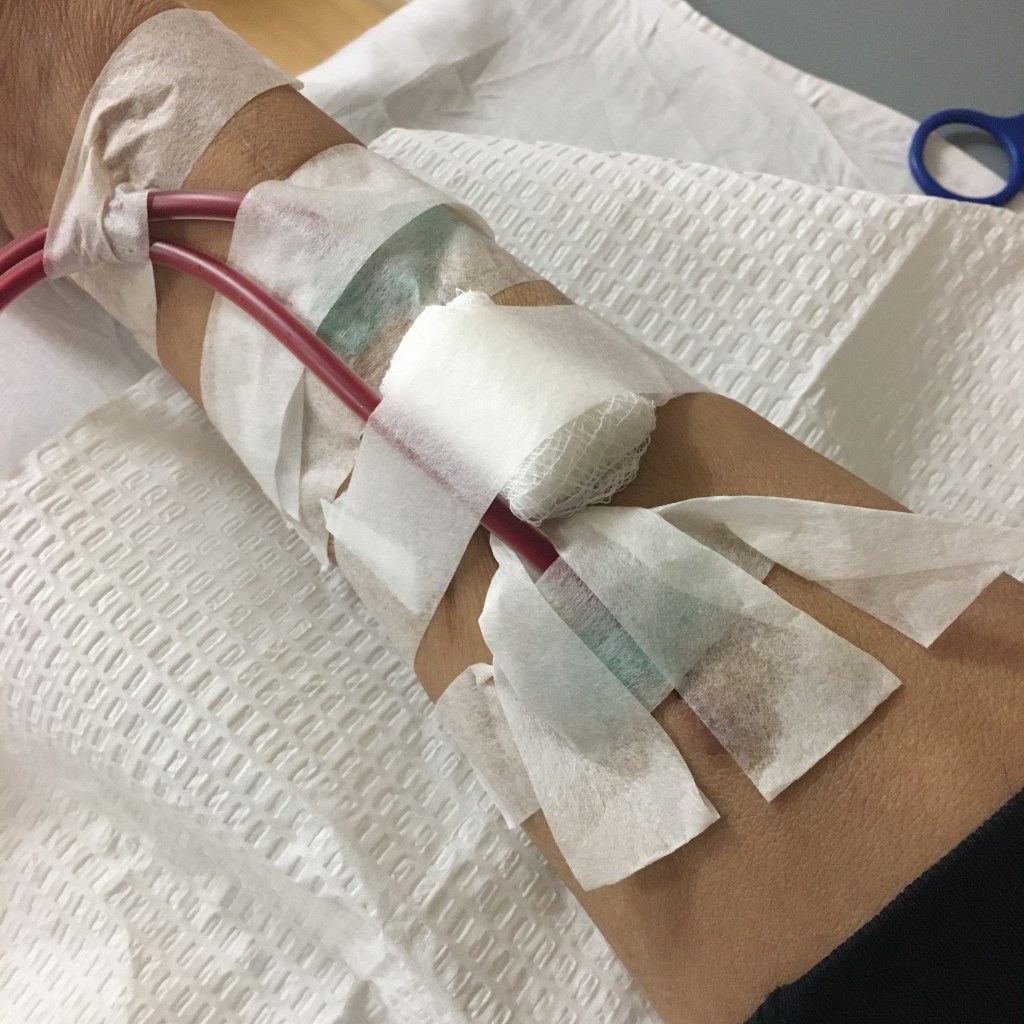
My fistula is ugly.

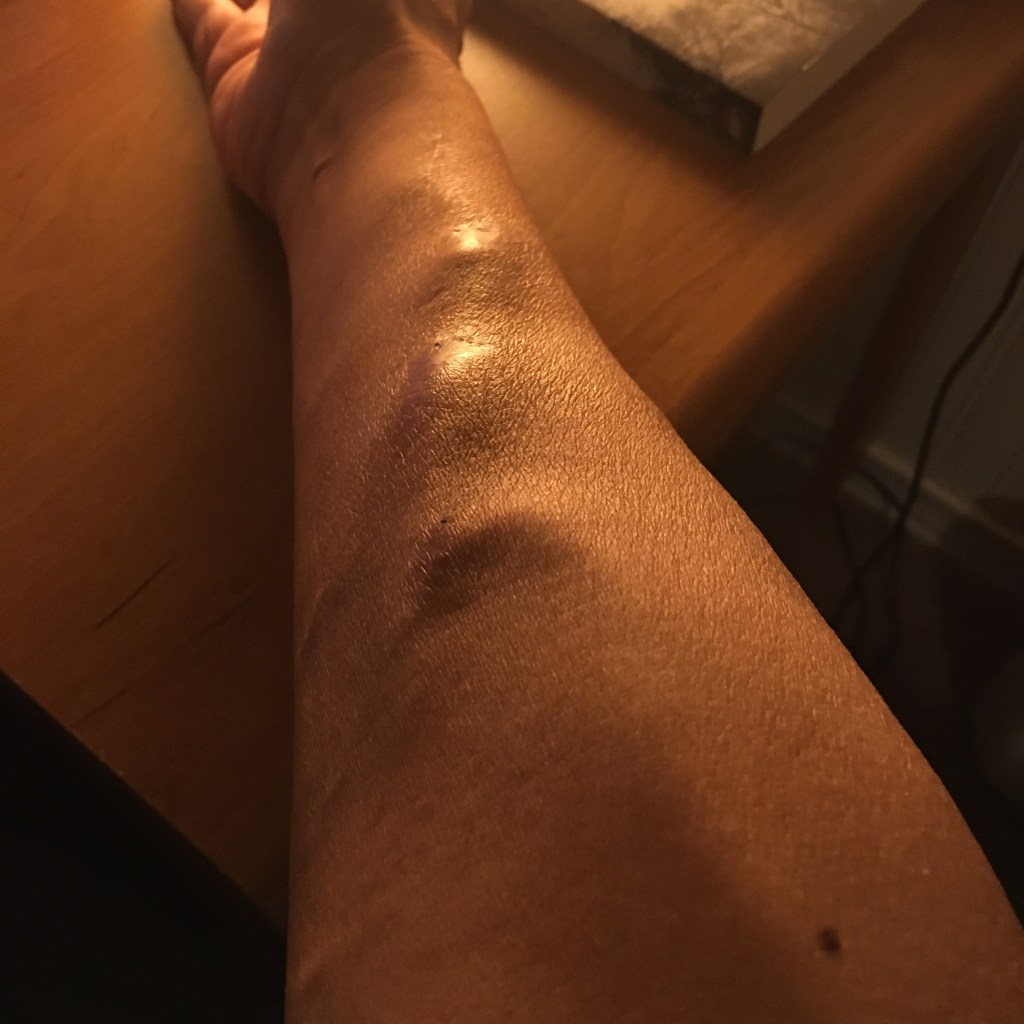
It’s not as large as some other patients but under certain lighting, it looks pretty bad. It also gave the techs some problems today. Everything was going well for the first 45 minutes. Then the arterial pressure alarm started screaming. The tech tried to rotate then reposition the needle but it started hurting. She then decided to switch the needle site so the other tech got another needle and jabbed me without lidocaine. Ooooowwwww! Holy sh*t did that hurt a lot. By then my entire arm was in pain, and my blood pressure was dropping fast. Usually they pull all the needles out at the end of the session, but they pulled the unused one now to see if it wold lessen the pain. Not really.

Since I was getting dizzy from the low blood pressure, the nurse came over to give oxygen and stop the UF fluid removal. Now there are three people surrounding my chair, with me in obvious pain. They ended up reclining my chair and giving me some ice for the arm. There was still a lot of pain but it was slowly subsiding. Great, another three hours to go.

It’s now about 8:30 am so I have another 1:20 to go. Arm is better if I don’t move it too much. Since the dialysis chair sucks and my back hurts if I recline too long, I’m sitting up again, but with the oxygen tube still stuck in my nose under the mask.

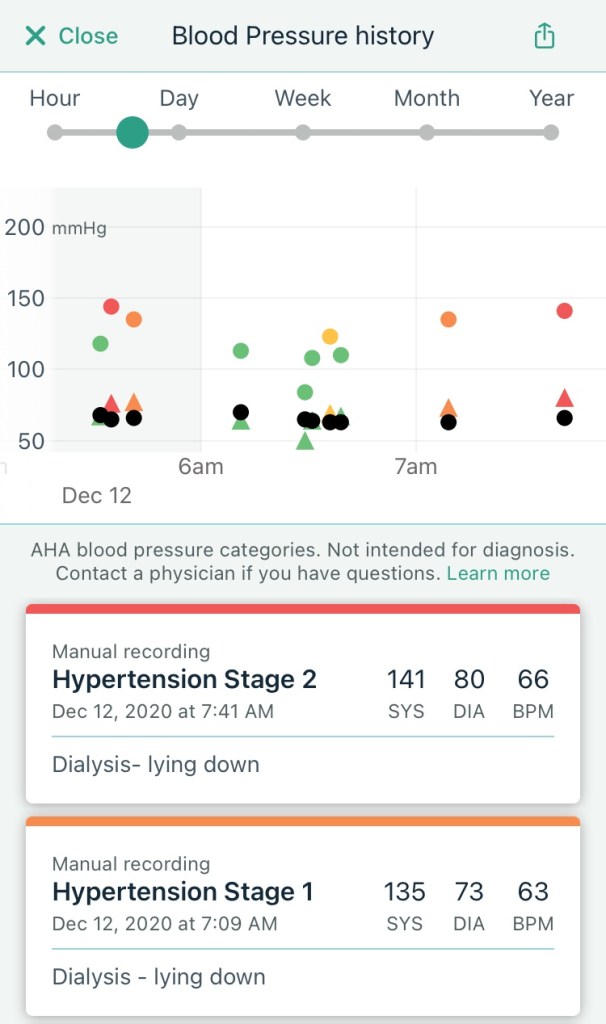
I’m weirded out by the huge blood pressure drop. I was very lightheaded and my vision started to blur. The tech said it was a natural reaction to stress and pain. I thought it would go up instead. Here is a chart for the first few hours.

The AHA categories are not too useful. I’m always in Hypertension Stage 1 or Stage 2. Even my low reading of 84/50 was recorded as normal even though I was about to pass out.

==========

It’s now 5:00 pm. The rest of the dialysis session was uneventful. They unhooked me at 10:00 am and I was out by 10:15 am. I took a short nap earlier, but my arm is still hurting a bit, and my right hand is somewhat numb. I am worried about going into dialysis on Monday and having “strangers” try to cannulate my fistula. I hope they don’t screw up.

Fluid Balance

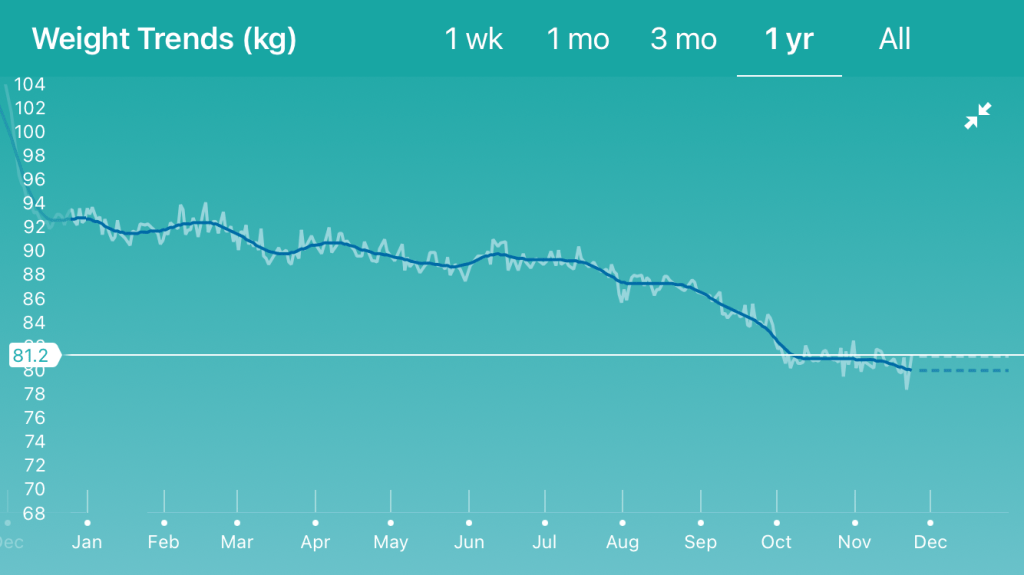
I’m a bit confused on what is going on with my fluid balance. I thought that I was losing weight but retaining fluids so my weight is fairly constant. Once we started removing more fluid during dialysis, my weight should drop more. My nephrologist thinks there a couple of liters of excess fluid by looking at my lower legs. After a week of using the Crit-Line monitor, my lower legs look pretty “normal” but my weight haven’t changed that much. My scale at home says I’m about 81.0 kg now, which is pretty consistent over the past several weeks.

YTD weight. I’ve been around 80 kg since October but blood pressure is much lower during the last week.

From what the nurse showed me, there’s several “buckets” of fluid: in cells, between cells, and in the bloodstream. I found this chart online:

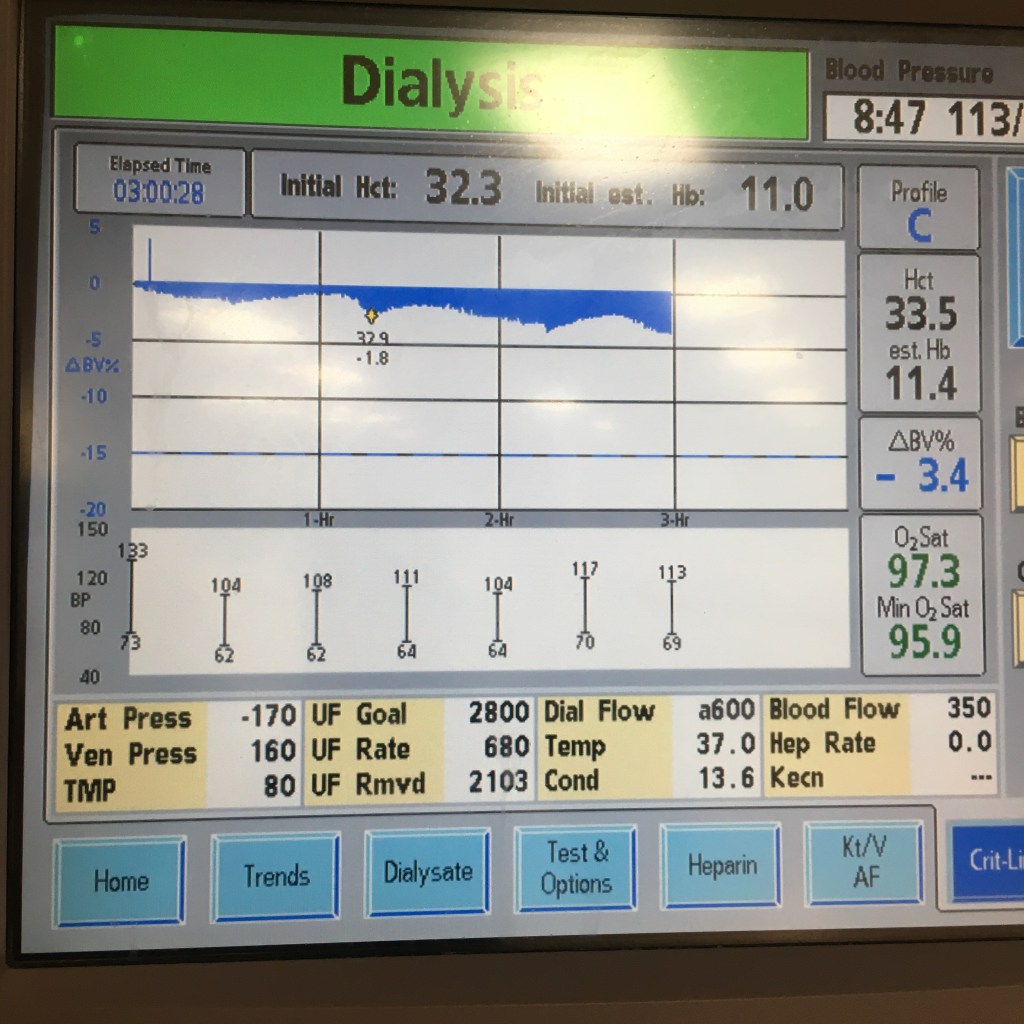
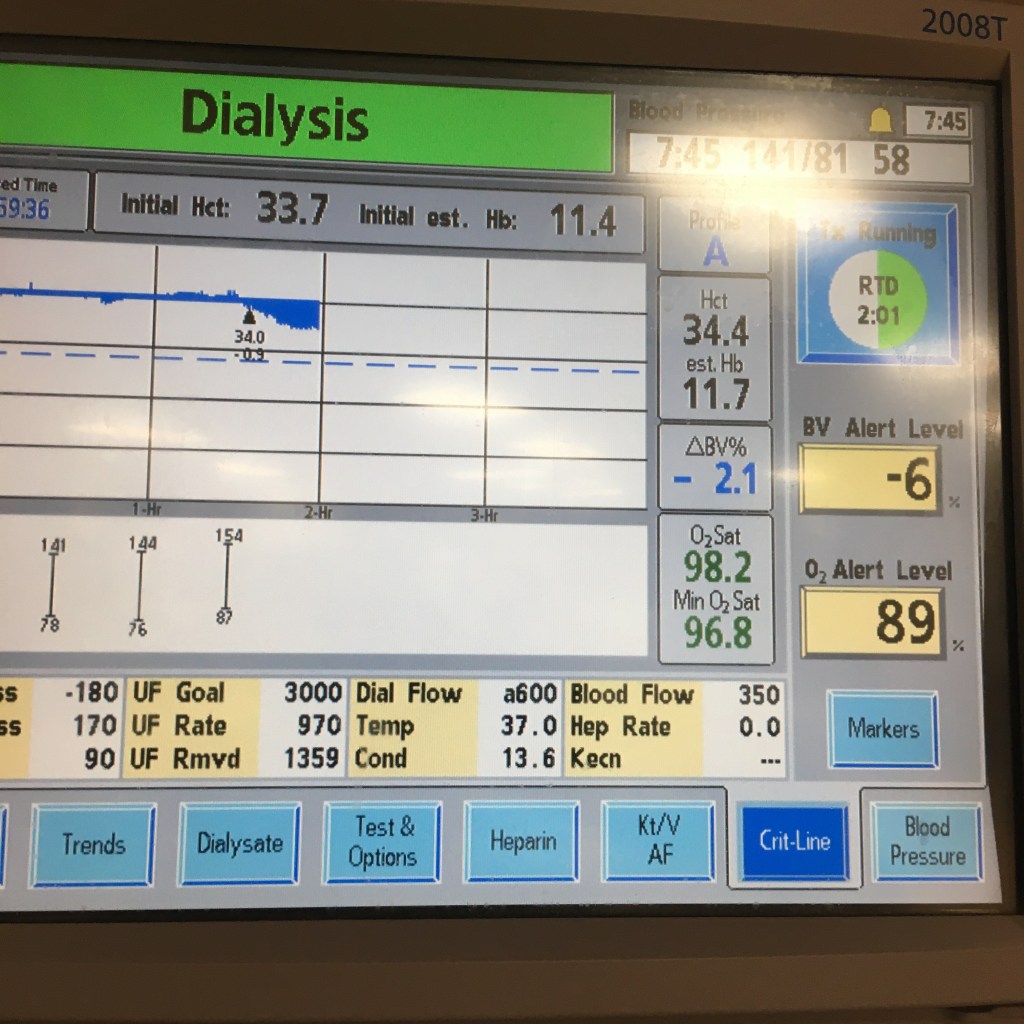
I’m not sure what my percentages are but we’re trying to remove more fluid than what is moving to the first area or blood plasma. I was told that during dialysis, as we remove fluid, it’s constantly being replaced by fluid in and between cells. It seems to make a difference how fast fluid is removed during dialysis, though I can’t understand why. Here is the Crit-Line graph from Thursday:

Initially, nothing much was happening. After an hour, the chart started to show a decrease in blood volume % change. It seems the flow rate between the different fluid buckets in the body is not constant either. Even though we didn’t change the setting after the marker, the chart values change constantly. Blood pressure is much improved as well, which supports the conclusion that fluid in the bloodstream is lower than before when my blood pressure was up to 180’s. I didn’t caputre Saturday’s chart but the blue wedge was much larger as we removed 3,200 mL of fluid and I ended at 78.4 kg. The only questions is what is different since my weight is about the same. Either I gained non-fluid weight (unlikely) or fluid is being retained in the cells but the absence of edema says otherwise. Very confusing.

Crit-Line, Day 2

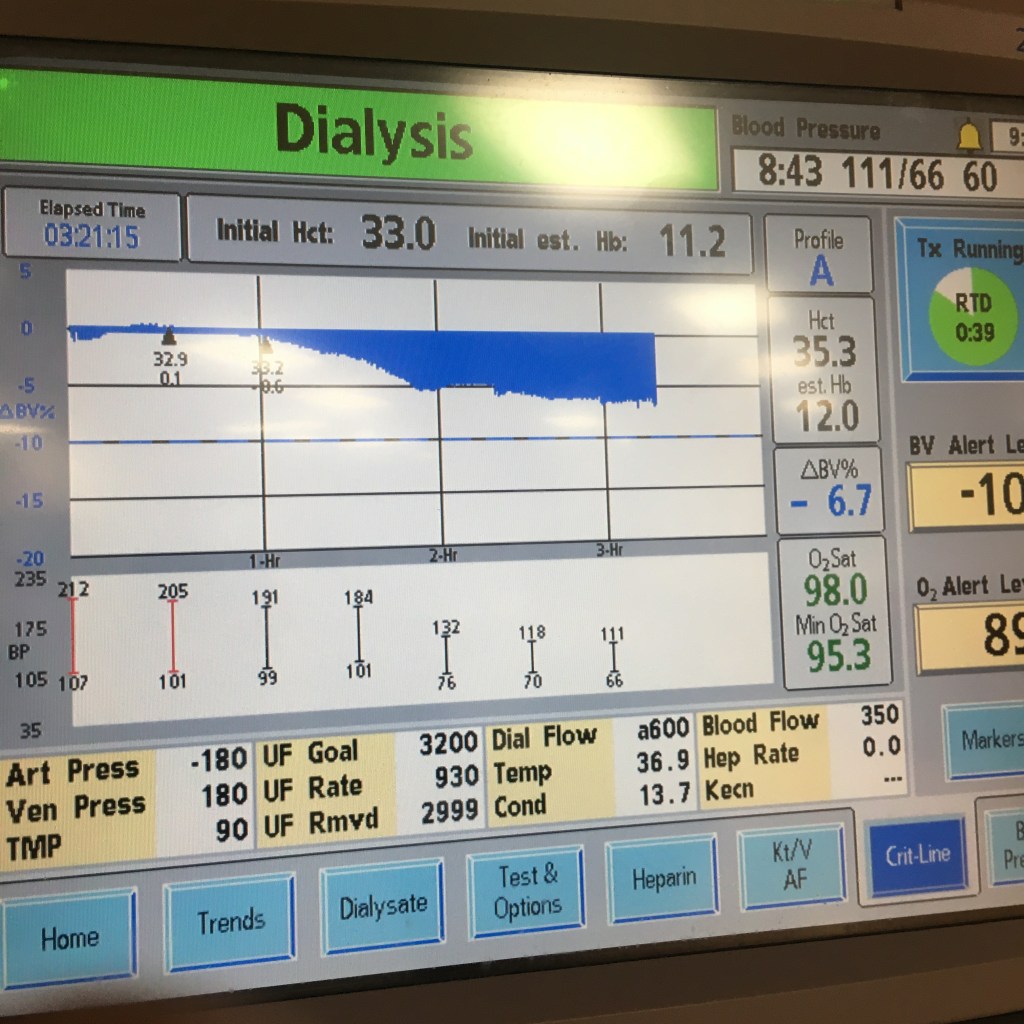
The dialysis center used the Crit-Line monitor again today to measure my change in blood volume % during dialysis. They think I still have some more fluid to take out, which matches with UCLA’s request for more “aggressive” dialysis. I went into the session at 82.0 kg, a gain of 2.8 kg over Thursday’s ending weight of 79.2 kg. We originally set the UF to 3000 mL over four hours, which is 750 mL/hour. However, the Crit-Line graph showed that there was not much change in the blood volume so we increased the rate to 1000 mL/hour, then to 1200 mL/hour.

From the photo above, you can see a definite drop in blood volume after the first hour.They ended up taking out 3217 mL of fluids in total over the four hours. You can also see the blood pressure measurements. It starts with a ridiculous 212/107 measurement, but once the blood volume starts dropping, the blood pressure also drops very quickly. At the end of hour 2, blood pressure is down to 132/76, and even lower to 111/66 at end of hour 3. I think my final systolic standing blood pressure was 103. I initially felt fine walking out but got a bit dizzy in the parking lot. I ended up getting some lunch and went to charge my car at the Santa Ana Supercharger.

I do think we’re getting close to getting rid of the excess fluid. My lower legs were on the verge of cramping today during dialysis. Maybe that’s due to the 1200 mL/hour rate. I had read that the UF rate should be kept under 10 mL/kg/hour. At ~80 kg, the maximum UF should be ~3200 mL over 4 hours or ~800 mL/hour. The supervising nurse came by and said that I’ve probably been waterlogged for a few months, and it may take a few weeks to get me back to the correct dry weight.

Fluid Removal Lesson

Just got a 10 minute lesson on fluid removal from the head dialysis nurse. There is an attachment on the machine that measures fluid volume in the blood plasma. I think the gist is that fluid is always being transported from cells to tissue space to bloodstream. However, if you can’t make urine, then the fluid stays in your bloodstream, which causes high blood pressure and excess fluid can backup in your organs (e.g, lungs).

YouTube video

This supports my theory that I’ve been losing tissue mass but retaining fluids. By keeping my “dry” weight somewhat constant, I’m actually retaining too much fluid. This was pretty evident a few months ago when I had difficultly breathing and a CAT scan showed ~500 mL of fluid in my lungs. It’s better now since they lowered my weight but it’s probably not enough. My lower leg and ankles are still swollen sometimes and my breathing is not back to 100% yet.

Crit-Line tab on dialysis machine

The above is a new screen on the machine that I haven’t seen before. It shows the change in fluid volume in post-dialysis blood. Before the marker on the graph, the change was around zero, which means my body was transporting the same amount of fluid to my bloodstream as the machine was removing. It’s basically saying we need to increase the rate of fluid removal to effectively reduce blood volume. I think the previous rate was 640 mL/ hour, and now it’s up to 970 mL/ hour. You can see the difference in the chart after the marker. My blood pressure is also dropping, which is normal for dialysis. I think the last systolic reading was 157 over something. Previously, since the blood volume was pretty constant and my medication for high blood pressure was being dialyzed out, my blood pressure was actually increasing. This also means that my weight post-dialysis will probably drop some more.

I did ask the nurse why they don’t run this analysis on every patient every session. She said most patients are stubborn and have lots of opinions about their treatment, especially how much fluid to remove. That seems crazy to me; why would I know more about dialysis than the nephrologist/nurse/technician? This device takes the guesswork out of determining the right amount of fluid removal. They’re going to do this a few more sessions to pinpoint the optimal fluid removal rate.

Science!

==========

We had to turn off the ultrafiltration part of dialysis about 30 minutes from the end since I was feeling dizzy, and my systolic blood pressure dropped to 103. I didn’t get a photo of the Crit-Line screen but the blue area was decreasing at the end, and my blood pressure starting increasing a bit. I think the systolic number got to 128 at the end of the session and I no longer felt dizzy. I left the dialysis center at 79.0 kg, which is the lowest weight recorded so far. We’re going to use the device again on Saturday since the nurse thinks there is more excess fluid to remove, but we’re going to start on a higher ultrafiltration rate and lower it over time, instead of starting low and going high at the end. This should reduce the risk of hypovolemic shock.

Fistula Update 11/3/2020

Election day!

At the end of the dialysis session, after the tech removes the needles, I usually have to sit there and hold some rolled-up gauze on the needle sites to stop the bleeding. Today, the fistula bled a lot. It was probably the most I’ve ever seen of my own blood.

Since I have to sit there an hold the gauze for 10-15 minutes, I’m usually reading Reddit on my iPad. Normally I’m not looking directly at my arm. Today, I felt my arm getting warm which is unusual. When I looked over, there was a huge pool of blood under my arm. I quickly got the tech over and she managed to change the gauze. I then applied pressure again but it was still bleeding. The tech thinks my vein “rolled” away from the gauze while I was applying pressure so she stood next to my chair and held the gauze for 10 minutes. My fistula did stop bleeding after that but I wonder how much blood I lost.

I ended the session at 79.2 kg. The nephrologist lowered my dry/ideal weight again to 79.5 kg so I’m still losing weight, though not as much as the weeks right after surgery.

Fistula Update 10/24/2020

Happy to say that the fistula is working great today. The tech didn’t even use the rubber tourniquet; he just asked me to put some pressure on my arm with my finger below the elbow. Needles went in on the first try and flow has been good. No pain… yet. Thursday was like this too but something hurt really bad for a bit when the needles were taken out.

The bruise looks much better today.

Speaking of flow, my dialysis prescription is four hours at 350 mL/min, which comes out to 84 liters or ~22 gallons (US) total. All through two (relatively) small needles.

==========

Ugh. With about 30 minutes left in the session, the top of my third toe on my left foot starting hurting from neuropathy. I think it’s the first time that the pain attack started during dialysis. It was bearable but the tech saw me wince a couple of times and thought it was the dialysis needles. I had to explain that my arm is fine but my foot is killing me. Again, I took two Tylenol pills to see if I can head off the pain.

==========

The sharp pain in my arm happened again. I think tip of the bottom needle is too close to the top (venous) needle so when the tech presses down to control the bleeding post needle removal, he’s also putting pressure near the tip of the needle still in my arm and it hurts a lot. Last time he said he would pull the bottom needle out first but I guess he forgot. The pain went away as soon as he pulled out the second needle.

==========

Fortunately, the foot neuropathy pain didn’t last that long. I got some lunch on the way home from dialysis, and took a 3 hour nap after eating lunch. The pain went away sometime during the nap. This seems to be the new pattern: more nerve pain attacks but not lasting as long each time. I’m not sure if it’s the Tylenol or the leg shaking (for increased blood flow) or the calf massage that’s reducing the pain duration. It all seems kind of random; I wish there was more a cause-effect to this.

Fistula Bruising

This is what my arm looked like last night:

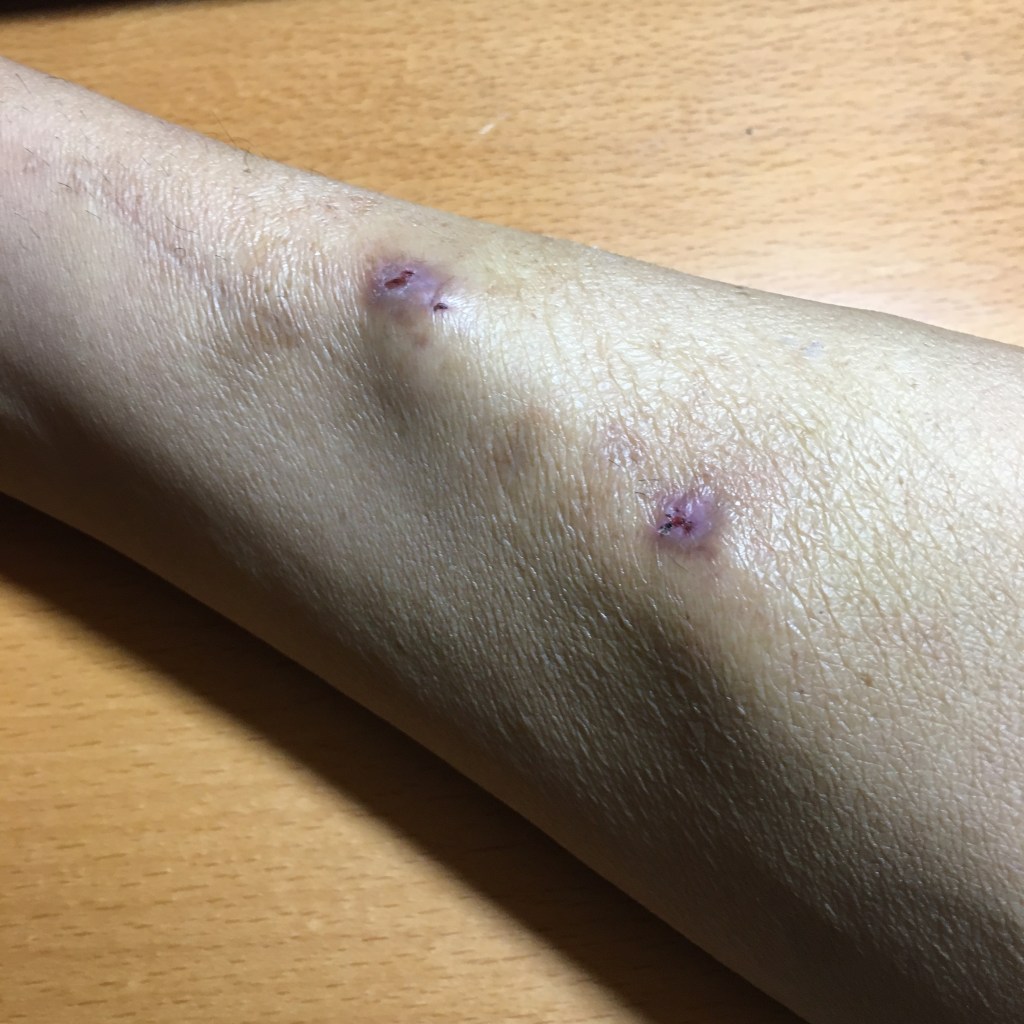
The purple spots near the elbow are bruises. It looks a bit worse this morning, but they still jabbed me in the same spot. I was instructed to put an ice pack on my arm today, then use a warm compress tomorrow to prevent the vein from hardening. I think this is from the screw up on Tuesday where the needle infiltrated the blood vessel and caused some internal bleeding. Fortunately, it just looks ugly and doesn’t hurt that much.

Also, the chaplain intern showed up today after disappearing for seven months. I’m not sure if he is still in school, or interning full-time. Unfortunately, his English didn’t get any better so I only got ~50% of our 10 minute conversation. It was difficult because I had to ask him to repeat a lot, and I don’t think he understood everything I said. Instead of asking me to repeat however, he just has a puzzled look, then keeps going with the conversation. He said he will be back to the clinic twice a week so maybe he’s making up for lost time.

Fistula Update 10/13/2020

Not off to a good start today. The tech that usually sticks me messed up this morning. Something happened to the return line needle after being connected to the machine. Pressure was too high or something. He tried moving the needle around a lot but to no avail, and the insertion site started to swell. I think that’s bad. He then went to the original lower site since swelling usually means the blood vessel was blown at that site. He asked me if I wanted lidocaine or just to stick it. I said, “Just stick it.” Holy shit, wrong answer. I guess I’ve always had lidocaine before needle insertion since it hurt like hell without it. The third site did work even though it hurt a lot at the beginning, and now we’re running at 350 mL/min again.

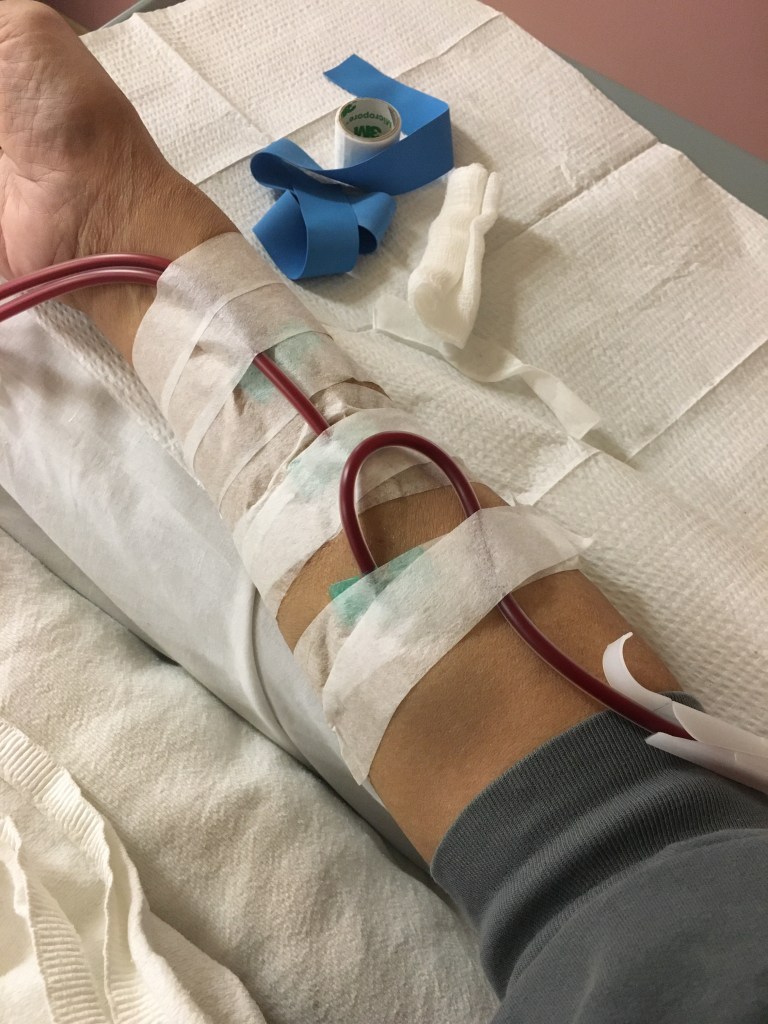
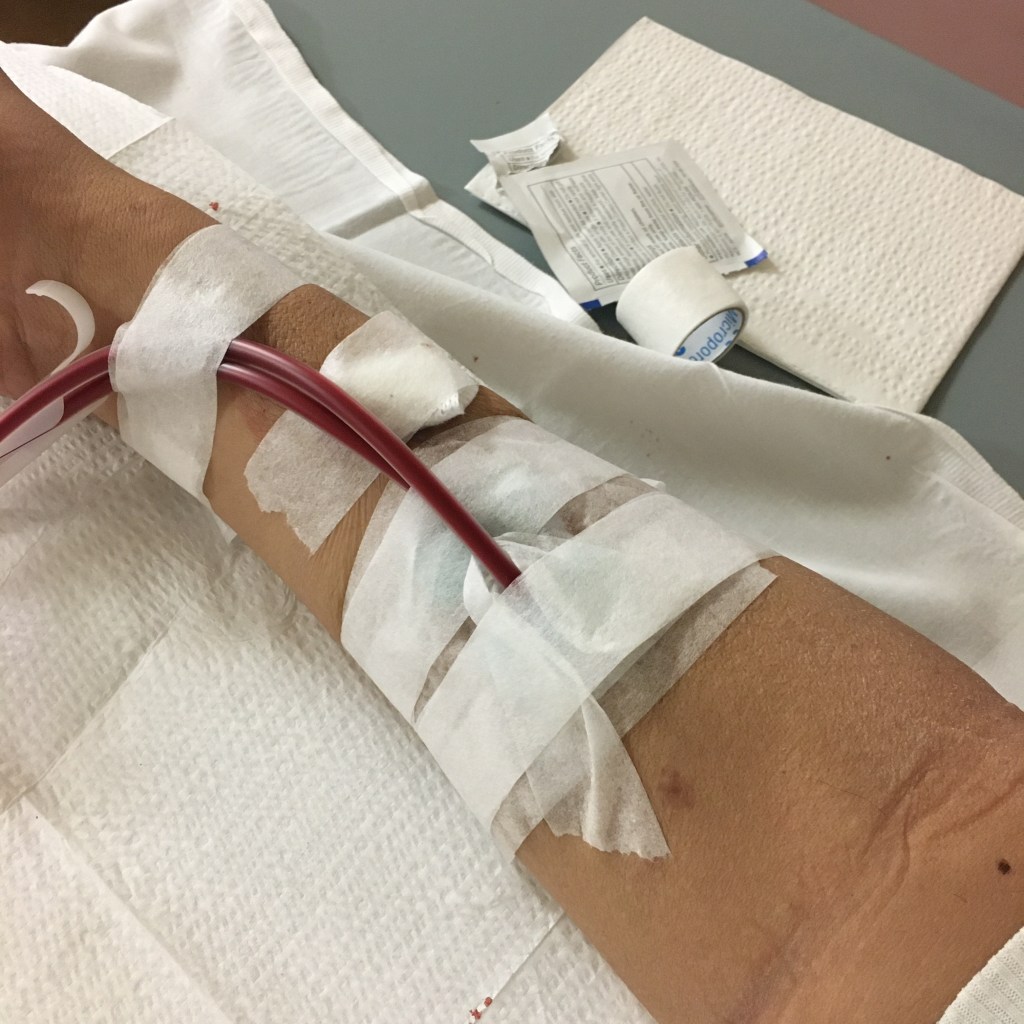
Here is my arm with three huge needles stuck in it. You can see the large bump on the top one that’s not being used.

Also, I skipped breakfast since I thought it was lab day. Turns out it’s not today so I kinda fasted for no reason. At least my blood pressure is somewhat normal today. Last reading was 133/74/56 sitting down. Three hours and twenty minutes to go.

==========

Ugh. Arm is hurting more than usual. Don’t know if it was the “no lidocaine” needle jab, or something else. I can’t tell where the pain is coming from since my arm gets cold and numb during dialysis as the blood flow is diverted away from my wrist/hand by the fistula. I’m going to try and sleep to hopefully pass the time faster.

Fistula Update 9/29/2020

Ugh. The tech didn’t get the arterial needle in right again this morning. After a bit of gauze and pressure to stop the bleeding, he managed to get it to work. However, they had to stick some more gauze under the needle to support it, so the angle of entry is weird. The result is that every minute, pretty sharp pain would shoot through my arm at the arterial needle site. It’s been 30 minutes of pain and I have three hours left. At least the blood is flowing.

==========

Just got home. I typed the above one-handed while on the dialysis chair. The four hours went by slowly. I finally fell asleep during the session just to have the rounding nephrologist wake me up. There was nothing new except he lowered my “dry” weight to 82.5 kg. I think I finished today at 82.7 kg, but my legs are still a bit swollen. Ugh, how much excess fluid do I have?

I picked up a 4-kabob family combo from Panini Kabob Grill after dialysis since my cousin and his wife are visiting us for lunch. They went to see their daughter (I guess that would be my niece) in San Diego, and they’re driving home to the Bay Area. I talked to them for awhile but I can’t eat lunch right now. I have the Lexiscan test later this afternoon and the technician wants me to fast beforehand in case I have a reaction to the injection and vomit.

It’s about 11:45 am now so I have to leave in about 40 minutes. The arterial insertion site was hurting all session long and it’s still hurting even now. Also, when the tech pulled out the venous needle, it hurt really bad. Today was just a painful day. I wish they could have kept me on the chest catheter for a bit longer.

Fistula Update 9/24/2020

My fistula failed this morning. The tech could not get any blood flow from the arterial needle. She tried several times but was unable to get the needle in the right place. One of the supervising nurses decided to go up higher on my forearm and create a new insertion point outside of the area suggested by the vascular surgeon. Even though they used lidocaine, it hurt a lot when the needle was inserter. Fortunately, she was able to get good blood flow and we used the new site as the venous site since it was higher up in the arm. However, it did hurt pretty badly for the rest of the session, and I was told not to move my arm since it was a new site. They were afraid the blood vessel would collapse then I would be without a fistula. Not sure what happens after that? Skip a day of dialysis? Go to the hospital for another chest catheter?

The gauze wad (second set of tape from the wrist) was the blown site. The tech had removed the first needle since I said it was hurting. They were going to leave all three needles in until the end of the session. As usual, there was quite a lot of bleeding but that stopped quickly. I tried to sleep but each of the three needle sites were painful so I was awake most of the time.

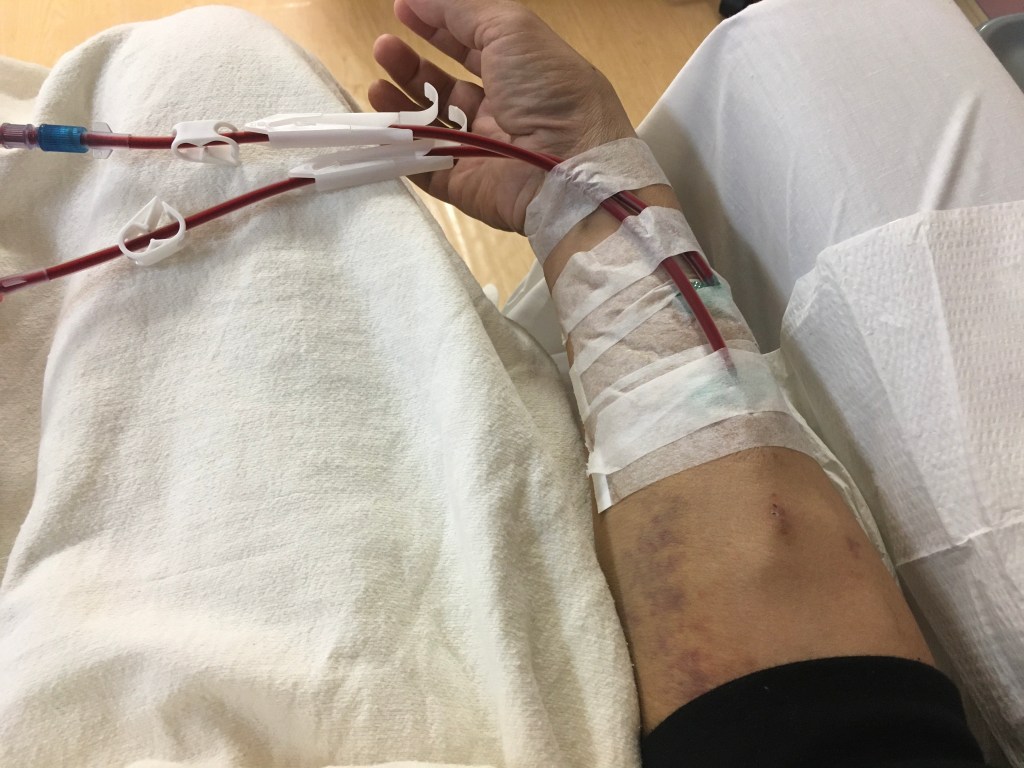
Here’s what my arm looks like the previous day. There’s persistent scabbing on both exit sites, and the vein underneath is very visible. It’s hard to see in the photo but the vein protrudes out quite a bit. I’m thinking of putting on a band-aid over the needles sites for cosmetic reasons since I look like an IV drug user with all the marks on my arm. Hopefully some of this will fade post-transplant.

Fistula Update 9/17/2020

I guess I’m using this title (Fistula Update) for general dialysis updates. Today was pretty uneventful. There was some pain in my arm and a bit of bleeding during the session but nothing noticeable. There was some problem with the arterial line at the beginning but the tech moved the needle a bit and it seemed to work fine afterwards. I was pretty tired again and semi-slept through about two hours of dialysis.

For some reason, the latest lab results are not on the patient portal. One of the nurses told me that my kT/V was 1.27 and URR was about 66%. Once again, I just barely passed the bar of 1.2 for kT/V and 65% for URR. That pretty much means they won’t be shortening my dialysis time in the near future. Maybe if they run the machine at a higher flow rate.

Blood pressure was weird again. I started at about 130 and again, it gradually increased to 182. At about 9:15 am, I took 10 mg of NIFEdipine and by 10:00 am, it was back down to 120’s. I think the final standing reading was 13o-something. My doctor friend also mentioned the importance of fluid balance so maybe my BP will stabilize once they remove some more fluids from me. I left dialysis today at 83.8 kg.

Fistula Update 9/3/2020

Since the chest catheter was removed on Tuesday, this was the first dialysis session where all I had for access was the fistula. I told the tech that there’s no backup today. In the past, if something went wrong with the fistula, we could always move one or both dialysis lines to the catheter. Not so today. Anyway, the needles went in fine, and everything worked. There wasn’t even any bleeding today from the arterial needle, but there was the occasional mystery pain in the arm. It wasn’t too bad.

Since the nephrologist lowered my dry weight on Tuesday, we thought we would try to get ahead of it, or “challenge” me. I finished the session at 85.5 kg, another low weight mark. Yet my ankles are still swollen so maybe there is a few extra kg of fluid to remove.

==========

It’s now about 6:30 pm. I left this unpublished for several hours while I fell asleep. I’m still very tired but the nap went well. Breathing was a bit easier so I was able to sleep for a few hours without waking up every 30 minutes. I removed the post-dialysis bandages and only one needle prick point was bleeding. I also changed the bandage for the catheter exit site. There was still a tiny bit of blood so the hold should seal in a few more days.

Bleeding Out Again

Today was the second to last day of dialysis with the chest catheter still intact. Even though we’re not using it, it’s good to know it’s there in case the fistula becomes troublesome. The needles went in pretty smoothly today, but there was some sharp pain in the arterial line as we started dialysis. This is the line that leaked blood all over the place last session. I guess the pain should have warned me that there will be bloodletting today too.

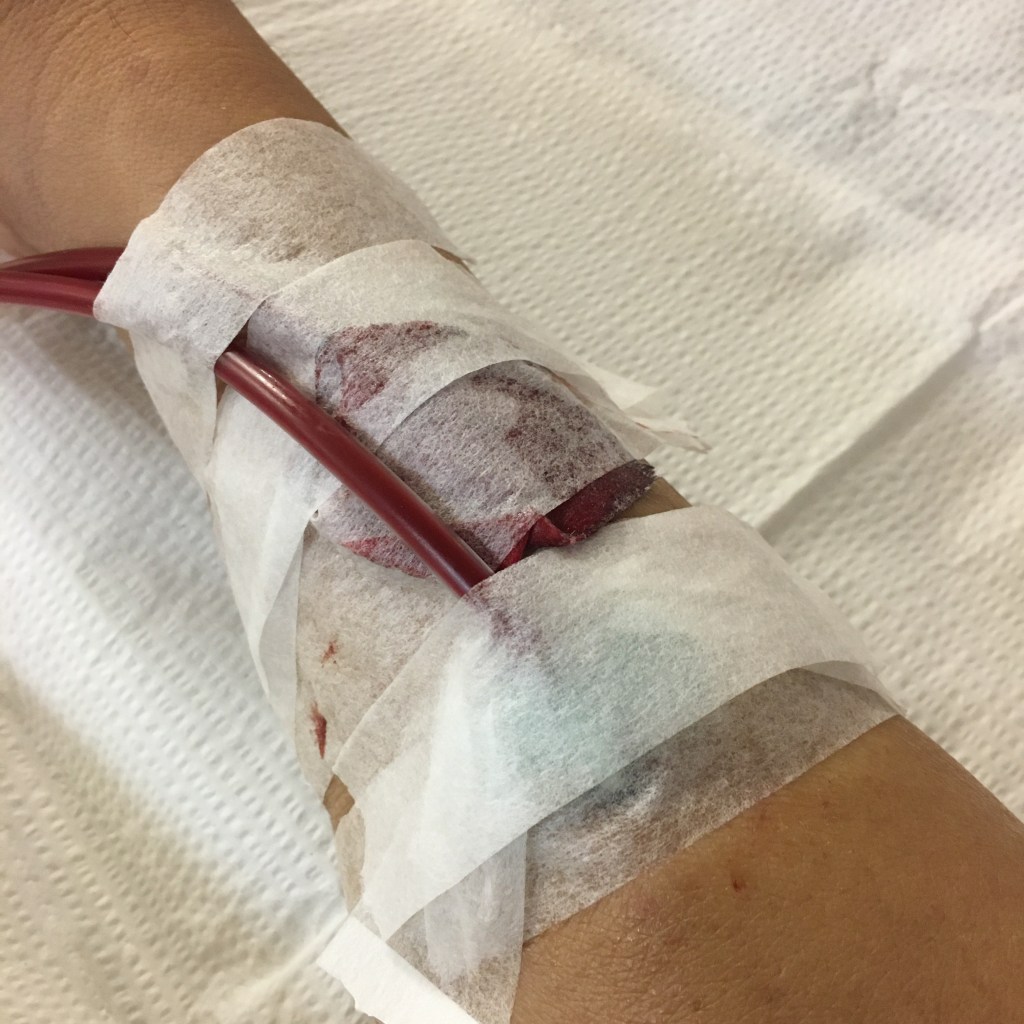
I was so tired from not sleeping that I fell asleep right away but woke up at ~7:00 am. I looked at my right arm and there was a trickle of blood coming from the arterial line again. I called the nurse and she cleaned it up, this time putting a alcohol pad on the insertion point as well. About two hours later, I look again and both the pad and the tapes seemed saturated with blood. I got a picture this time but it’s pretty gross. I don’t know how to embed photos other than as an inline graphic so no room for a trigger warning.

This was all coming from the lower needle; the upper venous line was doing great. By now, most of the blood had clotted so the tech said to leave it until the end when she removed the needles. There was still sharp pain coming from that area for the rest of the session and a lot of blood when she finally took all the tape off. Nobody was concerned though so not sure if it’s a big deal if it leaks each session. I’m just afraid I’ll fall asleep and bleed all over the floor.

Bleeding Out

Okay, I’m exaggerating but there was a lot of blood. About three hours into the dialysis session, I noticed that there was a growing bloodstain on the waterproof napkin they were using to line the dialysis side tables. I looked at my arm and the lower needle (arterial) was leaking blood. I pushed the call button, much like in an airplane but not quite, and the tech came over to help. She said that leaks happen occasionally and it was nothing to worry about. She proceeded to get some alcohol swabs and wiped away all the blood running down my arm. She then replaced the medical tape holding the needle down, and promised me that she would finish cleaning up when the session was over.

I wasn’t too bad. The bleeding had stopped when she changed the tape, and post-dialysis clean up was pretty easy. Still, it was weird watching your own blood leak out of a rubber tubing and not being able to stop it. I really don’t like this fistula but since the chest catheter is coming out Tuesday, I’m stuck with no other options going forward.

Sorry, I didn’t get any pics.