COBRA Ending Soon

When I quit my job last year, I elected to receive COBRA coverage instead of looking for my own health insurance. Due to federal law, I was eligible for eighteen (18) months of coverage. The cost was from $650 to $700 per month for health, dental, and vision insurance. Other than changes in the mail order pharmacy provider, there were no significant changes in coverage.

After eighteen months, there is a California law that provides an additional eighteen months of COBRA coverage, called Cal-COBRA. I checked with the benefits team at my old employer regarding my eligibility and was told that I would not be covered since the company was considered self-insured. I am familiar with this part since I was the company treasurer, and I paid the $million insurance bill every month.

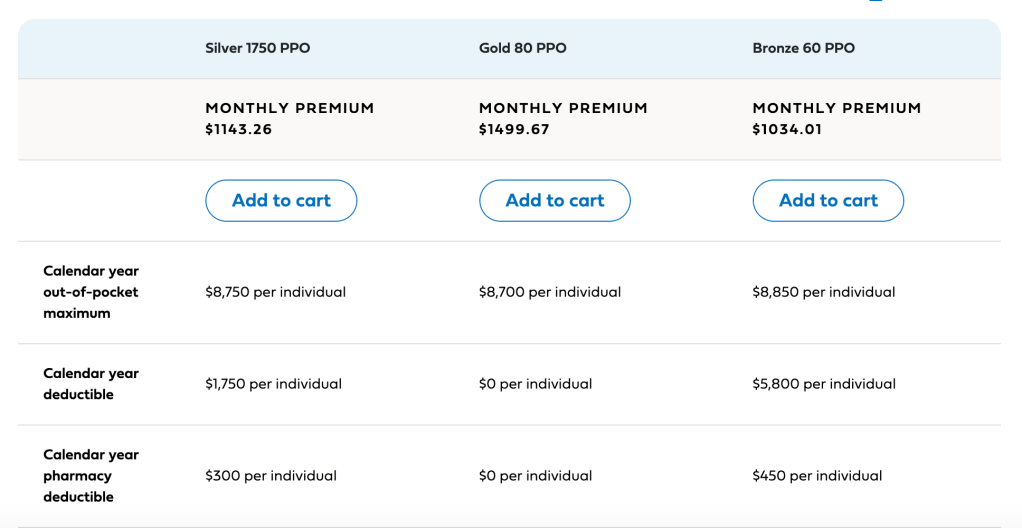
Like everything in this world, it is not a problem if it can be solved with money. If I am no longer eligible for COBRA coverage, I can simply go online and buy my insurance. I was told in the past that our company’s coverage is equivalent to a high silver plan. Since we used the Blue Shield of California network, that is where I looked first.

The first thing you notice is the very high primium cost for any plan. Looking through my current coverage, it appears to be better than the Gold 80 PPO plan shown above. There is a Platinum level plan, but the cost is over $2,000 per month. For just one person.

For now, I will need to verify the answer given to me by the benefits analyst. Her first email said I was eligible for Cal-COBRA, but a subsequent email five minutes later said otherwise. I want to stay with Blue Shield for ease of transition, but I should also check the healthcare exchange to see if there is a better deal.

Medication Mystery Solved

As I mentioned previously, my local pharmacy wanted $140 for filling my updated tacrolimus prescription. I called and left a message with my work insurance provider to figure out what changed since I was only charged $10 last time. Before they had a chance to reply however, the online pharmacy called. They get a notification whenever an out-of-network prescription order is placed at my local pharmacy. I believe I am supposed to fill those at the mail-order pharmacy to save my company some money.

Anyway, the nice lady explained that tacrolimus was not covered at local pharmacies. They do allow one or two courtesy fills so that is why my previous prescription only cost $10. They also said they tried filing the claim with my work insurance and it was accepted. I was worried since the online pharmacy did not accept Medicare Part B for prescriptions. Long story short, the online pharmacy will contact my nephrologist to resend the prescription to them for a three month fill, and I will only pay $10 total.

Glad that got resolved. Only took calls to my doctor, my insurance, and three different pharmacies.

Potential Cost of Medicare For All

I have been sleeping pretty well last few days, but for some reason, I cannot fall asleep tonight. It is 3:45 pm and I have not slept at all. Instead, I have been browsing Reddit and came across this post. It is nothing new; there is probably something about “free healthcare” posted every minute. Since Reddit users are mostly young and liberal, you can guess how these discussion usually go.

Politically, I am probably more liberal socially (for an American) and more conservative fiscally. Basically people should be able to do what they want, as long as I do not have to pay for it. Also, the post above is asking doctors for their opinion. I am not a doctor, just an experienced patient, but I feel qualified to discuss the financial impact of “universal” healthcare.

First, some data. Medicare was 14% of the US federal spending in 2019, or about $644 billion. Next, the medical insurance recorded medical costs of $632 billion and administrative costs of $88 billion. Overall, the industry only has a 3% profit margin, or about $22 billion. If we enacted “free’ healthcare, in the short-term, Medicare costs will increase by 100% or more since costs will not change much initially, but demand will likely increase. In 2019, insurance companies collected $735 billion in premiums so I guess companies/individuals can just pay that as a tax. However, since half of the population do not pay taxes, the impact of any new “healthcare” tax will impact middle and upper class Americans. Another issue is Medicare reimbursement rates are much lower than private insurance. A lot of doctors either do not take Medicare or limits the number of Medicare patients. What happens when Medicare is the universal insurance? Will doctors and hospitals agree to what essentially a huge pay cut?

Finally, as mention above, I really hate the word “free” because it is not free. In reality, it just means someone else is paying for it. Reddit comments like to say that insurance profits will save lots on medical costs. Yes, $22 billion is a lot of money, but it is tiny compared to the size of the healthcare market. The solution is probably to focus on preventive medicine and force doctors and hospitals to make less money. Will that work?

==========

Since I am missing a lot of demographic data, I will use my company as an example. We are self-funded, which means the company pays an insurance company (Blue Shield) a small fee ($40 PEPM*) to use their provider network and negotiated prices. Our costs are around $850 PEPM, and some employees pay a premium. If we use $800/month, that works out to $9,600 per employee annually. If the company pays that to the government as a corporate healthcare tax, then I am agnostic. However, I know from speaking to our insurance broker that $850 PEPM is very low, as our employee base is pretty young. Most other companies in the industry spend more. Our company switched to a self-funded model to save money, but a universal healthcare tax may just spread costs based on averages and we would pay more. Even worse, if our company just gave everyone $10k to cover the new healthcare tax, I am pretty sure my tax increase will be a lot more than the $10k since I am in the group that pays taxes.

Sigh. I see the benefit of universal healthcare. People do not have to worry about going bankrupt from medical bills, and it will probably increase the health of poorer Americans. However, if we cannot control costs, then we could have worse health outcomes and a damaged economy. I have a lot of relatives in Canada. They pay a lot more taxes for their “free” healthcare, and while it seems like a better system for small health problems, it is absolutely terrible for serious illnesses.

*PEPM = per employee per month.
More Critical Illness Insurance Update

In a previous post, I mentioned that Allstate approved and paid me $50,050 for my kidney transplant since it was covered under the critical illness insurance I enrolled in at work. They were also reviewing some older illnesses that I assume they found in the backup documents for the transplant claim.

Since then, Allstate approved my claim for ESRD, which also pays out $50k. I just received the check in the mail yesterday for $49.790; I think I missed a few premium payments while I was out on medical leave for my heart surgery. When I called Allstate a few months ago regarding this “potential” claim (I had not filed a claim yet), they said usually claims are limited to one-year after starting dialysis, but to try anyway. I guess 3.5 years is not too late.

That leaves an open claim for my heart surgery from November of 2019. Again, I did not file any claims but Allstate started on anyway. I did send in some requested backup documents a few weeks ago. In the benefits document, CABG surgery was covered at 25% so I was expecting $12,500 if the claim was approved. Well, this morning, Allstate sent me a message that the claim was approved for $50k again. I was confused so searched and found the EOB (explanation of benefits) document for that claim, and it turned out it was for both a heart attack and the bypass surgery. Heart attacks are paid out at 100%, so that is where the $50k came from. The CABG surgery was denied since it was considered the same “event” as the heart attack. So all together, Allstate is sending me $150k in total claim payouts. I sure hope this is not taxable.

==========

I wonder if I waited for 90 day after the initial ER visit in November 2019 for the CABG surgery, would Allstate treat that as a separate event/claim and pay out another $12,500? I would probably be dead now though.

Endocrinologist Appointment

I had a Zoom telehealth appointment with my endocrinologist. I had been sending her office email updates post-transcript but she wanted to discuss my blood sugar and medications. UCLA also has been asking me to see my endocrinologist too.

The appointment went well. I had given her assistant all my blood sugar readings for a week. Since I am already at the maintenance level for prednisone, she does not think my blood sugar will decrease further from reducing other medications. The pill I am taking, Januvia, does the same function as the HumaLOG, which is to control blood sugar due to food. Since my blood sugar is consistently above 200 during the day, she is replacing the Januvia with a long-lasting insulin. She had prescribed Toujeo previously but I never used it. Now I will need to inject two types of insulin each day. Ugh.

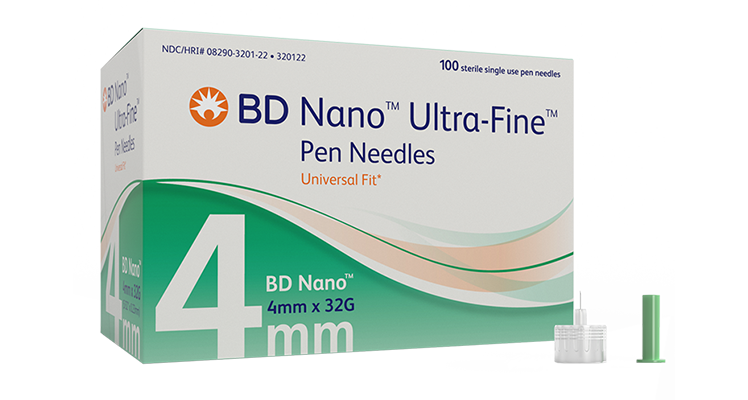
The pricing on the pen needles also suck. At UCLA, I had a copay of $30 for a box of 32 gauge 4mm needles. My local pharmacy wanted $44 as copay for the same needles. I have not checked my mail order pharmacy for prices. On Amazon, there are a lot of inexpensive options for the same size needles. However, none of them will deliver to my house, probably because you need a prescription in some states to order insulin needles. I did find another mail order diabetic supply company that has 100 needles of the same size for $11 per box of 100. Even with shipping, that is much cheaper than either of my pharmacies. Hopefully a needle is just a needle so as long as it is the same size, the needle will work with both pens.

==========

This is what I initially received from UCLA along with the HumaLOG pens. I looked at the pharmacy receipt and UCLA’s price was $71.50, and my copay was $30. On Amazon, the same item with 90 needles cost $45, but there are other sellers selling for as low as $15. Of course, I cannot order since no one will ship “prescription medical devices” out to patients. You probably have to be outside the USA to receive these items. Our medical insurance system is so corrupt.

I also tried getting needles at Albertsons pharmacy. My endocrinologist sent over a prescription for Droplet pen needles, same 32 gauge 4 mm needles as the BD ones above. Albertsons said my copay was $44 but this item clearly sells on Amazon for $13.89 a box. Again, I cannot order it from Amazon due to our corrupt medical insurance system.

Searching online, I found a company called Medical Supply Corner selling the Droplet needles for $9.99 for a box of 100. I ended up ordering three boxes to spread out the $6 shipping cost. They also have a four box pack for $40 that I did not see before ordering. I used my FSA debit card and the transaction went through. Hopefully the will ship the items to me but I am expecting the order to be blocked, or maybe the SWAT will come knocking to get the needles back.

Medicare Premiums

I guess they found out about my salary levels. Instead of paying the base rate of $144.60/month, I think Medicare is charging me $462.70/month, or about 3x the base rate. I paid $723.00 in March for 5 months but got a huge second billing of $2,978.60 a week ago.

Since dialysis is super expensive, my high premiums are still worth it. I think I still have a few denied claims to work through from the beginning of the year, then I have to get some of my co-pay reimbursed by Medicare.

UCLA Medical Billing

Remember my visit to UCLA to see their cardiologist? I saw the doctor for literally three minutes. On the way out, I told the receptionist that I sent in my Medicare card to the Transplant Center, and asked him if he needs a copy. “No, we’ll get it from the Transplant Center” was the reply.

Ha! Of course they tried to bill my work insurance first and got the claim rejected. I guess my transplant coordinator didn’t update my records since they are trying to bill me for the entire amount. Why must everything medical be so difficult?

Also, the cost of the three minute visit? $725. That seems like a ridiculous amount. There’s no way we can reform healthcare costs in the US if doctors and hospitals can get away with billing like that.

Coordination of Benefits, Part VI

It’s been over a month since I posted about my insurance issues. It’s good to have health insurance, but it’s “bad” to have more than one. When you have multiple coverage, all the payers want to be second in line to pay, not first.

During the month that passed, I called and wrote my work insurance many times. Each time the member advocate (MR) would tell me that the supervisor would contact me but he never did. All I heard was that they were still working on it. I provided them with written documentation and contact info for Medicare but it didn’t seem to help. In the meantime, I had my surgery claim rejected (~$18k) plus two months of dialysis (~$36k per month). It was a bit stressful to have ~$100k of unpaid medical claims.

I sent another message this morning and finally got a reply saying they accept the April 1st cutover date, and will reprocess all the rejected claims during January through March. Yay! I hope they do this quickly since I’m getting second and third notices from my providers.

Coordination of Benefits, Part V

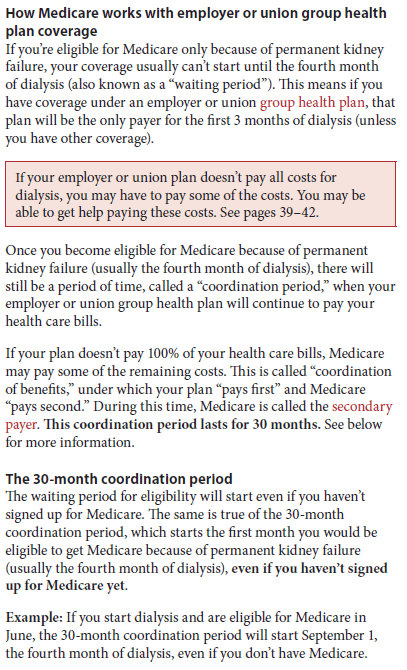
It’s getting serious now. My insurance just rejected my February dialysis bill for ~$33k. I still can’t get through to Medicare’s benefit coordination center; the wait time was too long last time so I need to try again tomorrow. However, I found a document on Medicare’s website that clearly states that I need to wait 3-months before beginning Medicare, and the 30-month benefits coordination starts after that date. That is why all the info I’ve received from my dialysis clinic mention the coordination period as 33-months. Now all I have to do is get my work insurance to agree and reprocess all the rejected claims.

Coordination of Benefits, Part IV

I’m so frustrated with all this. I called our work insurance service provider again today and spoke to the claim supervisor. It turned out he has been out sick so he never got back to me. Anyway, their conclusion is that after 30-months of dialysis, Medicare becomes the primary insurance for all claims. Therefore, I need to have all my providers bill Medicare first, then any remaining amount will be paid by my work insurance. The problem is that Medicare starts three months after the first dialysis date of July 5, 2017, so by rejecting claims after January 5, 2020, my insurance is off by three months. The rules are so confusing that each time I call my insurance or Medicare, the answer seems to change. I’m now getting invoices for this failure of benefits coordination.

DENIED!

Because of this confusion, I’ve stopped seeing my therapist and acupuncturist. I also have several upcoming appointments to see the cardiologist, primary care physician, endocrinologist, and others. I feel like I need to postpone those appointments until the insurance situation is cleared up. My work insurance also started rejecting my cardiac rehab claims so I’m not sure how to continue there since the hospital doesn’t seem to want to bill Medicare on my behalf.

Cancelled Appointments

I’m not sure what to do about my work insurance screw up. My therapist basically suggested we stop meeting until the payment issue is resolved. I don’t think she has received any rejected claims back yet but we’re stopping anyway. There could be as many as four rejected claims for my therapist so that’s an extra $400 I would have to front and maybe get reimbursed later.

This is happening to claims from the acupuncturist as well. I’m still going tonight but will probably have to stop. There are a lot more potential claims to reject since I’ve been going twice a week. Also, Medicare does not cover acupuncture nor elective therapy so even if Medicare was my primary insurance, my work insurance would still have to pay these claims. I wish they would at least stop processing claims while researching the case instead of going ahead and rejecting them and causing me a lot more work later on.

I also skipped cardiac rehab today. It’s been over a week since I went. I missed a couple due to feeling like crap after dialysis, one due to an early work event, and one due to my tooth hurting from a dentist appointment. When I walked out of dialysis today, my legs felt weak so I didn’t want to walk another 30 minutes on the treadmill. I need to get lots of sleep tonight so I can go in tomorrow morning. I can still meet UCLA’s April deadline if I don’t miss too many sessions from now on.

Health Insurance F*ck Up

I just checked my work health insurance activity and they rejected all sorts of claims, even after my phone calls and emails clarifying that Medicare is secondary insurance, not primary. I called their customer support and it seems that they are still researching my case. They still think Medicare pays primary until 30 months or something. During our last conversation, a supervisor clearly said they were going to make a note about Medicare being secondary insurance in my files, and reprocess all messed up claims. I guess not. Now there are even more messed up claims, some for thousands of dollars, that I have to deal with with time I don’t have.

Medicare Benefits Call

I called Medicare today with questions regarding coordination of benefits when I still have my work insurance. The person on the phone was really nice but the call took awhile since she had to look up a lot of info. I guess it’s not a common topic.

She confirmed that as long as I have my work insurance, Medicare will pay as secondary insurance, except for dialysis after 30 months, and the kidney transplant. I asked about previous claims where I paid a co-pay and was told that I can file a claim. However, if the provider charged more than the Medicare rate, and most do for private insurance, Medicare will calculate their responsibility with the lower rate. I’m still unclear what that means. If my doctors bills my insurance $200 and they paid $160 since my co-pay was $40, how much will Medicare reimburse me? If the Medicare rate is $100, will they pay up to $80 (80% of the initial claim at the lower rate), or pro-rate my co-pay and only reimburse me $20? We decided over the phone that I should just file the claim for $40 and see what happens. I also didn’t get any statements from my doctors so I’ll need to go back to all of them for more info in order to file the claims. Medicare does pay for cardiac rehab so that’s a lot of co-pay to get back for the entire program.

I also got the first statement from my dialysis clinic. The insurance amount was close to $30k. My work insurance only pays 85% but since I also have an out-of-pocket maximum each year, my portion comes out to ~$3,000. I’m thinking Medicare should pay that but their dialysis reimbursement rate is much lower, probably like $3,600. So will Medicare pay only 80% of that or $2,880? Also, if Medicare pays some of the bill, will my insurance count that when calculating my out-of-pocket maximum? Otherwise I’ve hit my max and my work insurance will pay 100% from now on. Super confusing.

Coordination of Benefits, Part III

Crap! There were five claims (so far) that my work health insurance screwed up. When I called them, I thought there was only one but after going through all the claim activity online, there were four more where my work plan paid as if they were the secondary insurance. I sent them a secure message on their platform with all five claim statements. I hope they review and repay in a timely manner so I don’t have to answer all sorts of calls from my doctors. Sigh…

I still have to call Medicare to figure out what to do with all my co-pays. I figure I must have paid >$350 in co-pays excluding acupuncture and therapy. Not sure if those two things are covered. I called Medicare once before and they were pretty helpful so maybe this won’t hurt too much.

Coordination of Benefits, Part II

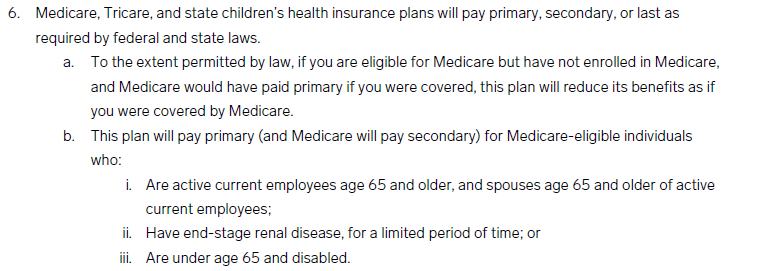
I talked to our benefits department and they found an 85-page plan detail document from 2017 that clearly states if I qualified for Medicare because of ESRD, our insurance plan would be primary and Medicare would be secondary. This is contrary to the last claim details I received. Our benefits coordinator requested a callback from a supervisor from our insurance and he verified that our plan should be primary. He also said he would ask his team to reprocess my claims again to make sure they were paid out correctly. Yay! I was afraid I had to mediate between insurance plans if both thought they were secondary insurance.

Pretty clear, no?

Like my sister, our benefits coordinator said this coordination of benefits when you have multiple insurance coverage is the most complicated topic in health insurance. No one wants to be the primary coverage insurance since they usually paid 80%-85% of the claim. I avoided getting Medicare because of this coordination mess, and only got it because my work insurance will stop paying for dialysis soon.

Additional Insurance

Several years ago, my benefits coordinator at work told me about some supplemental insurance programs that we were offering for extra cost. The programs were underwritten by Allstate Benefits and included Critical Illness Insurance and Hospital Indemnity Insurance. I signed up for both since I was already at stage 5 of CKD (chronic kidney disease). For Critical Illness Insurance, I enrolled in Plan 4 which costs about $50 each pay period and pays $50k per illness. That same year, I started hemodialysis in July but never filed a claim with the insurance. With the recent heart bypass surgery, I now have two claims to file.

BenefitsPlan 4 Payout
Heart Attack (100%)$50,000
Stroke (100%)$50,000
Major Organ Transplant (100%)$50,000
End Stage Renal Failure (100%)$50,000
Transient Ischemic Attack (TIA) (25%)$12,500
Coronary Artery Bypass Surgery (25%)$12,500
Invasive Cancer (100%)$50,000
Carcinoma in Situ (Non-invasive Cancer) (25%)$12,500
Second Event Initial Critical Illness BenefitYes
Benign Brain Tumor (100%)$50,000
Coma (100%)$50,000
Complete Blindness (100%)$50,000
Complete Loss of Hearing (100%)$50,000
Paralysis (100%)$50,000
Allstate Benefits Critical Illness Insurance Brochure

For some reason, they only pay out 25% for CABG surgery. Maybe it’s not as serious as ESRD (ha!). Also, if you have a second critical illness event of the same type, they will pay again. I don’t know how they would treat ESRD since I went from hemodialysis to peritoneal dialysis and back again. Probably counts as one illness event since I never stopped dialysis. My benefits coordinator said she will help me fill out the claim forms. For sure I can claim both the ESRD and CABG items for $50,000 + $12,500. If I have the transplant this year, then it’s another $50,000 for a major organ transplant. Not bad for $1,300/year in premiums.

The other insurance for hospital indemnity doesn’t pay that well. It pays $1,500 for the first day, then up to 10 additional days at $150/day. You can also only make one claim per year. I don’t know if they will count my CABG surgery as two claims: critical illness plus hospital stay. You really can’t have the surgery without staying in the hospital. If they count it as a separate claim, then it’s $1,500 + $150 x 9 days = $2,850. I also stayed in the hospital for a few days back in 2018 for a foot biopsy. Looking at old medical claim forms, it appears to be three days in May 2018 so maybe another $1,500 + $150 x 2 days = $1,800. I hope Allstate doesn’t drop our insurance coverage because of me.

If any of my claims are paid, I told my benefits coordinator that I’d buy her a nice steak dinner.

Insurance Coordination of Benefits

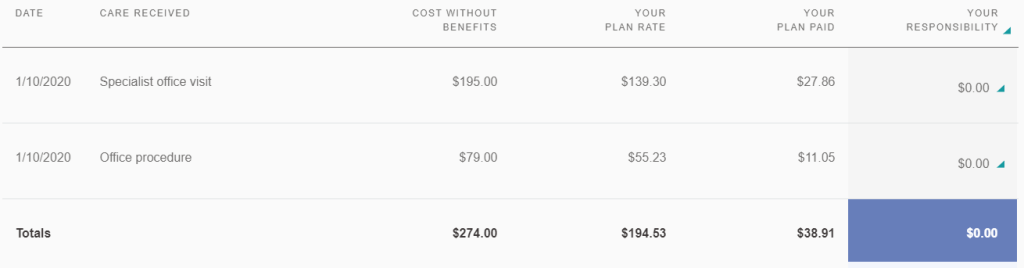
The fun starts now! Back on January 10th, I went to see a podiatrist for a check up since I’m diabetic and have peripheral neuropathy. Since the podiatrist was a specialist, I paid my $40 co-pay and thought everything was fine. Well, the podiatrist office finally filed the insurance claim, and I got the following statement of benefit from my work insurance.

The podiatrist office billed $274.00 for my visit but the negotiated rate for Blue Shield is $194.53. My insurance then determined that since I have Medicare starting 1/1/2020, they are the primary insurance, and should cover 80% or $155.62. Therefore, my work insurance only needs to cover the remaining 20% or $38.91. On my call with my work insurance yesterday, they said I need to give all my providers a copy of my Medicare card so they can bill Medicare. For this claim, I should get my $40 back once Medicare pays. I had a lot of doctor appointments in January. Since none of the claims have been processed, I will need to do this with 5-6 providers and lots of claims.

I see some potential problems with this. First, once I pay my co-pay, it’s very hard to get that money back. I have to follow up on each claim to see if and how much Medicare pays, and harass the doctor’s office for refund. Also, who determines which insurance is primary? What if Medicare decides they are secondary and my work insurance should pay 85% first? Also, for the claim above, the plan rate was less than what the podiatrist billed. What is the Medicare plan rate? I think it’s often less than private insurance reimbursement rate. So what if Medicare’s rate is only $100 and they pay 80% or $80? What happens then? What if the medical provider does not accept Medicare in the first place? Sometimes I think having a single health insurance payer, like they do in Canada, is much easier on the consumer. Doctors and hospitals will probably lose out though since reimbursement rates will definitely be lower.

Dialysis Blood Pressure 2/6/2020

I’m still writing down blood pressure readings during dialysis, trying to figure out the pattern and how to minimize the fluctuation. Here are some readings from today:

TimeSystolicDiastolicPulseNotes
8:50 am1277365Standing
8:55 am1377863Sitting/legs up
9:07 am1488363Sitting/legs up
9:38 am1317763Sitting/legs up
11:08 am1788865Sitting/legs up
11:38 am1568865Sitting/legs down
12:45 pm171Sitting/legs down
1:00 pm131Standing

I can’t remember what I was doing between 9:30 am and 11:00 am but I missed several readings. My nephrologist agrees that likely the Metoprolol is being dialyzed out of my bloodstream during dialysis but she doesn’t want to prescribe more drugs yet. She did say the both the Metoprolol (beta blocker) and Olmesartan (ARB) are good for heart disease patients. NIFEdipine, even though it works great on me, doesn’t have any heart protection properties.

I handed a copy of my Medicare card to the front counter person. She said she will give it to my dialysis social worker. I hope they know how to coordinate billing since Medicare is supposed to pick up whatever my insurance does not pay. That is probably ~$3,000 since I am responsible for 85% of dialysis costs until I hit my out-of-pocket max. I still don’t know if Medicare covers my work insurance co-pays because I paid $280 already just for acupuncture co-pays.

Acupuncture Costs

One of life’s greatest mysteries is healthcare pricing in the US. You have a list price that patients are supposedly charged if they do not have insurance, you have an insurance negotiated price, then there is the co-pay that the patient is responsible for. I tried looking at my dialysis and emergency room statements and I can’t figure them out. BTW, I have a MBA degree in Finance.

Provider website

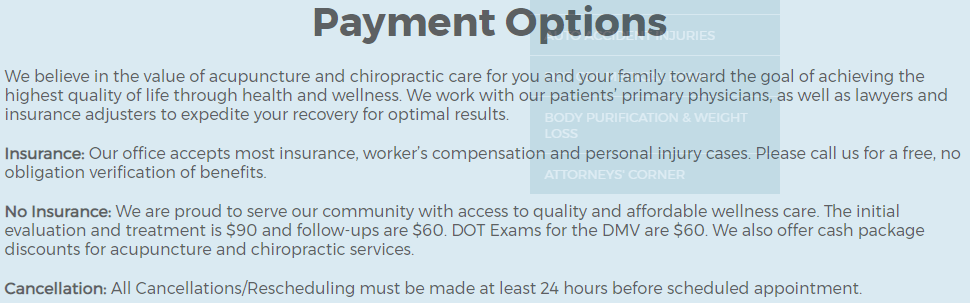
For acupuncture, the provider’s website says they charge $90 for the first visit (consultation), then $60 for subsequent visits. It doesn’t say whether that’s for acupuncture or chiropractor so I assume it’s both. My co-pay for each session is $40, so I thought my insurance is paid $50 for the first session, then $20 for subsequent visits. Nope.

Insurance statement for second acupuncture session

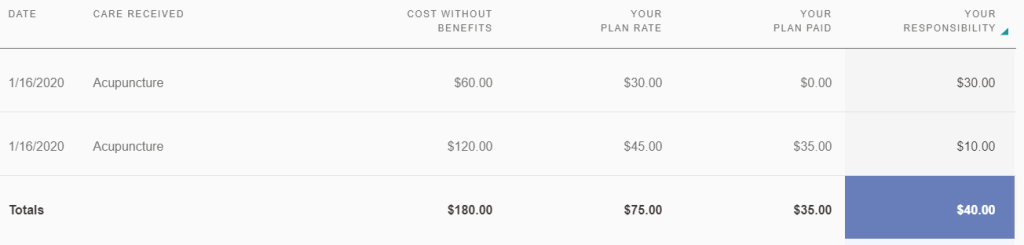
For the first visit, the provider billed $290, which has an insurance price of $125. Out of that amount, my insurance paid $85 and I paid $40. For subsequent visits, they billed $180, which became $75. My insurance paid $35 and I still paid $40. Why aren’t they billing $90 and $60 per their website? My insurance will only pay for 30 sessions. Does that mean they make less money if they bill me directly without insurance?