No More Medicare

So, my Medicare coverage ended yesterday. I was eligible for Medicare due to ESRD while I was on dialysis. This carried over when I received a kidney transplant three years ago. The rule says that kidney transplant patients can keep Medicare for three years post-transplant. Since I was still working and making salary, I was in the highest Medicare premium tier and my monthly payment was around $600. Going forward, I will only have my work insurance, then COBRA when I finally retire in a few months.

I am not sure if Medicare was worth it after transplant. With two insurances, I did not have to pay anything for medical services since Medicare covered 80%, and my work insurance covered the rest. Now I will be subject to deductibles and co-pays but save on Medicare premiums. I also have the option to continue Medicare coverage just on my anti-rejection medication, but since no one accepts Medicare Part A for drugs, I will probably rely on my work insurance for prescriptions and deal with everything together when COBRA runs out.

==========

The Social Security Administration did send me a letter last month reminding me that my Medicare coverage ends on January 31, 2024. I am 50/50 on whether they stop debiting my bank account for premiums at the same time.

Medical Insurance: DEXA

Since I am taking prednisone for anti-rejection, my nephrologist asked me to get a DEXA scan to check my bone density. I read online that taking prednisone long-term has many side effects, including osteoporosis.

The National Osteoporosis Foundation (NOF) recommends obtaining a DEXA if a patient is on prednisone or an equivalent of 5 mg/day or greater for 3 or more months.

https://www.rheumatologyadvisor.com/home/decision-support-in-medicine/rheumatology/steroid-induced-osteoporosis/#:~:text=The%20National%20Osteoporosis%20Foundation%20(NOF,for%203%20or%20more%20months.

So today I called the St. Joseph outpatient pavilion to schedule an appointment. I get most of my scans done in the second-floor radiology department. After being put on hold for five minutes, I was told the diagnosis code provided on the order was not covered by Medicare. The code was Z94.0: kidney transplant status. The scheduler said Medicare needs a code like osteoprosis, high calcium, or something like that. I Just called my nephrologist’s office to let them know and hopefully they can change the order.

I have had many medical procedures and appointments in the past seven years, and I am pretty satisfied overall. The worst part of the experience was insurance. I have both Medicare and Blue Shield. I pay almost $600 per month for Medicare, and it only covers 80% and does not cover medication. My work insurance does not have any premiums and usually pays for most things. By having two insurances, I end up paying more, not counting Medicare premiums. Recently, Medicare rejected a claim due to me not meeting my deductible. Without Medicare, my work insurance would pay for it, but since it is secondary, Medicare gets to decide how much work can pay and it is less than if I did not have Medicare. WTF?

More Medicare Questions

Ugh. It is pretty cool that Medicare covers dialysis and transplant costs, but everything is so confusing. It is even worse if you have a secondary insurance from work or somewhere else. I endured several months of claim confusion and screwups during the time when Medicare switched to be my primary insurance.

Anyway, the rules state that I can keep Medicare for three years post-transplant. Since Medicare paid 80% of all my medical bills, except for prescriptions, while my work insurance paid the rest, I assume that arrangement will stay the same for the next three years. However, due to my prior salary, my monthly Medicare premiums for Part B is ~$500/month or ~$6000/year. Under coordination of benefit rules, I had to get Medicare since my work insurance will not pay for dialysis after 33 months. They did pay for the remaining 20% of medical bills and all prescriptions.

The premiums for my work insurance is $0; it is covered by the company. I do have a $3400 out-of-pocket maximum, which I hit in January each year due to dialysis. Post-transplant, Medicare continues to pay for 80% of my medical appointments, while my work insurance pays for the rest. Since they are secondary, the $3400 out of pocket max does not apply so I have not paid any medical bills this year, except for co-pays on medications.

So the question is whether I should continue to pay $6000/year for Medicare. If I cancel coverage, then my work insurance will cover everything, subject to the $3400 out-of-pocket max. Without dialysis, I have never come close that number so I will save a few thousand dollars a year. I cannot think of any downsides, other than if I lose my job. I also need to make sure there are no weird rules that says I have to have Medicare while eligible. I would make sense for my work insurance since they (or our company since we are self-insured) end up paying less if I keep Medicare. Also, if I quit or get fired, Medicare will keep covering 80% of my medical bills for three years; I am not sure how long COBRA lasts and it probably cost more than Medicare.

I posted this question on Reddit. Hopefully someone more knowledgeable has experienced the same issues and can help. I will probably call my work insurance too to see if they have any advice.

Good News From Medicare

The US Senate passed a bill yesterday to provide immunosuppressive drugs post-transplant for life. Previously, Medicare only pays for three years of medication post-transcript. For patients that won’t qualify for Medicare after that date, they have to find their own insurance or risk losing their transplanted kidney. I read that about 375 patients die each year from losing Medicare and not being able to afford the needed medication. This is supposed to save $400M over 10 years since thousands of patients can avoid a return to dialysis, which is also paid for by Medicare.

For me personally, this means I can consider retiring post-transplant. I’m in my early 50’s so if I go through the transplant soon, I will run out of Medicare coverage in my mid-50’s and need to find insurance coverage for 10+ years. That typically means getting a job and work-provided insurance. I do need to find out if Medicare will only pay for immunosuppressive drugs or will they continue as my primary health insurance, paying for 80% of all claims.

Medicare Premium Increase

Apparently, Medicare increased it’s premiums for next year. I only found out after received a billing statement for January 2021. For December, I paid $462.70 for Part B. That has increased to $504.90. Since my work insurance won’t pay for dialysis anymore, I have to continue to pay for Medicare. At this point, I believe Medicare will pay 80% of transplant costs, and Blue Shield will pick up the remaining 20%, hopefully. Because I sold some stock this year, and the proceeds go on my W2 statement, my premiums will likely increase again to the highest tier right after I file my taxes.

Medicare Premiums Update

I just got the billing from 9/1/2020 through 11/30/2020 and it was for $1,388.10 or $462.70 per month. I think it’s the same as what I paid since the beginning of the year. It’s much higher than the base $144/month premium but worth it compared to the cost of dialysis, even at Medicare prices. For comparison, I also got the EOB (explanation of benfits) for May from dialysis:

  • Cost without benefits = $32,687.23
  • Your plan rate = $4,047,42
  • Your plan paid = $810.81

This is from the perspective of Blue Shield, my work insurance carrier. On medicare.gov, I found the same claim and Medicare paid $3,236.61.

Medical insurance is weird in the US. If I didn’t have insurance, my dialysis center would initially charge me the $33k for services in May, but we will probably negotiate that down to some lower number. If my work insurance was paying, then the “plan rate” would be around $26k, and Blue Shield (or ultimately my work) would pay it. With Medicare, the dialysis center only gets $4k of which Medicare pays 80%. Again, with Medicare for All at the current pricing, all hospitals and clinics would go out of business.

So just for dialysis, I’m paying $463 per month and Medicare is on the hook for $3,200. The difference comes from Medicare taxes paid by everyone receiving a paycheck.

Medicare Premiums

I guess they found out about my salary levels. Instead of paying the base rate of $144.60/month, I think Medicare is charging me $462.70/month, or about 3x the base rate. I paid $723.00 in March for 5 months but got a huge second billing of $2,978.60 a week ago.

Since dialysis is super expensive, my high premiums are still worth it. I think I still have a few denied claims to work through from the beginning of the year, then I have to get some of my co-pay reimbursed by Medicare.

Coordination of Benefits, Part V

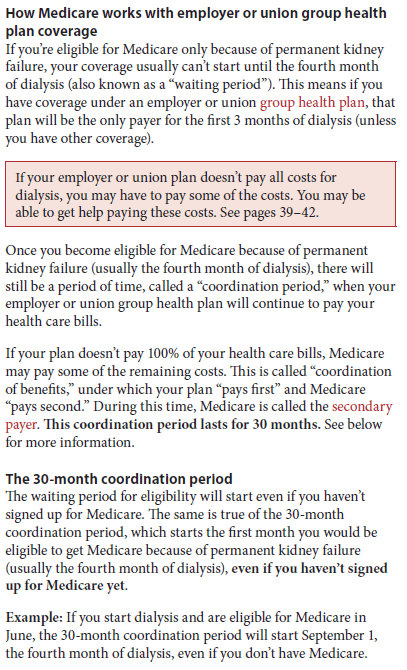
It’s getting serious now. My insurance just rejected my February dialysis bill for ~$33k. I still can’t get through to Medicare’s benefit coordination center; the wait time was too long last time so I need to try again tomorrow. However, I found a document on Medicare’s website that clearly states that I need to wait 3-months before beginning Medicare, and the 30-month benefits coordination starts after that date. That is why all the info I’ve received from my dialysis clinic mention the coordination period as 33-months. Now all I have to do is get my work insurance to agree and reprocess all the rejected claims.

Coordination of Benefits, Part IV

I’m so frustrated with all this. I called our work insurance service provider again today and spoke to the claim supervisor. It turned out he has been out sick so he never got back to me. Anyway, their conclusion is that after 30-months of dialysis, Medicare becomes the primary insurance for all claims. Therefore, I need to have all my providers bill Medicare first, then any remaining amount will be paid by my work insurance. The problem is that Medicare starts three months after the first dialysis date of July 5, 2017, so by rejecting claims after January 5, 2020, my insurance is off by three months. The rules are so confusing that each time I call my insurance or Medicare, the answer seems to change. I’m now getting invoices for this failure of benefits coordination.

DENIED!

Because of this confusion, I’ve stopped seeing my therapist and acupuncturist. I also have several upcoming appointments to see the cardiologist, primary care physician, endocrinologist, and others. I feel like I need to postpone those appointments until the insurance situation is cleared up. My work insurance also started rejecting my cardiac rehab claims so I’m not sure how to continue there since the hospital doesn’t seem to want to bill Medicare on my behalf.

Medicare Benefits Call

I called Medicare today with questions regarding coordination of benefits when I still have my work insurance. The person on the phone was really nice but the call took awhile since she had to look up a lot of info. I guess it’s not a common topic.

She confirmed that as long as I have my work insurance, Medicare will pay as secondary insurance, except for dialysis after 30 months, and the kidney transplant. I asked about previous claims where I paid a co-pay and was told that I can file a claim. However, if the provider charged more than the Medicare rate, and most do for private insurance, Medicare will calculate their responsibility with the lower rate. I’m still unclear what that means. If my doctors bills my insurance $200 and they paid $160 since my co-pay was $40, how much will Medicare reimburse me? If the Medicare rate is $100, will they pay up to $80 (80% of the initial claim at the lower rate), or pro-rate my co-pay and only reimburse me $20? We decided over the phone that I should just file the claim for $40 and see what happens. I also didn’t get any statements from my doctors so I’ll need to go back to all of them for more info in order to file the claims. Medicare does pay for cardiac rehab so that’s a lot of co-pay to get back for the entire program.

I also got the first statement from my dialysis clinic. The insurance amount was close to $30k. My work insurance only pays 85% but since I also have an out-of-pocket maximum each year, my portion comes out to ~$3,000. I’m thinking Medicare should pay that but their dialysis reimbursement rate is much lower, probably like $3,600. So will Medicare pay only 80% of that or $2,880? Also, if Medicare pays some of the bill, will my insurance count that when calculating my out-of-pocket maximum? Otherwise I’ve hit my max and my work insurance will pay 100% from now on. Super confusing.

Coordination of Benefits, Part III

Crap! There were five claims (so far) that my work health insurance screwed up. When I called them, I thought there was only one but after going through all the claim activity online, there were four more where my work plan paid as if they were the secondary insurance. I sent them a secure message on their platform with all five claim statements. I hope they review and repay in a timely manner so I don’t have to answer all sorts of calls from my doctors. Sigh…

I still have to call Medicare to figure out what to do with all my co-pays. I figure I must have paid >$350 in co-pays excluding acupuncture and therapy. Not sure if those two things are covered. I called Medicare once before and they were pretty helpful so maybe this won’t hurt too much.

Coordination of Benefits, Part II

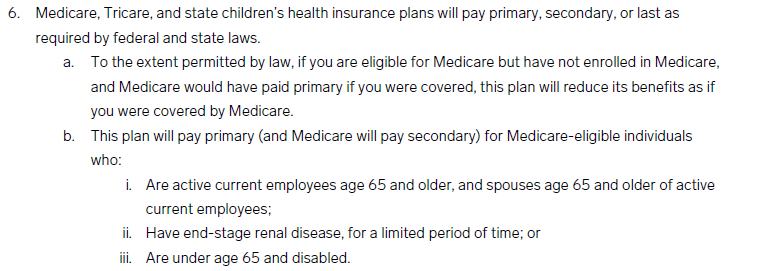
I talked to our benefits department and they found an 85-page plan detail document from 2017 that clearly states if I qualified for Medicare because of ESRD, our insurance plan would be primary and Medicare would be secondary. This is contrary to the last claim details I received. Our benefits coordinator requested a callback from a supervisor from our insurance and he verified that our plan should be primary. He also said he would ask his team to reprocess my claims again to make sure they were paid out correctly. Yay! I was afraid I had to mediate between insurance plans if both thought they were secondary insurance.

Pretty clear, no?

Like my sister, our benefits coordinator said this coordination of benefits when you have multiple insurance coverage is the most complicated topic in health insurance. No one wants to be the primary coverage insurance since they usually paid 80%-85% of the claim. I avoided getting Medicare because of this coordination mess, and only got it because my work insurance will stop paying for dialysis soon.

Insurance Coordination of Benefits

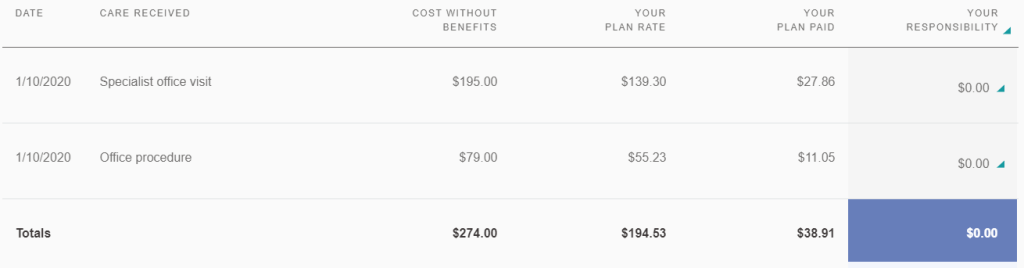
The fun starts now! Back on January 10th, I went to see a podiatrist for a check up since I’m diabetic and have peripheral neuropathy. Since the podiatrist was a specialist, I paid my $40 co-pay and thought everything was fine. Well, the podiatrist office finally filed the insurance claim, and I got the following statement of benefit from my work insurance.

The podiatrist office billed $274.00 for my visit but the negotiated rate for Blue Shield is $194.53. My insurance then determined that since I have Medicare starting 1/1/2020, they are the primary insurance, and should cover 80% or $155.62. Therefore, my work insurance only needs to cover the remaining 20% or $38.91. On my call with my work insurance yesterday, they said I need to give all my providers a copy of my Medicare card so they can bill Medicare. For this claim, I should get my $40 back once Medicare pays. I had a lot of doctor appointments in January. Since none of the claims have been processed, I will need to do this with 5-6 providers and lots of claims.

I see some potential problems with this. First, once I pay my co-pay, it’s very hard to get that money back. I have to follow up on each claim to see if and how much Medicare pays, and harass the doctor’s office for refund. Also, who determines which insurance is primary? What if Medicare decides they are secondary and my work insurance should pay 85% first? Also, for the claim above, the plan rate was less than what the podiatrist billed. What is the Medicare plan rate? I think it’s often less than private insurance reimbursement rate. So what if Medicare’s rate is only $100 and they pay 80% or $80? What happens then? What if the medical provider does not accept Medicare in the first place? Sometimes I think having a single health insurance payer, like they do in Canada, is much easier on the consumer. Doctors and hospitals will probably lose out though since reimbursement rates will definitely be lower.

Medicare Card

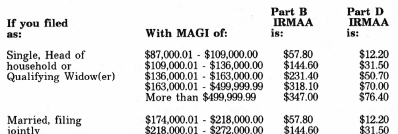
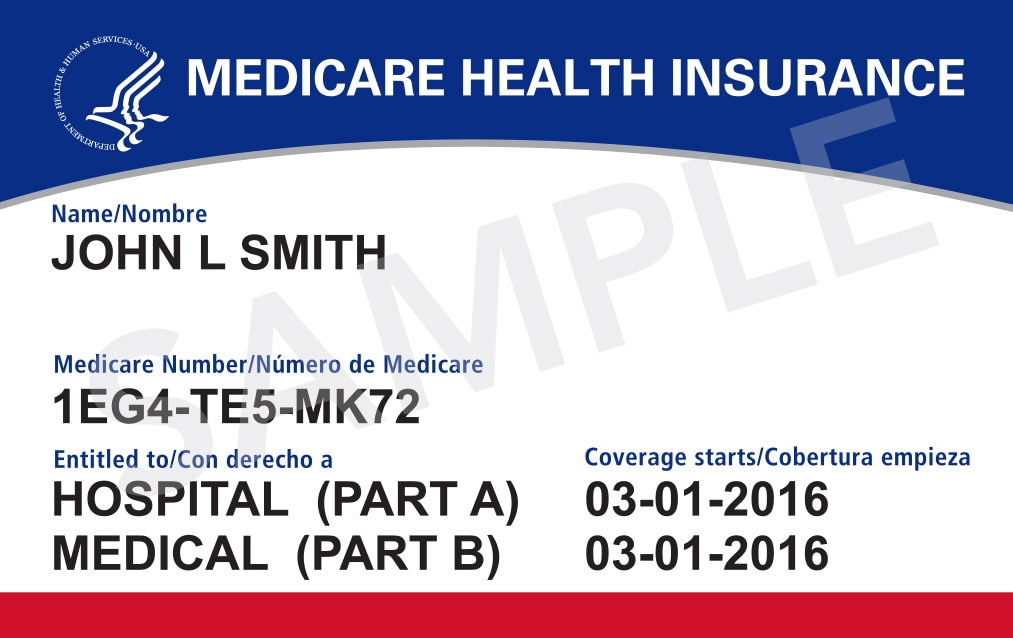
I got my Medicare card in the mail. I already have my Medicare number from a different letter but having the card seems more legit. I also got a notice of Medicare Part B premiums. I thought based on my last tax return, my premium would be $433.40/month. I guess I had the wrong lookup chart. The letter says my premium will be $318.10/month, which is $115.30/month less. That’s a lot of breakfast burritos.

What’s weird is I looked up the Medicare website and they also have a different rate table than my original post and the letter I received.

Here it looks like my premium will be $462.70/month. However, the letter had these set of numbers:

At first I thought the premiums table at the website was adding Part B and Part D premiums but the math doesn’t work out either. With the cost of dialysis so high, I’ll pay whatever they bill me. Again, I don’t know who pays for the kidney transplant if it happens this summer. Also, I don’t have Medicare Part D. Does Medicare still cover post-transplant medication?

==========

Also this is post #350!

Using Medicare

I’m at the hospital and just checked in for my surgery. During check-in, they asked about medical insurance. I told them that I was just approved for Medicare but have not received the insurance card yet. Luckily, I saved a copy of my benefit letter on Google Drive and was able to get my Medicare number. She keyed in the data into their computer and I guess it was verified as active. We’ll let their billing office figure out how to coordinate the two different insurances.

After years of paying Medicare taxes, I finally get to use it.

Medicare Update 1/25/2020

I got a letter from Social Security Administration in the mail today. It’s a Notice of Award that I am entitled to Medicare because of my kidney condition. It’s a more detailed version of what I saw online yesterday.

The letter also said that I could start my Medicare Part B benefits on December 2018 as well, but I would have to pay $1,760 in premiums within 60 days. I’m still very confused about this. Last year, I had to pay my out-of-pocket limit of $3,400 since I only have my work insurance. Does Medicare cover that amount? If so, then I can pay $1,760 to get reimbursed $3,400? I think the premium will be more than $1,760 because of my salary so it’s likely not worth it.

Letter also mentions that I should get my Medicare card within two weeks. I can’t wait.

Medicare Update 1/24/2020

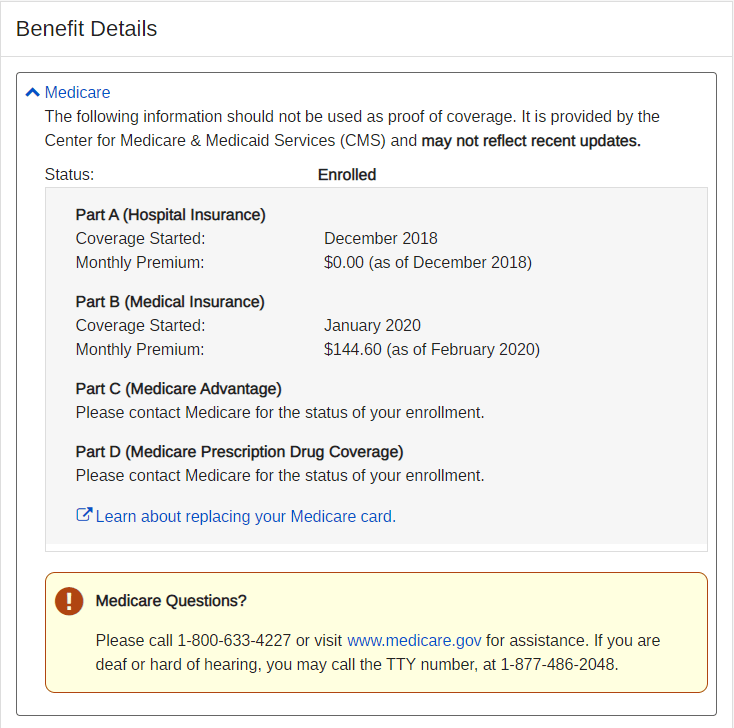
I have not received my Medicare card in the mail yet but there are some updates on the my Social Security website. There is a new section called Benefit & Payments Detail and it lists more info about my benefits.

I guess the most interesting part of the page is the Medicare Part B premiums. It still says $144.60/month which is the base premium. From their own website, I think I have to pay a lot more based on my salary. I have not received an invoice so far so I don’t know my premium yet. On the benefit verification letter, they’ve added my Medicare ID number, which I can use to get services before my card arrives. I’m still not sure what Part A and Part B covers other than ESRD related costs.