I’ve Fallen…

My uncle fell down over the weekend. I made a post about his story awhile back. He suffered from a pretty major stroke several years ago. It did look like he was making slow progress on recovery, but has deteriorated quite a bit in the past few years. Initially, my aunt took him to the ER after his fall, and they did not find anything. For some reason, they took a second look and found he fractured a vertebrae, and sent him to a physical therapy clinic (since I am overhearing this from a conversation between my parents, it is a bit unclear). While he was there, he fell again, and we do not know if there was further injury. My dad went to see him today at the clinic and sent some photos. My uncle was sitting on a wheelchair by himself in front of a table. He was wearing a face shield because he is still unvaccinated. He looked confused and sad. My dad said my uncle probably did not recognize him, and all he could say was “hurt” (probably 痛 in Chinese).

I understand life must be tough for my aunt, having to take care of him for the past several years. They did get an in-home care person, but she quit after a few days. His two sons (my cousins) are in Asia, though I heard one of them is coming back, not sure how long. His daughter was married a few years ago and currently pregnant so likely not much help. My mom said the son-in-law is a nurse, and is helping when he can. I guess my frustration is him not being vaccinated, With his poor health and the prevalence of the delta variant of COVID, I firmly believe if he gets infected, he will die. Since my uncle cannot make decisions, it is totally up to my aunt. Whenever my parents ask about COVID vaccination, she comes up with an excuse why they are not vaccinated. I do not know if she is hardcore anti-vaxx or just confused by all the disinformation out there, but the whole situation sucks.

K-Pop Attempted Suicide

Another post about K=Pop, but not a happy one. I do not know if the situation is similar in the US music scene, but there is a lot of bad shit that goes on in the K-Pop industry. There is plenty of abusive behavior by management companies and very high suicide rates for idols. I posted about Sulli and Hara before, and just this morning there was news that Kwon Mina from AOA tried to take her own life. She claim she was bullied for 10 years by another member of her girl group, and was suffering from depression. There used to be seven (or eight if you count the drummer) members, but there is only three now.

AOA has a subunit called AOA Black where each member played an instrument. Mina was the bass player. I have only found a couple of videos on YouTube of them performing live with instruments so I do not know if it was just a gimmick. Since I kinda play bass, Mina was always my favorite member of AOA.

I used to follow her on Instagram, but after the bulling became public, it became difficult to see all the hate she was getting, and how her mental health was deteriorating. Every country has its share of assholes, but Korea seems to have a real serious problem of online harassment of celebrities. Mina also seems unable to get away from social media, despite the damage to her mental health. I believe she even slit her wrist before but seemed better recently. I also heard she does not really have a support group since her father passed away and her mother and sister are dealing with their own health issues. What do you do when Asian culture is so anti-therapy?

Here is more news about the latest suicide attempt: Geo News. 😟

Additional Vaccine Doses

I saw a link on Reddit to a CDC presentation regarding additional vaccine doses for immunocompromised people (IP) (PDF). It outlines steps needed to have the CDC recommend additional doses, but we are still very far away from that. It appears that we are still in the reviewing data process, and still required FDA approval under the Emergency Use Authorization for the vaccines.

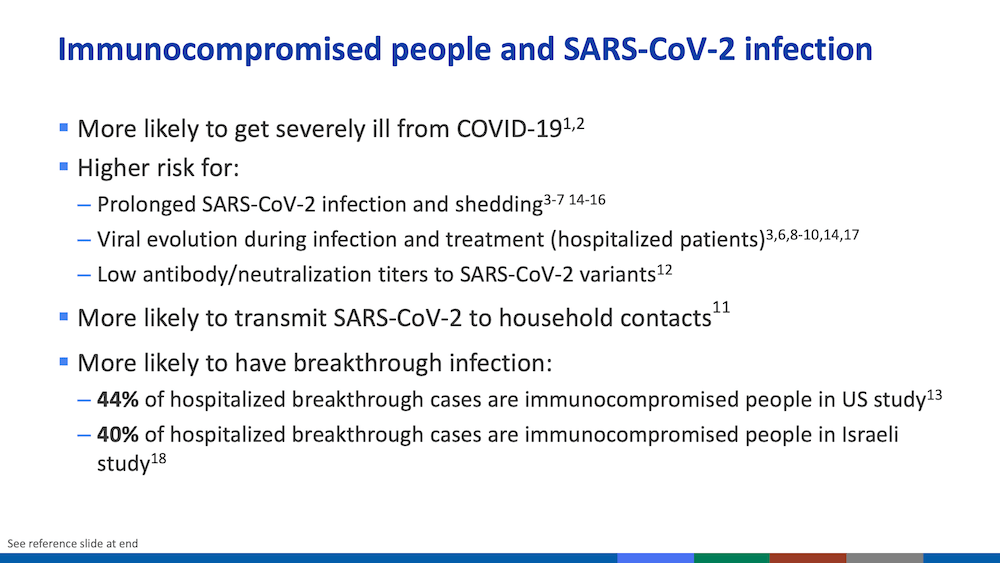
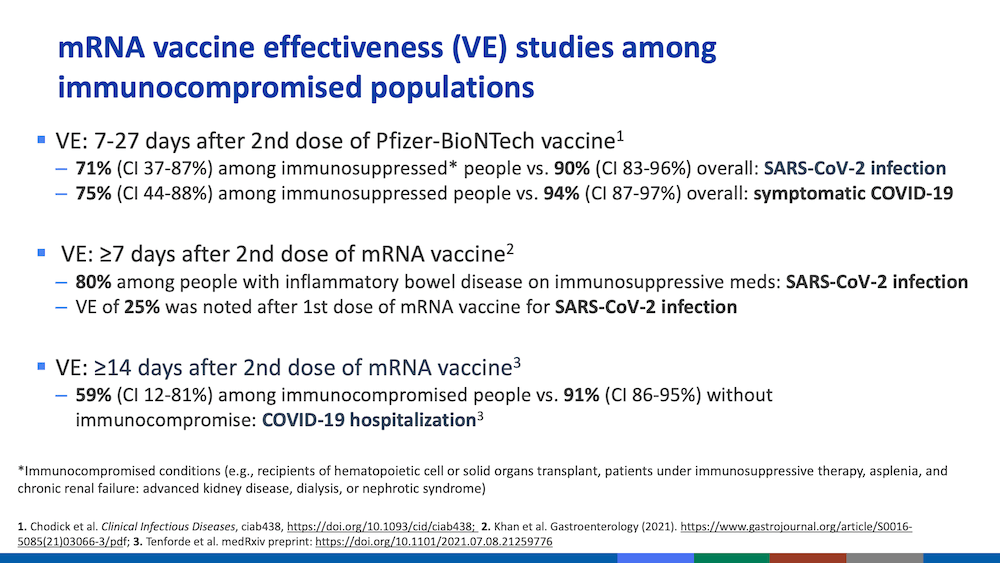
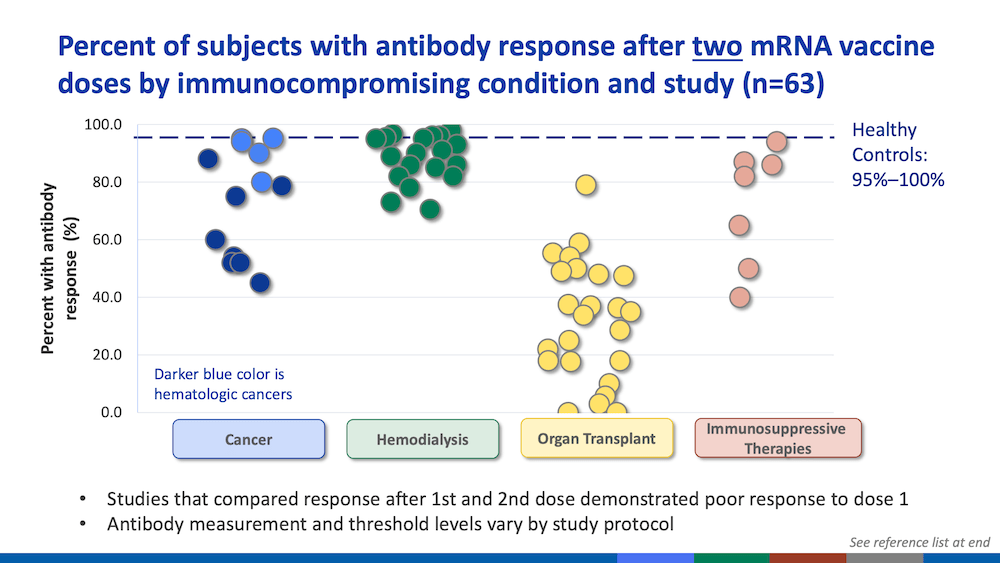
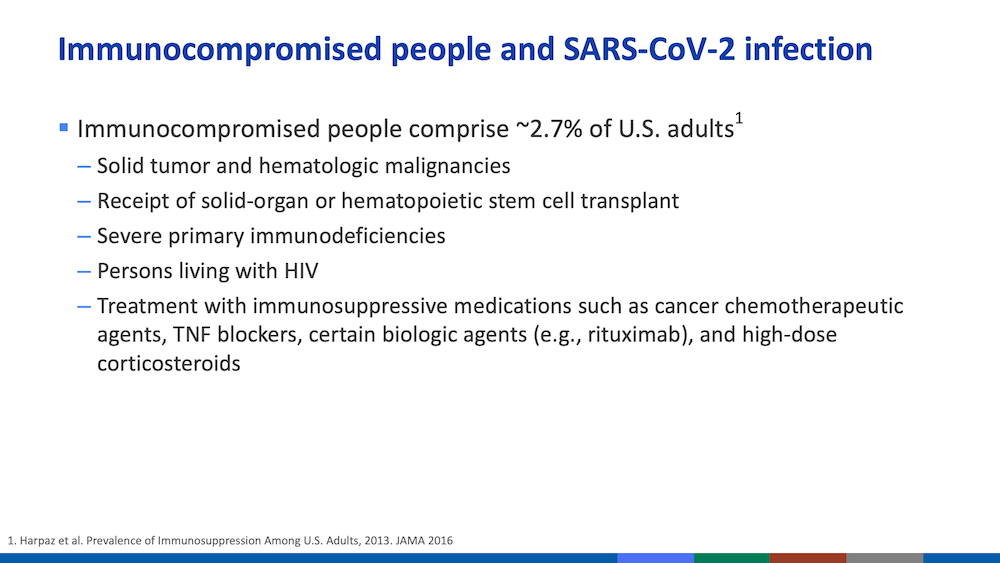
There were four slides under the section “What do we know now?”

I am #2 on the list, but do not know what portion of the ~2.7% are organ transplant recipients.
Even though IP are ~2.7% of the population, they/we account for 40-44% of hospitalized breakthrough cases. Again, they do not disclose what % of breakthrough cases are from IP. It is likely lower than the 40-44% since infected IP are “more likely to get seriously ill from COVID-19.”
This one is a bit confusing because I think they are combining data from several categories. It does appear that vaccine effectiveness (VE) is lower in IP than in the general population: 75% vs. 90% for infections, 71% vs. 94% for symptomatic cases, and 59% vs. 91% for hospitalization. Some of the non-mRNA vaccines (Sinovac, Sinopharm) are around this level of VE anyway so maybe it’s not that bad?
This is a small sample size (n=63), but it seems that organ transplant recipients have the worse antibody response out of all the IP categories. I was on hemodialysis for several years, and was categorized as a high-risk for infection at the beginning of the pandemic. However, it is probably due to cardiovascular and respiratory issues rather than the immune system. So the response to the vaccine should be fairly normal, but once infected, symptoms will likely be more serious.

Again, since the data is not segregated by type of immunocompromised people, it is hard to estimate the increase in infection risk, even subjectively. My reading is that if there is a response to the vaccine, it is about 2/3 the effectiveness vs. non-IP. However, this may be lower for organ transplant recipients since the anti-rejection medications are specifically designed to mute any immune response.

In my case, I am slightly hopeful since my first vaccine shot was about 18 hours before surgery. I do not know if that is sufficient time for the immune system to develop any protection. Post-surgery, I was on a higher dosage of anti-rejection medications compared to today, but I do not know objectively whether it was a larger then normal dose. The transplant center did start to lower my dosage after about two weeks so there may be a slight chance that the second vaccine shot was somewhat effective, even though I did not experience any response side effects.

I am thinking about this daily because I am invited to my boss’s party next weekend. It is indoors but with a lot of open doors plus patios and balconies. In the past, the room was somewhat crowded. If I go, I am going to wear a KN95 mask, but it will be difficult to maintain a six foot separation from everyone else. It is difficult to manage risk where there is essentially no data. I am bringing my sister as my +1 guest. She is excited to go but she understands if I decide to skip the event.

Conflicting Mask Guidelines

Due to the large increase in numbers of COVID infections, Los Angeles County has resumed a mask mandate for indoor interactions. Accordingly, my work sent out an email Saturday reminding all employees that masks are required again starting Sunday. So far so good.

Last night, another email comes out after hours and basically says the county mandate is inconsistent with the science and recommendation of the CDC, so anyone that is vaccinated does not need to wear a mask indoors. Huh? There is no “company policy” exemption in the county’s order. What the heck is going on?

Obviously, the second email came from our CEO. Even though the email came from HR, there is no way some random employee sends out an email that advocates violating a county health order. Our CEO often says controversial things on Twitter, but this is no joke. More people are getting infected again, likely due to the Delta variant. You can’t have people sending mixed messages. Someone in my department just tested positive for COVID last week and they were fully vaccinated. What if that was me? Would I feel anything? Lose my transplanted kidney? Have to go to the ICU? Or even die from a number of complications?

This just means there’s no way I am heading into the office anytime soon.

COVID-19: Delta Variant

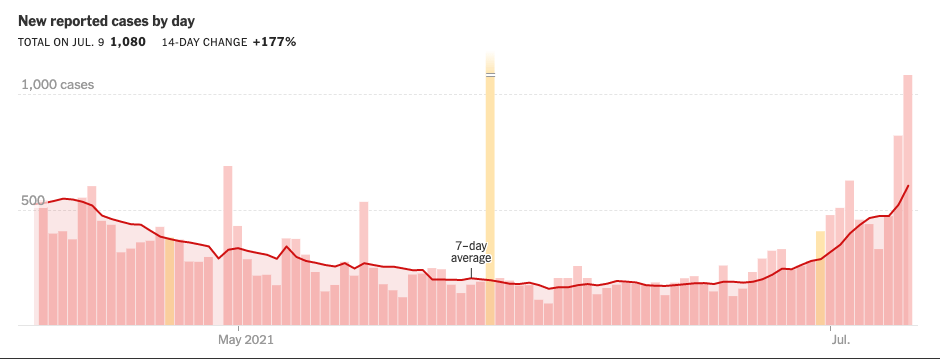
It appears that the number of positive cases of COVID-19 is on the rise again in Los Angeles and Orange counties. Of course, this is all due to the idiots that will not get vaccinated, excluding those that have a valid medical reason. The last article I saw, Los Angeles county is again seeing a huge increase (relatively) of new COVID cases.

https://www.nytimes.com/interactive/2021/us/los-angeles-california-covid-cases.html

California opened up in mid-June because the it appeared we were headed for herd immunity, and the number of new cases was steadily decreasing. However, the vaccination rate stalled as most everyone that wanted the vaccine got their shots. Now the much more infectious delta variant is taking hold in the unvaccinated population. For most vaccinated people, the impact may be minor if any. For me and other immunocompromised people, this could be deadly, again. Also, with more people infected, it increases the chances of further mutation with unknown results.

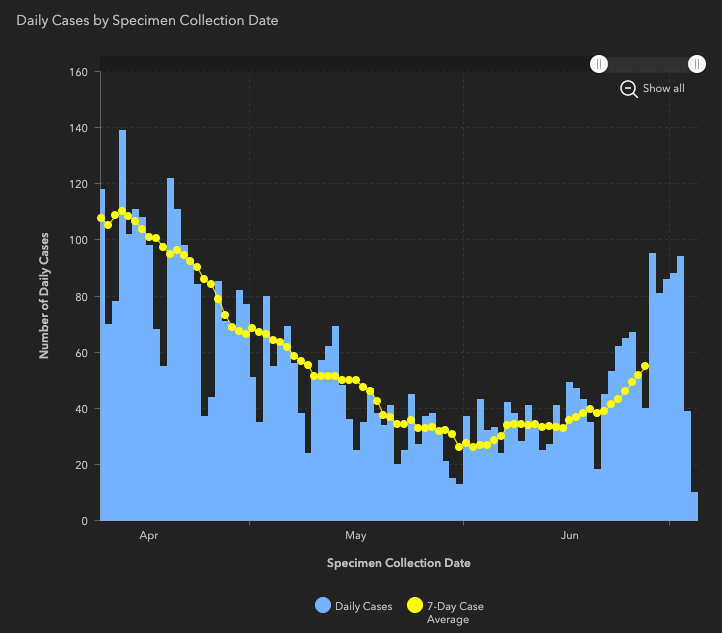
Here is Orange County showing a similar trend:

https://ochca.maps.arcgis.com/apps/dashboards/cc4859c8c522496b9f21c451de2fedae

The absolute numbers in OC are lower than LA since the population is lower, but it shows a similar trend. Everything looked good near the end of May, but since the state removed restrictions and the mask mandate, cases are increasing again. Seems like common sense but I guess common sense is uncommon. Also, because of these selfish and irresponsible anti-vaccination idiots, I still cannot go to work or out to restaurants. I wish California or Orange County would implement a vaccine passport so there are consequences for refusing to help end the pandemic.

Dental X-Ray

Just a funny little story from my visit to the dentist yesterday. It was supposed to be an easy appointment to put in a new permanent crown. There was a cavity under an old crown so my dentist removed it, drilled away the cavity (and more tooth), then put a temporary crown on about two weeks ago. However, I was in the dental office for about an hour instead of the 15 minutes I was expecting.

So most of the time was spent trying to get a x-ray of the tooth with the new crown before applying the cement. I was let to the dental chair by an assistant that I have never met, and I most definitely have met them all. She felt like a new employee. No matter, I just getting a crown put in, and the dentist ended up doing it anyway.

I have no idea what type of x-ray machine my dentist has

The first, second, and third x-ray she took did not seem to work. She thought that the sensor was not attached to the computer, but it was wired and connected. She got one of the front desk people to help, and they pointed out that she did not put the lead shielding vest on me. I am not planning to have kids at the moment, but still. The front desk person was also unable to get the x-ray to work, so to save time, we moved to another chair with a much older x-ray machine. We tried again, but still nothing, which was super weird. Finally, the new assistant got the dentist to take a look. My dentist went to the same school and program as me, and spent a lot of time as an electrical engineer. He fiddled with the equipment a bit, and then pointed out to the new assistant that the sensor/detector was put in the bracket backwards. It is like looking at the back of a LCD monitor and wondering why there is no image. By now, 30 minutes have passed.

Anyway, we go back to the original dental chair, and she took several perfect x-rays of my tooth. Afterwards, the dentist came by and cemented the tooth, and all was fine. It was confirmed that she was a new employee since he was basically training her how to pass the crown to him while maintaining spatial orientation, and how to mix and apply the dental cement. She was a lot less talkative after the x-ray fiasco, and looked a bit sad, though it was hard to tell behind her mask.

I thanked her when I left the office, but wondered if I should have said something more encouraging? I remember my first day at various jobs and it was nerve-wracking for sure. It is not even that bad for me since being in finance, there is just a computer, not live patients. My dentist is super nice and chill, so this will probably end up being a good learning experience for her.

More Insulin v2.0

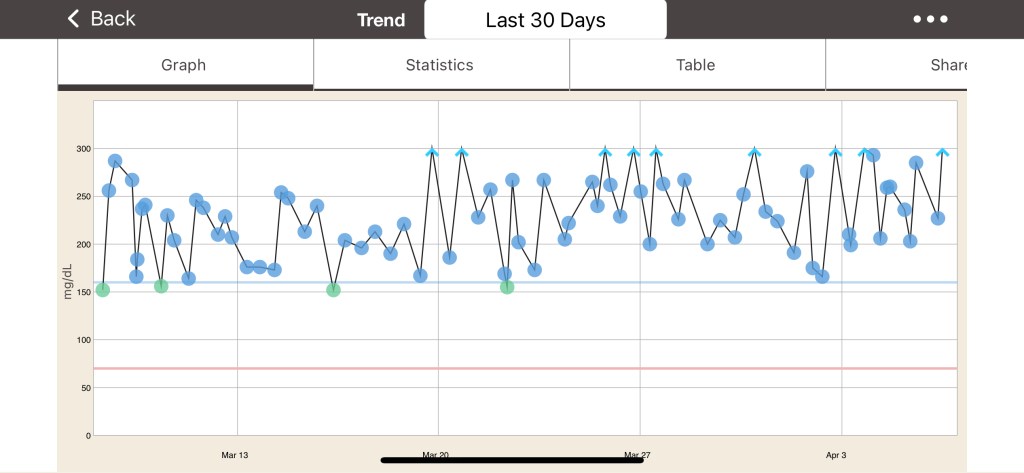
My endocrinologist got back to me today. I sent her my blood sugar readings for the past two weeks a few days ago. Based on the numbers, she decided to increase my insulin dosage again. The daily shot of Toujeo has gone up from 13 units to 18 units, and she added one unit to the baseline Humalog dosage from 5 units to 6 units. Even though my blood sugar is trending lower, it is still not consistently below the magic 130 number.

If you compare this to the previous post, the data points do appear lower, but not enough. I copied the old chart below for easier comparison:

I was hoping the blood sugar situation would improve over time, but it appears I may need insulin for the rest of my life. It does not look like my anti-rejection medications will be reduced further, so any blood sugar effects will remain. Also, maybe my type II diabetes has gotten worse during the past five years, but it was masked by the effect of dialysis on blood sugar levels. Now that I have a working kidney, old problems are becoming more noticeable again.

==========

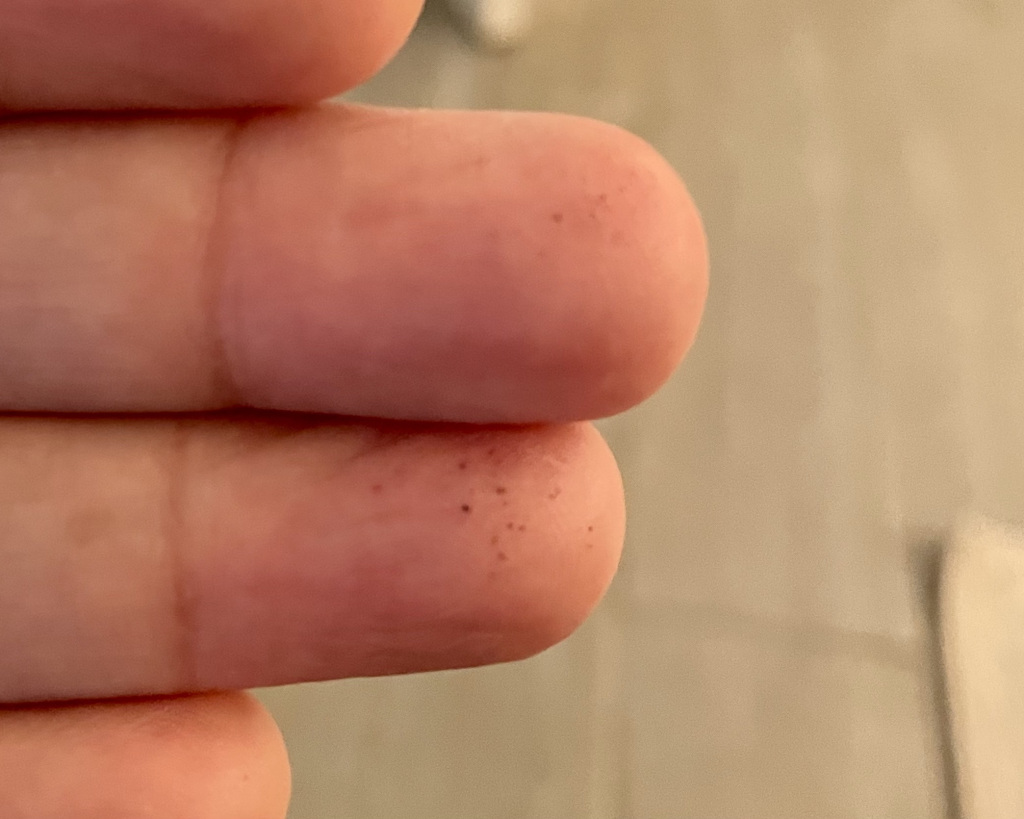
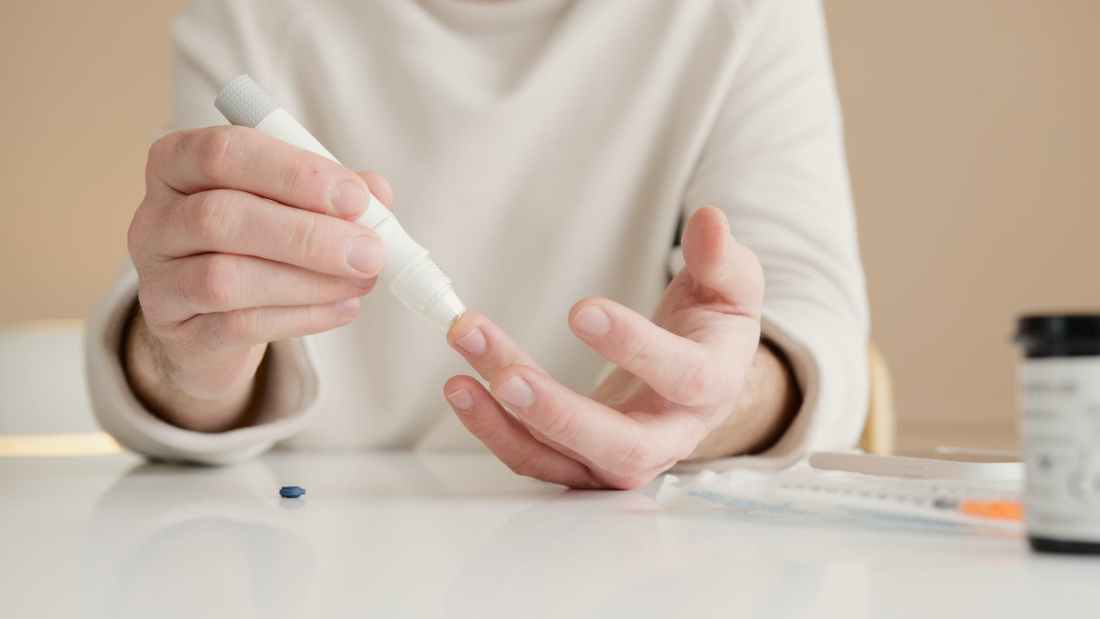
Another frustrating part of diabetes is the number of lancet finger-pricks needed for blood sugar tests. I do three or four tests daily, and since I am right-handed, almost all the blood is coming from my left hard fingers. It is hard to take a photo with the iPhone due to the focusing distance, but you can see a lot of tiny block dots on my ring finger:

The way around this is either not test, or getting a continuous glucose monitoring (CGM) solution. Two of my cousins are using the FreeStyle Libre system, and they really like it. It does contain a sensor will a spike that you have to insert in your arm for the duration. When I was taking blood sugar readings once a day, it was not worth it. Now that I need to monitor it up to four times a day, maybe it is time to reconsider.

Nice PR video. It is painfully obvious Abbott wants to avoid showing patients the huge ass needle on the back of the sensor patch. Maybe you will not feel it after getting used to it, but I would think the needle will hurt for some time. Not as big as dialysis needles, but not tiny like glucose meter lancets or insulin needles.

OG Nephrologist

I just saw my “local” nephrologist. She is not really OG since she is the third or fourth nephrologist I have seen outside a hospital. When I was initially asked to see a nephrologist due to deteriorating kidney function, I found someone close to all my other doctors. I think she was an Indian woman and I saw her for quite awhile. At some point, she left the practice and I was assigned to the main nephrologist, but he was an ass. As soon as they hired a replacement, I was transferred to him, a Korean man. That went on for awhile, but my kidney function kept decreasing. He also left the practice to move to San Diego, so I got a referral from my primary care doctor, and ended up at the current medical practice. I was supposed to see the primary nephrologist, but was scheduled for another doctor who was more available, and she has been my nephrologist for five or six years now.

The was my first appointment with her since my transplant. UCLA was supposed to send a package with all my notes, medications, and test results. Of course, she has not received anything. I was low-key expecting this since UCLA has probably thousands of active patients, and you are monitored by a team of doctors instead of just one. Good think I had all my records on MyChart on my phone. Long story short, she did not change anything in terms medication or care, but she did have lots of questions for UCLA. The big surprise to her was how fast UCLA stopped my prescription for mycophenolate (Cellcept). She said many patients are on that medication for life, yet it was discontinued for me only after a month. She also said that patients typically get more anti-infection medication for longer periods, while I was only one one, atovaquone.

Even though my nephrologist has worked with UCLA before, I believe she refers most of her patients to St. Joseph Hospital for transplant. I also started there, went through orientation and tests, and met the transplant surgeon. Unfortunately, their transplant social worker was terrible, and rejected by sister as a donor for basically no reason. When I retold the story to my nephrologist and dialysis social worker, they both wanted more information so they could refer the transplant social worker to the licensing board for review. We did not follow through however, and just transferred my case to UCLA. It does sound like the St. Joseph transplant surgeon is much more risk adverse, and keeps transplant recipients on high doses of anti-rejection medications for many years. UCLA seems like the opposite. Hopefully I chose correctly.

ProPublica Kidney Transplant Article

Initially, I ended the previous post with a paragraph regarding an article on ProPublica written by the same journalist that contacted me nine months ago. However, as I read the first few paragraphs of the story, I felt it needed its own post for discussion.

ProPublica is a nonprofit newsroom that investigates abuses of power.

ProPublica begins all their stories with the above line. It pretty much tells the reader their biases and how they will tell the story. After reading the first few paragraphs, I was not wrong.

First, there are plenty of things that are wrong with the dialysis industry. I came up with the following just from memory (no Google):

  • Two for-profit companies control 70% of the market
  • Medicare coverage provides distorted incentive to maintain the status quo and milk the system for profit
  • Very little public awareness on the impact of dialysis on ESRD patients
  • Even less awareness on the need for organ donation

Just from the recent ballot proposition fights in California between the for-profit dialysis companies and SEIU (employee union) demonstrates even the industry cares only about profits and not patients.

Having said that, ProPublica is obviously biased against dialysis and transplant providers. First, if I assume my interview request in September 2020 is related to this story, the timing is a bit off. The actual article was published on December 15, 2020, but the subject of the article passed away earlier in August. So, by the time I was contacted, they already had most of the information needed for the article. What did they need my story for? A supplemental article about how getting a transplant suck for everyone?

If you read about the life of JaMarcus Crews, it is definitely a more compelling story than if they had written about me. JaMarcus was was black, living in Alabama, and likely experienced a lot of discrimination/racism in life and the whole dialysis/transplant process. Me, being a middle class Asian in California and getting relatively good care, will be a boring subject for the story ProPublica wanted to tell.

I found a few questionable items at the very beginning of the article.

When it was over, and all anyone wanted was sleep, JaMarcus drove to the wide parking lot at Target to wait for his cashier’s shift. He missed working at the bank, but a nine-to-five was no longer possible.

It is true that in-center hemodialysis takes up a lot of time, but many people work full-time. ProPublica just says this without any sources or statistics. I worked full-time for the first two years of hemodialysis and during peritoneal dialysis. If JaMarcus was a teller, then he must be at the bank in person, which makes it difficult, but not impossible. He could be assigned different tasks during dialysis days. It heavily depends on how willing employers are to accommodate the employee’s dialysis schedule. I was lucky but also essential to my company, so they were very accommodating.

JaMarcus didn’t tell his wife or son that he was making calculations in his head: most people didn’t survive five years on dialysis. He was nearing seven. His mother had died in year eight.

This one is totally false and can be researched with a quick Google search. I posted on this topic a lot, and most sources say that mortality is 20% after the first year of dialysis, and 50% after five years. That is definitely not “most people didn’t survive five years on dialysis.” The statistics are also skewed by older dialysis patients with multiple medical issues. JaMarcus was 36. That does not mean there is no risk, since JaMarcus did pass away, but the statement is absolutely false.

Having gone through all of this, ESRD and dialysis is definitely a huge problem that needs more attention and research. JaMarcus’s story is sad, and not even unique. I know my comments may be premature based on the first few paragraphs, but one-sided stories like these just entrench people and hinder progress. I am still amazed that I am not dead after years of ESRD and dialysis. If you browse through r/transplant on Reddit, there are lots of anniversary stories from transplant recipients. Of course, the process could be better, but I am hugely grateful and satisfied with my experience. Everyone I have engaged with, from my nephrologist, dialysis nurses and techs, transplant coordinators, surgeons, post-care doctors, to phlebotomists, have been compassionate and caring. The main issue is the scarcity of transplant organs that causes all these issues downstream. ProPublica should focus on that part of our society, but that does not fit their mission of investigating the abuse of power.

Maybe I will change my mind after reading the entire article.

==========

Just saw these lines at the very top of the story:

For years, JaMarcus Crews tried to get a new kidney, but corporate healthcare stood in the way.

He needed dialysis to stay alive. He couldn’t miss a session, not even during a pandemic.

That is lame. Whatever you think about “corporate healthcare” in general, JaMarcus weighed 400 pounds and had heart problems. There is no way he was going to get on any transplant list when healthy people must wait 8-10 years. I can see him getting a transplant if there were lots of organs available, but with only 10% of people on the waitlist transplanted each year, he needs to improve his health situation. No way this is the fault of “corporate healthcare.” Also, WTF is “corporate healthcare?” Of course, it is large hospitals (corporations) doing transplants. You do not want the procedure done in someone’s garage, for fuck sakes.

I also do not understand the second sentence. I had to go to my clinic during COVID pandemic. That is the only place I went outside of my house. Even without a pandemic, dialysis patients cannot miss sessions since that will mess up your health even worse. Is this the fault of “corporate healthcare” too? How is this racism? I thought ProPublica was like NPR: a good news source that leans a bit left. But so far, this seems like a total hit piece.

In hindsight, I am glad the journalist did not follow-up. I would be really pissed off if I were part of this story the way it was told.

Alkaline Phosphatase

There was a post recently on Reddit’s r/transplant subreddit about high alkaline phosphatase (ALP), and what it means for the transplant.

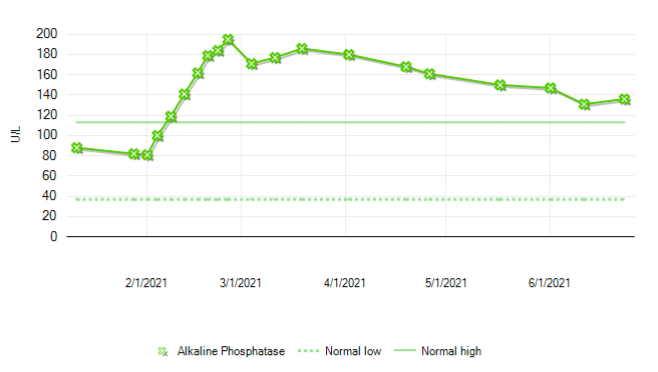
I have wondered about this test as well. My numbers were low post-transplant, but have been above the high limit since mid-February. However, at all my clinic appointments with UCLA, none of the doctors has ever mentioned my ALP results. After a few months, I also just ignored this result in a sea of numbers.

Here are my results. Since the high at the end of February, ALP levels have been steadily decreasing. The OP in the reddit post said his number was around 300; that is much higher than my result results.

I had no ideal what ALP was, other than it was an enzyme from the “ase” ending. MedlinePlus (.gov) had this description:

ALP is an enzyme found throughout the body, but it is mostly found in the liver, bones, kidneys, and digestive system. When the liver is damaged, ALP may leak into the bloodstream. High levels of ALP can indicate liver disease or bone disorders.

https://medlineplus.gov/lab-tests/alkaline-phosphatase/

If you search for ALP and post-kidney transplant, most of the results are from academic papers, which are usually more narrowly focused on something specific and much harder to read/understand. I did find one webpage on NKF, but it mainly focused on bone disease.

There are several comments on the Reddit thread, but I find the level of intelligence on Reddit is generally pretty low. Hopefully, people that comment on medical questions have either medical training or personal experience, but neither has access to the OP’s medical records. I think there is a lot of fear and uncertainty around medical issues, but I would not trust some random comment on an Internet forum. Maybe this is a more worrisome trend of people not trusting their own doctors? Or maybe they want validation on a life choice (illegal drugs, smoking, alcohol use) not recommended by their transplant doctors?

Back to my results, the UCLA doctors were pretty thorough when reviewing my test results each week, so maybe being a bit high on ALP levels is no big deal for now.

Stopping Sensipar®

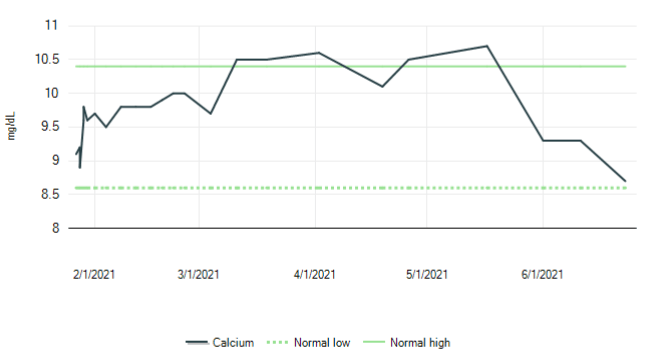
This has been bothering me since yesterday. I was prescribed Sensipar, or cinacalcet hydrochloride about a month ago due to high calcium test results. I ran out of the medication right before yesterday’s appointment at UCLA, so I ordered a three-month refill with my online pharmacy. Here is the latest historical test result trend for calcium:

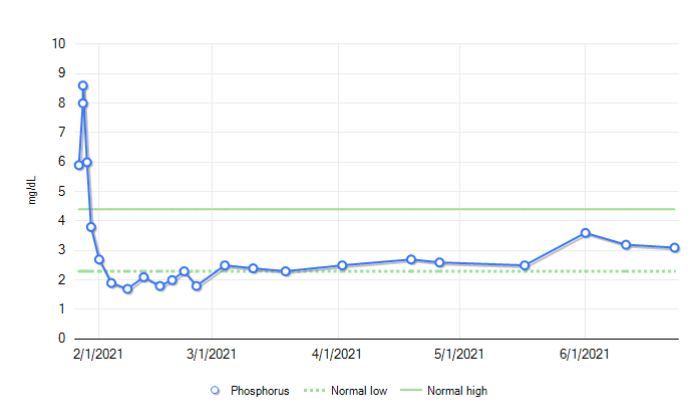
Everything was normal until mid-March, then above normal for the next three months. The only comment I received was to consume less dairy, while at the same time, I needed dairy to keep up my phosphorus levels. Often, I feel like I am an unwilling participant in a game where I need to achieve certain outputs by adjusting a few inputs that are connected via a black box. I my case, the inputs are food, exercise, and medication. The black box is the biological process inside my body, and the output is test results. The frustration is that the black box algorithms do not seem consistent over time. Sometimes test results change significantly without any obvious reasons, like the sudden increase/decrease in my creatinine. Here is my phosphorus result history:

It was too low post-transplant so I was prescribed a potassium/phosphorus supplement. Once the results were consistently above the low limit, I was told to stop taking the supplement. Since then, my phosphorus levels have continued to increase, with a huge jump in early June. That seems to have leveled off in the past few weeks. I do not remember any diet changes over the past month so I do not know what to do different if the numbers start changing rapidly again.

Weight Gain (updated)

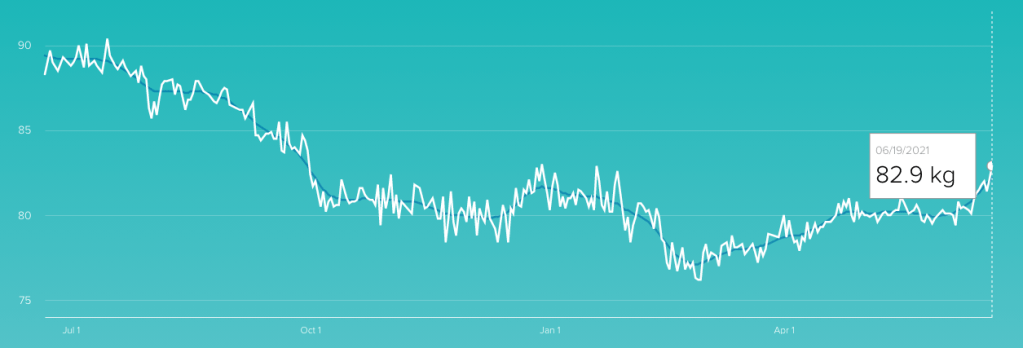
I read that many kidney transplant recipients will gain weight post surgery due to either better appetite or side-effect of medication. For me, my weight has been pretty steady at ~80 kg since the beginning of February. Recently however, I have been gaining a bit of weight, about two to three kilograms in the past two weeks. Since I am still using the Fitbit Aria scale, all my weight data is recorded online:

It is hard to read the time scale, but this is one year’s worth of data. Right after surgery, I weighed 80 kg. That dropped to a low of ~76 kg, and now I am up to ~83 kg. The fluctuation is only about 5% either way, but I am not sure if I should be worried. While I was in the hospital recovering, the transplant dietitian did say that I need to eat a lot of protein, so I can heal properly. I also do not think my diet has changed recently so I cannot explain why my weight has been slowly increasing over the past four months. This does put me back into the “overweight” category using the BMI calculation.

==========

In WordPress, you can put a “feature image” at the top of the post, and you can choose from a bunch of stock images. I entered “scale” as the search term, and had to go through over 10 pages of images until I found a bathroom scale (see above). About 3/4 of the images were of snakes and lizards.

==========

Updated: 4:30 pm

Oops. I should read my old posts before writing a new one. I posted a month ago that post-transplant weight goes up or down, but a webpage at NKF just mentions weight gains. I guess if you had too much fluid, that would probably fix itself right away once your new kidney starts working. It does seem there are more drivers for weight gain over time pos-transplant.

I also found a real research paper about this topic. The results were:

There were 181 (48.4%) female patients, 334 (89.3%) with white ethnicity and the mean age was 44.4 ± 12.8 years. The mean BMI pre-transplant was 24.7 ± 4.1 kg/m2, and 35 (9.9%) patients were classified as obese; 119 (33.6%) as overweight; 187 (52.8%) as normal weight; and 13 (3.7%) as malnourished. After one year of follow-up, the mean BMI was 26.2 ± 5.0 kg/m2, and 61 (17.3%) patients were classified as obese; 133 (37.8%) as overweight; 148 (42.0%) as normal weight; and 10 (2.8%) as malnourished. Weight gain was observed in 72.7% patients, and the average increase was 7.12 ± 5.9 kg. The female gender, lower pre-transplant body weight, lower number of hospitalizations, and a kidney received from a living donor were associated with weight gain by more than 5% in the first year post-transplant.

https://journals.plos.org/plosone/article?id=10.1371/journal.pone.0243394

So, after gain after one year was 7 kg. I have gained 3 kg after 5 months so it is pretty consistent with the research paper. I will ask the UCLA transplant team on Wednesday when I up there for an appointment to see what they think.

Open California

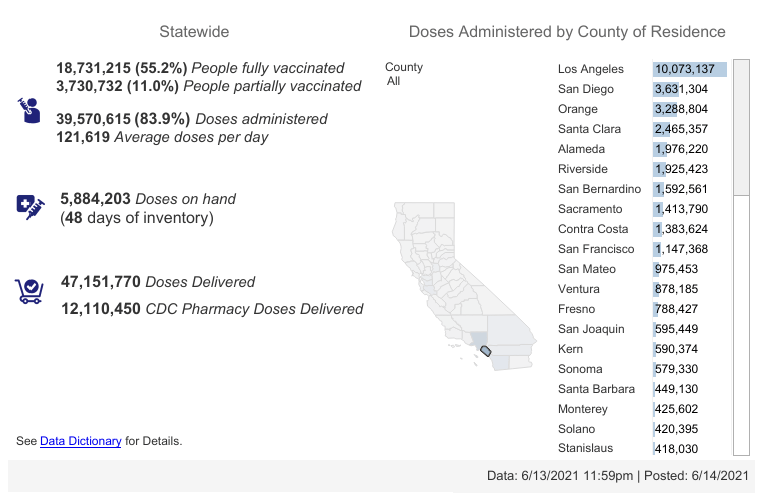
So, after 15 months of COVID lockdowns and social distancing, California is lifting most restrictions today. Looking at recent cases and deaths data, it does seem that the vaccines are working, and the pandemic is under control, in California anyway.

https://covid19.ca.gov/state-dashboard/

This is cases data for Los Angeles and Orange counties. The trend is very similar to statewide results.

https://occovid.com/compare

As for vaccinations, data shows 55% of California population are fully vaccinated with an additional 11% partially vaccinated. Assuming that there is some protection with partial vaccination, that is 66%. Not sure if this part is legit but if you add the total number of COVID cases, that gives another ~11%. Of course, there are likely many people that are vaccinated who previously contracted COVID, but maybe we are at 70% “immunity” already? Is that enough for herd immunity?

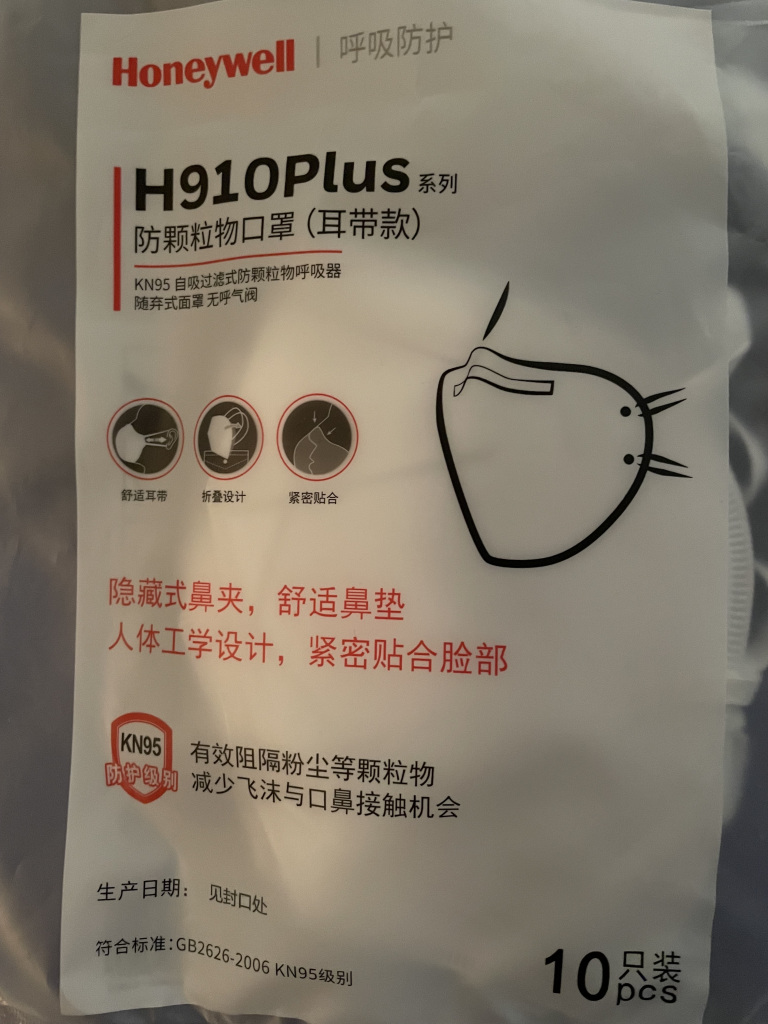
Personally, due to the anti-rejection medications, I will still need to wear a mask in most situations. Since most people will not be wearing masks, I need to start using the KN/N95 masks. I have been using a KN95 mask more and more, and it is not too bad. The only thing I am worried about is being harassed by anti-vaxx/anti-mask idiots that are harassing people that are still wearing masks.

Actual domestic Chinese KN95 masks from China. Employees from my friend’s company in Chengdu sent a bunch over when there was a huge shortage in the US.

Mail Order Insulin

When my endocrinologist increase my insulin dosage, I asked her to send new prescriptions to Express Scripts, a mail order pharmacy that my company’s insurance uses. The main benefit is that I can get three month’s of medicine per order, instead of just one month from my local pharmacy. The disadvantage is that stuff sometimes just show up without any warning, and you do not have the option to return it. At the local pharmacy, if anything is wrong, I can refuse the order, and they either restock it, or send it back to the drug company. Not so for mail order since the mail order pharmacy cannot be responsible for tampering risk once the drugs leave their site.

For example, my endocrinologist ordered both Trujeo and Humalog for me last Thursday. I immediately got an email from Express Scripts saying they are working on the order. For the next few days, it was radio silence. When I checked their website, it said both prescriptions were in progress, but with no additional information (ETA, cost, etc). Just now, the status for both said shipped. I guess I am used to the Amazon model where I get lots of email notifying me of my order status. Fortunately, the medications are covered by my insurance so I am not stuck with huge co-pays. Still, the Humalog will cost me $60.

It is also surprising how much non-generic medications cost. Nowadays, most prescription receipts include pricing so you can see how much your insurance plan paid. In this case, the Humalog, I am only receiving a 67 days supply. Even so, my insurance paid $900. When I first refilled the medication, I took it to my local pharmacy, and they charged me $30 for one month supply, which worked out to be five pens. Does this mean I get 10 pens for $60? If so, then there is no advantage for me to go with Express Scripts. The Toujeo was different. It only cost insurance $353 for a 90 supply, and my co-pay is $0.

Due to an overzealous doctor at UCLA, most of my prescriptions were converted to Express Scripts. The only difference is for Tacroliums as most pharmacies do not take Medicare Part-B for drugs. My worked insurance paid for it once, but I am sending the prescription to UCLA’s pharmacy to be safe. It takes a bit of effort to manage 10 prescriptions at three different pharmacies though.

Low Blood Sugar?

Weird. My blood sugar was 216 this morning. Obviously, that is too high for a fasting reading. I then took my regular morning insulin shots: 13 units of Toujeo plus eight units of Humalog. I think it was supposed to be seven units of Humalog but I did not think one extra would matter. Anyway, I got on the work computer and totally forgot about eating breakfast. Soon, I started sweating and feeling lightheaded. It was a strange yet familiar feeling so I tested my blood sugar again, and got 88. If my blood sugar falls below 90, I start feeling symptoms of hypoglycemia. It is probably more noticeable since my body has been used to ~200 levels of blood sugar post-transplant due to new medication. I had to find my glucose pills and quickly took two of them, which gave me 8 g of sugar. It has been about 10 minutes and I still feel a bit woozy. My mom is downstairs making oatmeal so I think I should go eat some before I faint (not likely but still).

https://www.verywellhealth.com/hypoglycemia-causes-risk-factors-1087616

Endocrinologist 6/10/2021

I just came back from an appointment with my endocrinologist. I was kinda dreading this appointment since my blood sugar has been hard to control since the transplant surgery. However, the meeting went pretty well, but I did have my insulin dosages increased. The morning Toujeo was increased to 13 units in the morning, and I am back on a sliding scale for the Humalog, though the scale is different than what UCLA originally prescribed. The base dosage was increased from 4 to 5 units, and I need to add more if my blood sugar is above 150.

The fructosamine test from Tuesday also came back. The endocrinologist said that my result of 401 is comparable to an A1C number of ~8.0. That is way too high and she said it also may affect my new kidney. Going forward, I need to send blood sugar readings to her every 1-2 weeks. Interestingly, they took my blood sugar meter during the appointment to dump the data. They must have a computer that can read all brand/model of meters.

Peripheral Neuropathy 6/8/2021

Life sucks. Sure, it sucks a lot less without dialysis, but there are still lots of health issues to deal with.

I was working on the computer at around 6:00 pm when I got a huge spike of pain on the inside of my left foot. Instead of going away and spiking periodically, the pain basically stayed for an hour. It was a bit less intense but still pretty painful nevertheless. Afterwards, the pain started shooting again for about three hours. I think it is mostly subsided now, but I was screaming into my pillow more than once.

It is super frustrating since I do not understand the pain mechanism or drivers. Why does it start up at random? And what exactly is causing the pain? What if I gave myself a lidocaine shot? It is combination of intense pain, and feeling helpless to do anything about it that really drains me in the moment.

==========

Speaking of medical issues, I had to get another blood test today for my endocrinologist. Her sent me documents via mail yesterday so I had to run down to the lab today. I waited about 20 minutes since I did not have an appointment, but everything was fine and they only drew two test tubes: one for a comprehensive metabolic panel, and the other for fructosamine. Not sure why the endocrinologist likes that test vs. an A1C now that I am no longer on dialysis. The results are out already and similar to UCLA’s results, several items are high. Glucose id definitely high at 150-something, but I know that going in. Potassium is at 5.5 so borderline high. Creatinine is 1.50, which is lower than the 1.58 a few weeks ago, but it is still on the high end. I have to doe the same test again for UCLA on Friday so hopefully it will continue to drop.

Post-Transplant Insomnia

It is getting worse. For about several months after the transplant, I was sleeping pretty well, especially compared to pre-transplant. However, I am having more and more difficulty falling asleep, and staying asleep. Right now it is 3:40 am, and I have not been able to sleep yet. It has been like this for three nights in a row. For nights that I have been able to fall asleep, I would get up around 2:00 am, then stay up the rest of the night. During weekdays, I end up taking several short naps in between work calls just to remain semi-functional.

I am hoping it is my body adjusting to medication, although that has not changed for almost two months. The only big change is the addition of Sensipar for calcium and PTH levels. I do not know if the insomnia is a side effect of that drug, or in combination with an existing medication.

I have not mentioned this for a long time, but the general numbness in my feet from peripheral neuropathy is definitely worse. It is sometimes difficult to notice changes over time, but I am 100% sure the buzzing is much more intense, and I can barely move my feet and toes below my ankles. Since the primary cause is diabetes, maybe the higher blood sugar post-transplant is aggravating the condition? It is still bearable but contributes to my insomnia as it is hard to ignore when trying to fall asleep.

Endocrinologist Appointment

Of all my doctor appointments, this is the one that worries me the most. With UCLA transplant center, most of my test results are in the normal range. Even my blood pressure readings have improved quite a bit. Some electrolyte readings are slightly high, but the transplant center does not seemed too concerned. The one area that is still a problem in my blood sugar readings. It is super sensitive to what I eat, and I have a vague correlation on how food affects blood sugar. I know it is related to carbohydrates and sugar, but there is a lot of variability and often the test readings surprise me, both positive and negative.

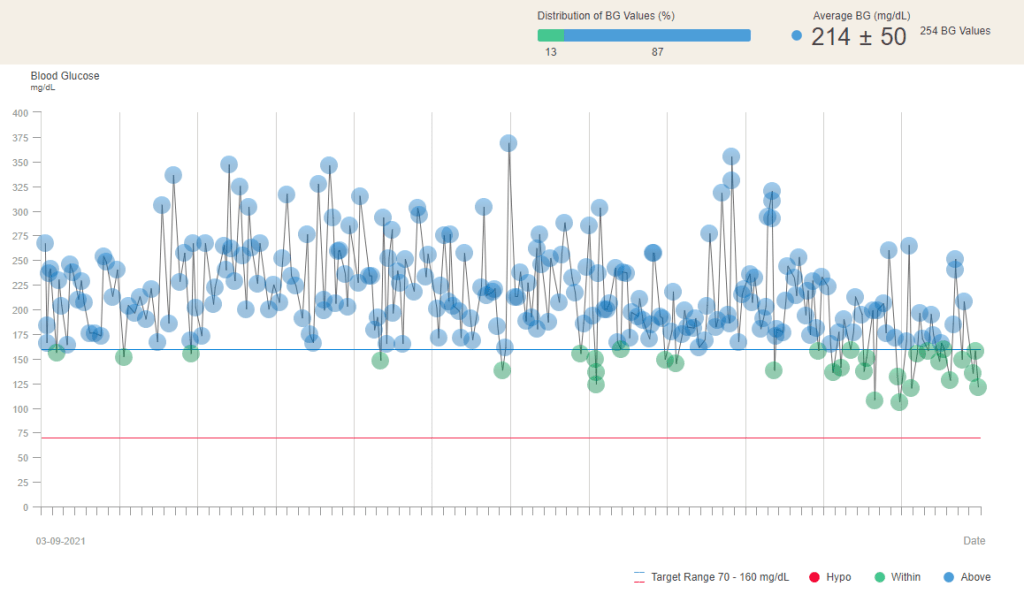
Here is a chart from data I uploaded to my meter’s website:

Data is from previous 12 weeks. There are a few outliers; I was too lazy to go back and delete obvious erroneous readings. If you squint, there does seem to be a very slight downward trend, especially during the last two weeks. There are definitely more green dots on the right side of the graph than the left. However, the numbers are still to high on average. If I shorten the time range, the average does drop somewhat.

Time RangeAverage Blood Sugar (mg/dL)
12 weeks214 ± 50
8 weeks207 ± 50
4 weeks195 ± 50
2 weeks173 ± 39

There is no real difference between one or two weeks. The problem is that I have been skipping some meals, but still injecting the prescribed amount of insulin. If the morning reading is high, I may just drink my cup of decaf coffee and not eat anything else. That would definitely drop my noon blood pressure reading. I am supposed to only inject the Humalog if I am eating carbs in the next 15 minutes so I am running a (slight) risk for hypoglycemia. Again, had that once before and definitely do not want a repeat performance.

Back to the top of my post. I sent my updated prescription list (10 medications) plus blood sugar readings for all of May. Hopefully she can shed some light on why my blood sugar is so hard to control.

Vaccine Lottery

People suck.

The post title does not mean what it usually means. By now, about 50% of US population has at least one vaccine shot, but progress is slowing. Instead of a lottery to get a vaccine shot, this is a lottery in California that pays people to get the vaccine. How lame.

Basically, the next two million people to get a COVID vaccine will get a $50 gift card, while everyone that has received the vaccine by June 15 will be eligible for a drawing with ten $1.5 million winners, and 30 $50,000 winners. That divides California into three groups of people:

  • Those that already received the vaccine
  • Those that still will not get the vaccine
  • Those that will the vaccine because of the $50, or the lottery

I am in the first group, but due to anti-rejection medication, I am unsure if the vaccine is effective. For the second group, some people may have good reasons, such as a prior COVID infection, but most are likely anti-vaxx idiots. However, at least they stick to their beliefs, however illogical they may be.

Photo by Waldemar Brandt on Pexels.com

Then there is the third group. I am not even sure why they have not received the vaccine yet, but it appears that $50 will change their mind. As someone that pays a great deal of California taxes (income, sales, property, vehicle, property, etc.), this pisses me off. They are nothing more than prostitutes, their principles and actions easily swayed by a bit of cash. This will also make things worse when we need COVID booster shots or vaccination becomes an annual event. These same assholes <spit> will now expect payment to be vaccinated. Instead of being grateful for the vaccine will save their lives, it will just be another entitlement that other people have to pay for.

People suck.